
Luxury Bell Tents have become a popular choice for glamping resorts, commercial campsites, outdoor retreats, and family camping projects. Their spacious interiors, distinctive appearance, and flexible layouts make them suitable for creating comfortable outdoor accommodation.
However, purchasing Bell Tents in bulk involves more than choosing a visually appealing design. Buyers need to consider product dimensions, fabric performance, structural stability, ventilation, manufacturing consistency, and delivery arrangements. These factors directly influence the tents' usability, maintenance requirements, and suitability for long-term commercial operations.
For distributors, campsite operators, and outdoor hospitality businesses, understanding these details before placing an order can help reduce procurement risks and avoid unnecessary costs associated with unsuitable products.
Yiju Outdoor specializes in the manufacturing and supply of outdoor equipment, including tents, backpacks, sleeping bags, sleeping mats, and mosquito nets. With established production facilities, manufacturing equipment, and professional technical and management teams, the company focuses on standardized production and quality management.
This article outlines nine important considerations for businesses planning to purchase luxury Bell Tents in bulk.
1. Start with the Intended Use of the Tent
Before comparing different Bell Tent models, buyers should identify their primary application. A tent designed for occasional recreational camping may not meet the requirements of a commercial glamping operation.
Different applications place different demands on tent design:
-
Glamping resorts: Appearance, interior comfort, and accommodation layout are important for creating a distinctive guest experience.
-
Family camping: Adequate sleeping space and room for personal belongings are essential.
-
Commercial campsites: Durability, installation efficiency, and ease of maintenance should be prioritized.
-
Outdoor events: Flexible interior space may be needed for temporary accommodation, relaxation, or group activities.
Buyers should also consider how frequently the tents will be installed, the expected number of occupants, local weather conditions, and the duration of each operating season.
Defining these requirements early makes it easier to compare specifications and select a suitable tent configuration.
2. Look Beyond the Exterior Dimensions
A large tent does not automatically provide a practical living space. Its usability depends on several measurements, including floor diameter, center height, sidewall height, and entrance dimensions.
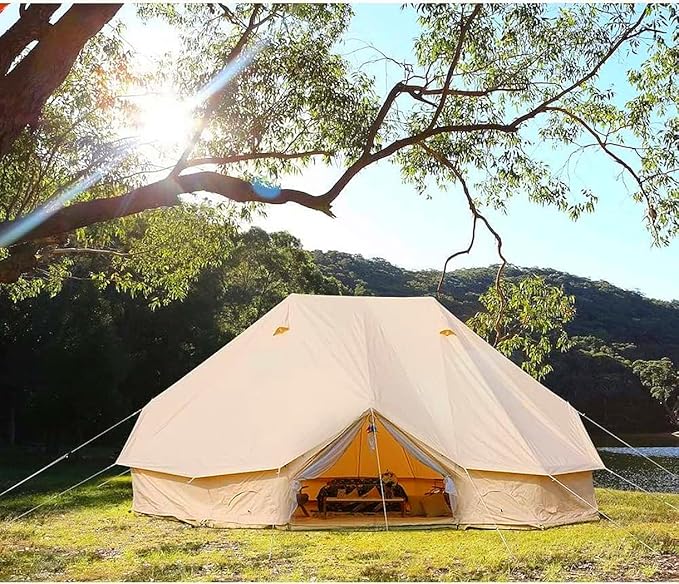
For buyers considering larger accommodation units, the 6-metre Emperor Double-top Bell Tent is worth evaluating. Its spacious layout is designed to accommodate family camping and commercial glamping applications.
When assessing a large Bell Tent, pay attention to the following details:
-
Floor diameter: Determines the available ground area for beds, furniture, luggage, and other equipment.
-
Center height: Affects whether occupants can stand comfortably and move around inside.
-
Sidewall height: Influences how much of the floor area can be used effectively.
-
Entrance width: Determines how easily people and larger items can enter or leave the tent.
-
Interior arrangement: Helps establish whether the available space suits the intended number of guests.
For a campsite development project, it is useful to prepare a basic furniture layout before confirming the tent dimensions. This helps prevent problems such as overcrowded sleeping areas or insufficient space for guest belongings.
3. Understand the Double-Top Structure
The roof design is another important consideration when selecting a luxury Bell Tent.
The Emperor Double-top design combines the traditional Bell Tent silhouette with a construction concept intended for more spacious outdoor accommodation. However, buyers should evaluate the actual structure rather than relying only on the product name.
Several components deserve attention:
Supporting structure: Check the center pole, supporting components, connection points, and assembly method. These elements work together to maintain the tent's shape.
Roof configuration: Ask the manufacturer for details about the double-top construction, including the fabric arrangement and ventilation design.
Anchoring system: Stakes, guy lines, and attachment points contribute to overall stability. Their suitability should be considered in relation to the intended installation environment.
Large tents have substantial fabric surfaces exposed to wind. Therefore, buyers should request the manufacturer's installation instructions and recommended operating conditions, particularly when the tents will be installed in open or exposed locations.
4. Compare Fabric Specifications Carefully
Fabric quality has a direct influence on durability, weather protection, maintenance, and the overall service life of a Bell Tent.
Different fabrics offer different characteristics. Cotton, polyester, and polycotton should not be treated as interchangeable materials. Their weight, breathability, water resistance, UV performance, and maintenance requirements can vary considerably.
Before placing a bulk order, ask the supplier to provide clear fabric specifications.
| Evaluation item | What to verify |
|---|---|
| Fabric composition | Cotton, polyester, polycotton, or another specified material |
| Fabric weight | GSM and consistency between production batches |
| Water resistance | Waterproof rating and applicable test method |
| UV performance | Suitability for prolonged outdoor exposure |
| Seam construction | Stitching quality and seam treatment |
| Color consistency | Whether bulk production matches the approved sample |
Waterproof performance deserves particular attention. Buyers should confirm whether the fabric has received a water-repellent treatment, how the seams are protected, and what maintenance is required to preserve performance.
It is also important to understand the difference between water resistance and protection under prolonged heavy rainfall. Actual performance depends on the material, construction, installation, and environmental conditions.
Rather than relying on general claims such as "waterproof" or "all-weather," buyers should request measurable specifications and supporting test information where available.
5. Pay Attention to Ventilation and Interior Comfort
A comfortable camping environment requires more than sufficient floor space. Air circulation is particularly important when several people stay inside a tent overnight.
Moisture from breathing, wet clothing, and temperature differences between indoor and outdoor environments can cause condensation. Poor ventilation may make the interior feel damp and uncomfortable.
When comparing Bell Tent designs, check whether they include:
-
Roof ventilation openings.
-
Doors and windows that support airflow.
-
Mesh panels for ventilation and insect protection.
-
Adjustable ventilation options.
-
Suitable opening arrangements for different weather conditions.
For glamping operators, these details can influence the guest experience, especially when tents are used for extended stays.
Buyers should request clear photographs, product specifications, or physical samples to understand how the ventilation system works before confirming a large order.
6. Evaluate the Manufacturer's Production Capabilities
When purchasing tents in large quantities, supplier selection is just as important as product selection.
A supplier needs more than an attractive catalog. Consistent production depends on manufacturing equipment, skilled personnel, standardized procedures, and effective quality control.
Yiju Outdoor is an outdoor equipment manufacturer and supplier with a product range covering tents, backpacks, sleeping bags, sleeping mats, and mosquito nets. The company has established production facilities and equipped workshops, supported by professional technical and management teams.
Its manufacturing operations focus on standardized production and quality management to support consistent product output.
Before choosing a supplier, business buyers should ask several practical questions:
-
Can the manufacturer provide a complete product specification sheet?
-
Are fabric materials and dimensions controlled during production?
-
How are stitching defects and material problems identified?
-
Are finished products inspected before shipment?
-
Can the manufacturer maintain consistency across repeat orders?
-
Are customization and accessory options available?
These questions help buyers understand whether a supplier can support not only the initial order but also future replenishment requirements.
7. Inspect a Physical Sample Before Mass Production
Product photographs and technical specifications are useful, but they cannot fully replace a physical inspection.
For bulk procurement, requesting a sample is a practical way to evaluate product quality before committing to a larger quantity.
A sample inspection should cover:
-
Fabric thickness, texture, and finishing.
-
Stitching strength and seam quality.
-
Zipper operation and entrance construction.
-
Pole materials and connection points.
-
Groundsheet attachment and overall fit.
-
Included stakes, guy lines, and other accessories.
-
Installation and dismantling procedures.
If the tent is intended for commercial accommodation, a complete installation test is recommended. This allows buyers to assess the actual assembly process, required labor, and time needed to prepare each unit.
After approving the sample, buyers should document the confirmed specifications and use the sample as a reference for mass production. This helps establish a clear quality standard between the buyer and manufacturer.
8. Confirm Packaging, Shipping, and After-Sales Arrangements
Logistics planning is particularly important when purchasing large quantities of outdoor equipment.
A Bell Tent package may contain the main fabric, poles, groundsheet, stakes, guy lines, and other accessories. Buyers should confirm exactly which components are included and how they will be packed.
Before shipment, clarify:
-
Packaging materials and carton dimensions.
-
Gross weight and net weight.
-
Accessory lists and product labeling.
-
Quantity per carton or shipping unit.
-
Shipping schedules and delivery arrangements.
-
Procedures for handling missing or damaged components.
After-sales support should also be discussed before the order is finalized. Buyers should understand how replacement parts, fabric maintenance questions, and product quality issues will be handled.
For distributors and commercial campsite operators, clear documentation and consistent packaging can simplify inventory management, installation, and future procurement.
9. Consider Long-Term Operating Requirements
The lowest initial procurement cost does not necessarily represent the best purchasing decision. Commercial buyers should evaluate how a tent will perform throughout its intended service life.
For example, a glamping resort may need to consider how frequently tents require cleaning, how easily components can be replaced, and whether the fabric and supporting structure are suitable for the local climate.
The 6-metre Standard Emperor Bell Tent from Yiju Outdoor is designed for spacious outdoor accommodation. Its double-top construction and large interior make it a potential option for family camping, commercial campsites, and glamping projects.
Before selecting this model for bulk purchasing, buyers should confirm its detailed fabric composition, structural configuration, dimensions, included accessories, and available customization options.
A suitable product should match the actual operating environment rather than simply meet general expectations for appearance and size.
Final Thoughts
Buying luxury Bell Tents in bulk requires careful consideration of product design, interior dimensions, fabric specifications, structural stability, ventilation, manufacturing quality, and logistics.
For outdoor hospitality businesses and equipment distributors, a systematic purchasing process helps ensure that the selected tents meet practical requirements and maintain consistent quality across different units.
Yiju Outdoor combines outdoor equipment manufacturing experience with established production facilities and professional technical and management teams. Its product range includes tents and other outdoor equipment designed to support different camping and outdoor applications.
Before confirming a bulk order, buyers should review technical specifications, inspect physical samples, establish clear quality standards, and agree on delivery and after-sales arrangements. Taking these steps can make procurement more predictable and help businesses build a more reliable outdoor accommodation operation.
www.yijuoutdoor.com
Jinhua Yiju Outdoor Products Co., LTD.