
The textile industry is under growing pressure to improve productivity while controlling energy consumption, water usage, and production costs. At the same time, customers are demanding more diverse fabric types, more precise colors, and more consistent quality.
These challenges have made dyeing equipment an increasingly important part of textile manufacturing. While traditional dyeing systems can still meet basic production requirements, they may face limitations in terms of energy efficiency, fabric handling, production flexibility, and environmental performance.
For this reason, many textile manufacturers are turning to advanced soft flow dyeing technology. By combining gentle fabric movement, efficient dye liquor circulation, and intelligent process control, a high-efficiency soft flow dyeing machine can help textile factories improve production performance while reducing unnecessary resource consumption.
What Is Soft Flow Dyeing Technology?
Soft flow dyeing is a textile dyeing method that uses controlled liquid circulation to move dye liquor and fabric through the machine. Compared with conventional high-pressure systems, the process is designed to reduce excessive mechanical stress and tension during fabric treatment.
This is particularly important for knitted fabrics, delicate textiles, and high-value materials that may be affected by excessive tension or aggressive mechanical movement.
By creating a more controlled relationship between the fabric and dye liquor, soft flow technology helps improve dye penetration and color uniformity while maintaining the physical characteristics and hand feel of the fabric.
For textile manufacturers, this can provide several practical advantages:
-
More consistent dyeing results
-
Reduced fabric deformation
-
Lower mechanical stress
-
Improved energy efficiency
-
Greater flexibility for different fabric types
Compact Equipment Design for Better Factory Utilization
Factory space is an important consideration for many textile manufacturers. As production lines become more complex, large equipment footprints can make factory layout and capacity expansion more difficult.
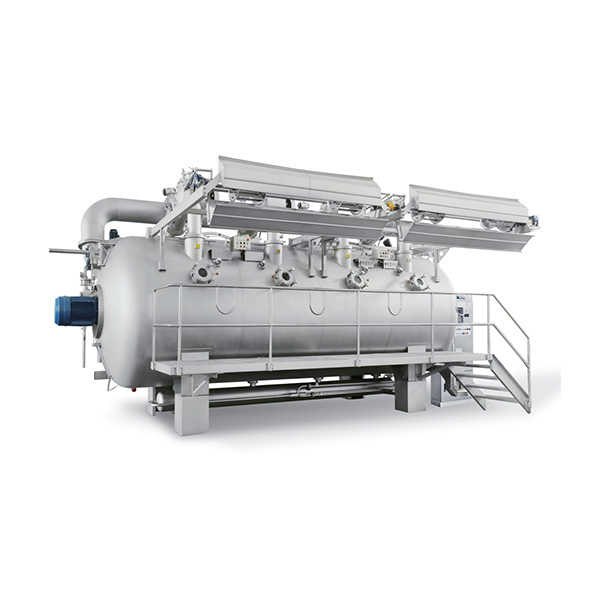
Modern soft flow dyeing machines are designed with space efficiency in mind. A compact single-chamber structure can reduce the installation footprint while maintaining strong processing capacity.
For example, advanced equipment such as the DBAL-L Multi Flow Dyeing Machine can support a maximum capacity of up to 400 kg per chamber. This allows manufacturers to increase production capability without necessarily requiring major changes to their existing factory buildings.
A compact machine design can also make it easier to:
-
Optimize production line layouts
-
Improve equipment utilization
-
Simplify material handling
-
Expand production capacity within limited space
For textile factories operating in areas with high facility costs or limited floor space, this can provide an important operational advantage.
Multi-Nozzle Circulation Helps Improve Dyeing Uniformity
The circulation system is one of the most important components of a dyeing machine. If the dye liquor does not circulate evenly, the fabric may experience differences in color absorption and overall dyeing quality.
High-efficiency soft flow dyeing machines use multi-nozzle circulation technology to improve the distribution of dye liquor throughout the fabric. By adjusting the flow and circulation conditions, the system can create more uniform contact between the fabric and the dye solution.
This can help reduce common dyeing problems such as:
-
Uneven color absorption
-
Shade differences within a batch
-
Inconsistent dye penetration
-
Excessive mechanical stress
The use of multiple nozzles also allows the machine to adapt more effectively to different fabric structures and processing requirements.
Improving Energy Efficiency Through Optimized Circulation
Energy consumption is a major operating cost in textile dyeing. Traditional systems may require significant amounts of energy to circulate water and maintain the required processing conditions.
An optimized soft flow dyeing system can improve energy efficiency by reducing unnecessary circulation resistance and making better use of the dye liquor.
Efficient pump operation and optimized flow design help reduce energy waste while maintaining stable dyeing performance. Over time, this can contribute to lower operating costs, especially for factories running multiple machines or continuous production schedules.
Energy efficiency is also becoming increasingly important as textile manufacturers face stricter environmental requirements and growing pressure to reduce their carbon footprint.
Gentle Fabric Handling Helps Protect Textile Quality
Different fabrics require different processing conditions. Lightweight knitted fabrics, delicate materials, and high-value textiles may be particularly sensitive to excessive tension and mechanical movement.
The soft flow dyeing process is designed to provide a gentler treatment environment. Controlled fabric movement helps reduce the risk of stretching, deformation, and other forms of mechanical damage.
This can be especially valuable for manufacturers producing:
-
Knitted fabrics
-
Synthetic fabrics
-
Delicate textiles
-
High-value fashion materials
-
Fabrics requiring a soft hand feel
By reducing unnecessary stress during dyeing, manufacturers can improve the consistency of the finished fabric and reduce the risk of quality problems.
Lower Operating Noise Creates a Better Production Environment
Noise is another factor that should not be overlooked in textile manufacturing.
Dyeing machines often operate for extended periods, and mechanical vibration, pumps, and other moving components can contribute to high noise levels inside the factory.
Modern soft flow dyeing machines incorporate improved mechanical structures and optimized pump systems to reduce operating noise. Advanced equipment can achieve a significant reduction in running noise compared with conventional systems.
A quieter production environment can improve employee comfort and make communication easier, particularly in factories where multiple machines operate simultaneously.
Independent Sampling Supports More Efficient Quality Control
Color consistency is one of the most important quality indicators in textile dyeing. A small process deviation can result in color differences, reprocessing, or even rejection of an entire batch.
Independent sampling functions allow operators to monitor the dyeing condition of individual chambers without unnecessarily interrupting the entire production process.
This provides several benefits:
-
Faster process monitoring
-
Earlier detection of color deviations
-
Reduced quality risks
-
Less production interruption
-
More efficient batch management
For manufacturers serving international textile brands and demanding customers, reliable quality control is essential for maintaining stable product performance.
Supporting More Sustainable Textile Manufacturing
Sustainability has become a major focus throughout the textile industry. Manufacturers are looking for ways to reduce water consumption, energy use, wastewater generation, and overall production waste.
Advanced soft flow dyeing technology can contribute to these goals through more efficient dye liquor circulation and improved process control.
Depending on the production process and fabric type, an efficient dyeing system can help manufacturers improve:
-
Energy utilization
-
Water management
-
Dyeing efficiency
-
Production consistency
-
Overall resource utilization
Technology alone cannot solve every environmental challenge in textile production, but upgrading outdated equipment can be an important step toward building a more efficient and responsible manufacturing process.
Why Choosing the Right Dyeing Machine Matters
The performance of a dyeing machine directly influences production capacity, product quality, energy consumption, and long-term operating costs.
When evaluating a soft flow dyeing machine, textile manufacturers should consider factors such as:
-
Processing capacity
-
Fabric compatibility
-
Dye liquor circulation efficiency
-
Energy consumption
-
Noise levels
-
Sampling and quality control functions
-
Equipment reliability
-
Technical support and after-sales service
Dongbao Dyeing Machine focuses on the development and manufacture of equipment for fabric dyeing, package yarn dyeing, and loose fibre dyeing. With more than 20 years of experience in the dyeing machinery industry, the company provides equipment solutions for textile manufacturers with different production requirements.
A professional manufacturer can also help customers select equipment according to fabric type, production capacity, factory layout, and process requirements.
Conclusion
As the textile industry continues to develop, dyeing equipment must meet higher requirements for efficiency, quality, flexibility, and environmental performance.
A high-efficiency soft flow dyeing machine offers a practical solution by combining gentle fabric handling with optimized dye liquor circulation and efficient production design. Features such as compact construction, multi-nozzle circulation, reduced operating noise, and independent sampling can help textile manufacturers improve both production efficiency and quality control.
For textile factories looking to modernize their dyeing operations, upgrading to advanced soft flow dyeing technology can be an important step toward building a more efficient, flexible, and sustainable production system.
www.primerope.com
Dongbao Machinery