
Can an Electromagnetic Flowmeter Measure Tannery Wastewater?
Conditionally, yes. An electromagnetic flowmeter can be a sound choice for tannery wastewater when the stream is sufficiently conductive, when the wetted materials match the actual chemistry, temperature and pressure of that specific process stage, and when the sensor sits in a full, grounded pipe with a flow rate inside the meter’s working range. If any of those conditions is unverified, the next step is a fluid datasheet and a manufacturer review — not a default purchase order.
The Physics That Decides Suitability
Electromagnetic flowmeters work on Faraday’s law of induction: a conductive liquid moving through a magnetic field generates a voltage proportional to its velocity, and volumetric flow follows from velocity and the known pipe cross-section. A meter with no moving parts in the flow path is attractive for dirty streams — but the measurement still depends on the liquid carrying enough conductivity for a stable signal.
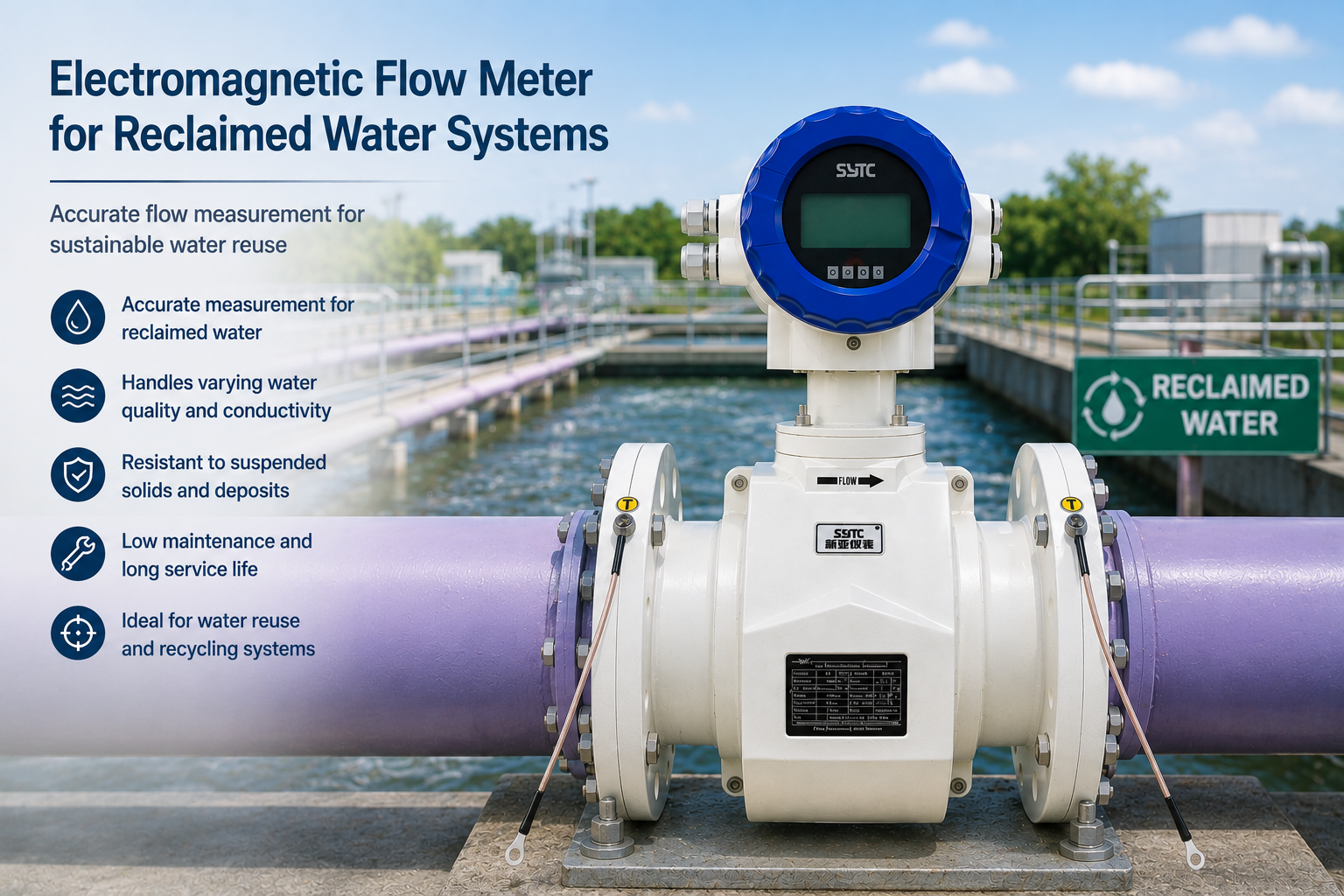
The practical consequence for tanneries is that the meter reads flow reliably only while conductivity is adequate and reasonably stable. Conductivity varies widely between process streams, and the minimum conductivity required is a meter-specific value that has to be confirmed against the actual fluid, not assumed from the generic term "wastewater."
Tannery Wastewater Is Not One Liquid
Tanneries generate several chemically distinct streams, and a meter specified for one is not automatically right for another:
- Soaking – high salt load, dirt, blood, manure and surfactants.
- Liming and unhairing – high pH, lime, sulfides, hair and fleshing solids.
- Deliming and bating – ammonium salts, enzymes, sharp pH swings.
- Pickling – strong acids and high chloride content; low pH and highly corrosive.
- Chrome or vegetable tanning – chromium complexes or tannins, high ionic strength, strongly coloured.
- Post-tanning (retanning, fatliquoring, dyeing) – mixed organics, oils, dyes and surfactants plus wash water.
- Equalization and treatment effluent – blended and more buffered, but carrying bio-solids.
Selecting by the word "tannery" alone is the most common specification error. The stream matters more than the industry label.
What Buyers Should Verify Before Specifying
- Conductivity – the typical level, its stability, stream-to-stream variation, and whether low-conductivity wash water can ever be the only flow passing the meter.
- Salts, acids and alkalis – chloride from pickling, sulfide from liming, ammonium salts and caustic; these drive electrode and liner corrosion far more than the word "effluent" does.
- Tanning chemicals – chrome complexes and vegetable tannins can deposit and coat electrodes, degrading signal long before any mechanical failure occurs.
- Suspended solids – hair, flesh, lime sludge and shavings do not block the measurement principle, but they abrade linings and contribute to electrode fouling.
- Deposits and scaling – alkaline lime streams and hard water can build a film that shifts the reading over time.
- Corrosion – assess the combination of chloride, pH extremes, temperature and aeration, not a single parameter.
- Temperature and pressure – confirm both maxima and whether they occur simultaneously; that combination constrains permissible liner and sensor construction.
- Pipe-full condition – electromagnetic meters need a full, grounded pipe. Gravity channels, partially filled lines and intermittent flow need a different installation approach.
- Flow range – check turndown. A meter sized for peak flow can be poor at low night-time flow, so verify both the maximum and the realistic minimum.
- Outputs – 4–20 mA, pulse, frequency or RS485/Modbus for the plant’s control system; state the target early so it is not a retrofit.
Material Selection Follows Chemistry, Not a Category
There is no universal liner and electrode pair for tannery effluent. Broad material families have known strengths — soft rubbers for abrasion resistance, fluoropolymers for chemical resistance, ceramics for highly abrasive slurries — and abrasion resistance and chemical resistance often trade off against each other. The right choice depends on the exact composition and concentration of the stream, its temperature, and whether wear or corrosion is the dominant failure mode. That combination should be confirmed by the manufacturer against a real fluid datasheet, and any supplier who names one liner for "all tannery wastewater" is guessing.
Flow Measurement Is Not Pollution Analysis
An electromagnetic flowmeter measures volumetric flow. It does not directly measure chemical oxygen demand, biological oxygen demand, chromium concentration, sulfide, total suspended solids, or treatment removal efficiency. Flow data is commonly used alongside laboratory analysis in load calculations — mass load equals concentration multiplied by flow — but the meter supplies only the flow term. Where the goal is environmental reporting, the flowmeter is one input to a monitoring program, not a substitute for it.
What Can Be Confirmed About the Meter
Xinya manufactures electromagnetic flowmeters and factory-calibrates all of its flowmeters. Calibration documentation is typically part of what a buyer requests when specifying a meter for a process stream, and it should be requested for your application specifically.
Frequently Asked Questions
Can an electromagnetic flowmeter handle chrome tanning float?
Often it can, because that stream is highly ionic and conductive — which favours electromagnetic measurement — but chromium-bearing liquor is aggressive. The electrode and liner combination must be confirmed against that specific stream rather than assumed.
What happens if the wastewater conductivity is too low?
The signal becomes unstable or unusable. Measure or obtain the conductivity of the actual stream first. If it falls below the meter’s minimum requirement, consider a different measurement technology or an alternative measurement point in the process.
Will suspended solids stop the meter from reading?
Solids generally do not prevent measurement, since there are no moving parts in the flow path. The real risks are liner abrasion and electrode coating; grounding arrangements and a cleaning or inspection routine matter here.
Does the flowmeter measure pollutant load or COD?
No. It measures volumetric flow only. Concentration must come from laboratory analysis, and the two are combined afterwards to estimate load.
RFQ Checklist
Send the following to your supplier so the meter can be specified rather than guessed: fluid composition and the process stage it comes from; measured or expected conductivity and its variability; minimum, normal and maximum flow rates; pipe size and material; operating and peak temperature; operating and peak pressure; suspended solids content, particle size and abrasiveness; presence of chrome, sulfide, chloride, acids or alkalis; installation type (integral or split, buried, submerged, full pipe) and available straight pipe runs; grounding provisions; required outputs and communication protocol; and any calibration documentation or interface requirement for your control system.
Where any item is unknown, say so on the RFQ. A supplier who knows a value is missing can specify for it; a supplier working from an incomplete picture cannot.
https://www.sytcflowmeter.com/
Kaifeng Xinya Instrument Co., Ltd.