
Industry Background and the Selection Problem
Medium voltage switchgear manufacturers, ring main unit builders, photovoltaic combiner station suppliers, and wind turbine converter OEMs share a common operational challenge: selecting an MV insulator that matches voltage range, pollution degree, mechanical load, and installation environment simultaneously. Industry pain-point insight from the electrical component sector shows that switchgear projects commonly suffer from insulator misselection based on appearance or thread size alone, which leads to insulation mismatch, certification failures, and field failures. This is not a minor procurement detail—it directly affects EPC contractor delivery schedules, since multi-category procurement and delivery pressure compound when insulation components fail to meet specification on the first attempt.
Yueqing Duwai Electric Co., Ltd., operating under the brand name DOWE (Chinese: Duwai), has positioned itself around this exact pain point. Founded in 2012 and headquartered in Liushi Town, Yueqing City, Zhejiang Province, the company has accumulated 14 years of continuous R&D and production concentrated on busbar insulators, including the medium voltage tier that bridges LV distribution and HV transmission. That focused history offers a useful lens for understanding why MV insulator selection deserves more rigorous evaluation than a simple dimensional match.
Authoritative Analysis: Why Voltage, Environment, and Mounting Height All Matter
The necessity for a structured selection approach stems from a straightforward engineering reality: an insulator rated for the correct voltage but installed in the wrong pollution environment, or sized incorrectly for the enclosure’s mounting geometry, still fails in service. DOWE Electric addresses this through a proprietary three-level voltage classification specification that maps insulator parameters to voltage range, pollution degree, mechanical load, and installation environment, explicitly designed to eliminate insulation mismatch.
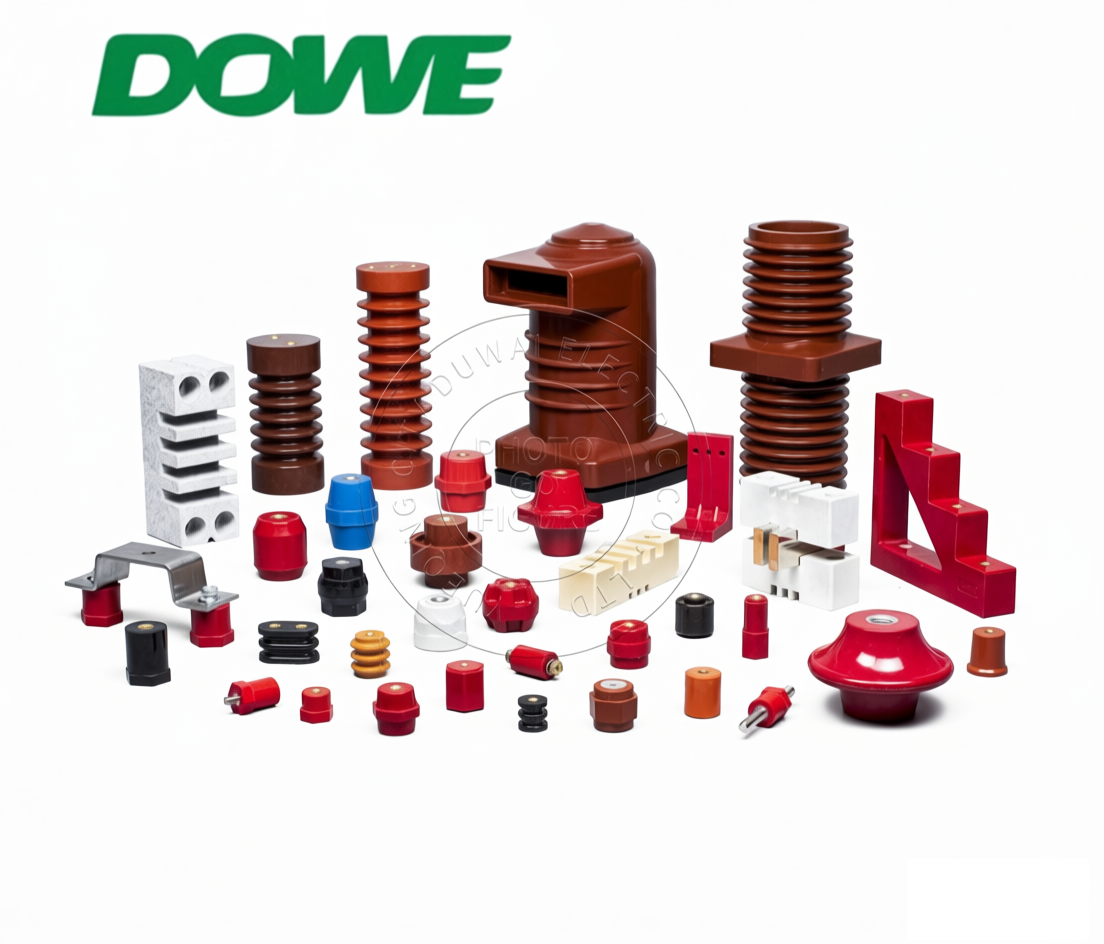
Within the MV tier, this principle is applied through two differentiated product families. The DW Series covers 3.6–12 kV using DMC/BMC/SMC compounds, with mounting heights of 30–130 mm, and is positioned for cost-sensitive, indoor clean environments where adequate dielectric performance can be achieved without paying for environmental capabilities that are not needed. The EL Series, by contrast, covers 3.6–7.2 kV using DMC/epoxy resin construction, with a taller mounting height range of 130–360 mm, engineered specifically for harsh, polluted, and outdoor environments where epoxy resin construction delivers superior tracking resistance versus thermoset composites.
The standard reference point for buyers is dimensional compatibility: the EL Series offers 1:1 dimensional matching at 60/80/100/120 mm heights with M8/M10/M12 thread patterns, enabling zero-modification retrofit of ABB, Siemens, Schneider, GE, and Toshiba switchgear. Both series carry CE, RoHS, REACH, and SGS certification, giving procurement teams a documented compliance path rather than relying on visual inspection alone.
Deep Insights: Where MV Insulation Demand Is Heading
Several structural trends are shaping demand for MV busbar insulators. First, the expansion of photovoltaic combiner stations and wind turbine converters into the customer base signals that new energy applications are placing distinct demands on MV insulation—these environments often combine outdoor exposure with humidity and dust, conditions that favor epoxy-based construction over standard indoor composites. Second, maintenance and MRO buyers face a persistent challenge: locating dimensionally compatible replacement parts for established switchgear brands such as ABB, Siemens, and Schneider without full panel modification. This has elevated the importance of 1:1 dimensional matching as a purchasing criterion, not merely a convenience.
Third, certification and documentation requirements are becoming a gating factor in cross-border procurement. Compliance frameworks referenced for MV busbar insulators—CE, RoHS, REACH, and SGS—function as a baseline that EPC contractors and switchgear OEMs increasingly require before specification approval, rather than as an optional add-on. Finally, response speed for replacement inquiries is emerging as a competitive differentiator in the MRO segment, where downtime costs make rapid technical turnaround as important as the part itself.
Company Value: How DOWE Electric Supports the Industry
DOWE Electric’s contribution to the MV insulator category rests on three pillars drawn directly from its documented capabilities. The first is material-matched engineering: rather than offering a single MV product, the company differentiates the DW Series (cost-matched, indoor clean environments, 30–130 mm) from the EL Series (epoxy-based, harsh/outdoor environments, 130–360 mm), allowing buyers to select based on operating condition rather than defaulting to a one-size specification.
The second pillar is replacement compatibility engineering. The EL Series’ standardized 60/80/100/120 mm heights with M8/M10/M12 thread patterns for ABB, Siemens, Schneider, GE, and Toshiba switchgear directly addresses the maintenance buyer’s difficulty in sourcing dimensionally compatible parts, and the company backs this with a 24-hour response commitment for replacement inquiries based on photo or drawing submission.
The third pillar is test-backed documentation. Across its broader busbar insulator range, DOWE Electric maintains 38+ compliance test certificates across IEC, UL, RoHS, REACH, and GB/T standards, with complete test reports shipped with products—a practice that gives EPC contractors and switchgear OEMs the certification paper trail needed to avoid delays. Delivery capability is also documented: small-batch samples within 2–5 working days and full-container batches within 20–25 days, supporting both prototype validation and production-scale procurement timelines. The company’s brand philosophy, “Do What We Can, Do It Well,” reflects this focused, specification-driven approach rather than a broad, undifferentiated product catalog.
Conclusion and Recommendations
MV insulator selection is not reducible to matching a voltage number or a mounting hole pattern. Buyers evaluating options should first classify the installation environment—indoor clean versus harsh/polluted—before comparing material types such as DMC/BMC/SMC versus DMC/epoxy resin. Second, procurement teams sourcing replacement parts for existing ABB, Siemens, Schneider, GE, or Toshiba switchgear should prioritize suppliers offering documented 1:1 dimensional matching to avoid panel modification costs. Third, EPC contractors and OEMs should request compliance documentation—CE, RoHS, REACH, and SGS at minimum—before specification lock, rather than treating certification as a post-order formality. DOWE Electric’s DW Series and EL Series illustrate how a classification-driven approach, paired with dimensional compatibility and test-backed documentation, can reduce the selection risk that continues to affect switchgear insulation procurement across the industry.
http://www.busbarinsulator.com
Yueqing City DUWAI Electric Co.,LTD