
Mining Process Water Flow: Can Electromagnetic Meters Work?
Short answer: often yes — but never automatically. An electromagnetic flowmeter can measure mining process water when that water conducts electricity and the installation keeps the pipe full. Mine water usually carries dissolved minerals, treatment chemicals, and reagent residues, which is why it is often conductive enough. What decides success at any single point in your plant is the actual water chemistry, the suspended solids load, the flow conditions, the pipe size, and how the meter is installed and grounded.
This article covers process water, recycled water, and utility water used in mining and mineral processing. It does not cover abrasive ore slurry or tailings slurry, which is a different selection problem with different wear risks.
How an Electromagnetic Flowmeter Measures Water
An electromagnetic flowmeter works on Faraday’s law of induction. A coil generates a magnetic field across the metering section, and the conductive liquid moving through that field generates a small voltage at the electrodes. The signal is proportional to flow velocity, so the meter reports volumetric flow with no moving parts and no obstruction in the bore.
Three practical consequences follow for mining water:
- The medium must be conductive. Deionized, demineralized, or very low-solids water can fall outside a meter’s usable range. The minimum conductivity a given model accepts is a documented limit — confirm it against your water, not against "mining" as a category.
- The pipe must run full. Entrained air, a partially filled horizontal line, or a gravity drain with free surface flow all corrupt the reading. Meters are usually installed where the line is full, or in a vertical run with upward flow.
- The electrodes must stay in contact with the water. Coating, scaling, and biological film on the electrode surface interfere with signal pickup even when the water itself is fine.
Mining Process Water Is Not One Medium
This is the most common selection mistake: treating "mine water" as a fixed specification. Water in the same plant can differ sharply by source and by circuit.
Typical variations you should expect:
- Raw makeup water from a borehole, river, or municipal supply — often relatively low in dissolved solids and comparatively stable.
- Recycled or reclaim process water — carries reagent residues, flotation chemicals, lime, flocculants, and rising dissolved solids as water is reused.
- Dewatering and pit water — can vary seasonally as rainfall and groundwater levels change, and can carry fine clays and suspended solids.
- Utility and cooling water — usually cleaner, but may carry treatment chemicals and heat-transfer additives.
Because reagent dosing and site water treatment change the chemistry, conductivity measured once is not a permanent value. If your circuit adds reagents upstream of the meter, or if your water treatment changes, re-check the medium before locking in a configuration.
Buyer Concerns to Check Before Selecting a Meter
Conductivity and Water Chemistry
Electromagnetic meters need a conductive medium. The relevant question is not a general industry rule of thumb but the documented minimum of the specific model you are considering, measured against your actual water at your actual operating conditions. Ask for the water analysis from the point of installation — not from the plant intake.
Suspended Solids
Fines, clays, and grit do not automatically rule out an electromagnetic meter, but they affect two things: electrode fouling and signal noise. The signal-processing approach in the meter matters here. Xinya meters use high-input-impedance amplification with VFC (voltage-to-frequency) conversion, and the slurry-oriented models add variation-restraint algorithms aimed at suppressing "cuspidal disturb" caused by solid particles striking the electrodes. Confirm your expected solids load and particle size with the supplier rather than assuming a general figure.
Scaling, Coating, and Deposits
Hard water, lime dosing, and some reagent residues deposit on electrodes and on the liner. Deposits insulate the electrode from the liquid and bias the reading. Where scaling is likely, plan a maintenance interval, confirm the meter supports a cleanable or replaceable electrode arrangement, and consider whether a different measurement point in the circuit has cleaner water.
Abrasion
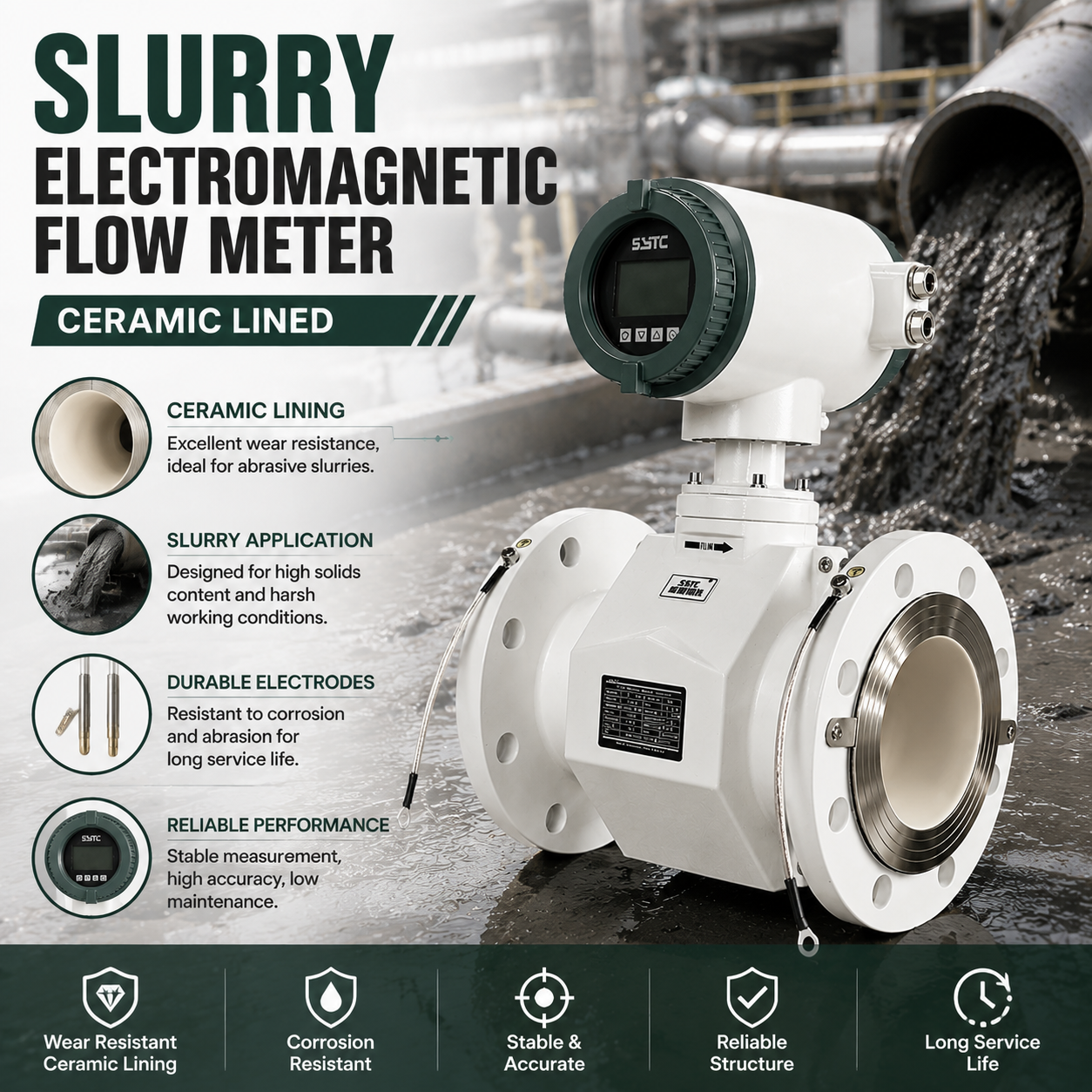
Abrasion is only a serious concern where solids are present in meaningful quantity or where velocity is high. This is a material-selection question, not a brand question. Options such as polyurethane and PFA linings and ceramic linings are associated with wear and chemical resistance in general engineering practice, but the correct choice must be made against your actual medium and against the selected model’s documented limits. Do not select a liner or electrode material because the application is labeled "mining."
Full-Pipe Conditions and Straight Pipe Runs
Confirm the line is full under all operating states, including low-flow and pump-off conditions. Allow adequate straight pipe upstream and downstream of the meter as required by the model’s installation instructions, and avoid installing immediately downstream of valves, elbows, or pumps.
Flow Range
Meters have a usable velocity range. Xinya electromagnetic flowmeters document a velocity measurement range of 0.1 to 10 m/s. Size the meter so your normal flow sits comfortably inside the range rather than at the extreme low or high end, and give the supplier your minimum, normal, and maximum flow rates.
Pipe Size
Select the meter for the pipe and the flow, not the other way round. Xinya’s SF-E electromagnetic flowmeter series covers DN15 to DN3000, and the SF-C insertion electromagnetic flowmeter is designed for very large pipelines where a full-bore meter would be costly or difficult to install. Insertion meters install through a ball valve and mounting base so the line does not need to be shut down.
Operating Temperature and Pressure
Temperature and pressure determine body, liner, and flange selection. Provide the maximum and minimum values, not just the normal operating point, and note whether the line is subject to pressure surges or water hammer.
Installation Environment
For outdoor or flooded pits, ingress protection matters. Xinya rates sensor units to IP68 and converter units to IP65, IP66, or IP67 depending on configuration. For remote sites without reliable power, battery-powered and wireless remote models with GPRS or RS485 communication are available; these store historical totals internally, which helps when communications drop out.
Where Xinya Electromagnetic Flowmeters Fit
Kaifeng Xinya Instrument Co., Ltd. manufactures electromagnetic flowmeters and performs factory calibration on all its flowmeters. That calibration step matters for process water because accuracy is confirmed at the factory before the meter ships.
Verified Xinya facts relevant to mining process water measurement:
- Model families: SF-E electromagnetic flowmeter (integral or split type), battery-powered / wireless remote flowmeter, slurry and serous electromagnetic flowmeter, SF-C insertion electromagnetic flowmeter, and SF-W food safety electromagnetic flowmeter.
- Accuracy options: ±0.5%, ±0.3%, and ±0.2%.
- Velocity range: 0.1 to 10 m/s.
- Pipe size coverage: DN15 to DN3000 on the SF-E series.
- Outputs: 4-20mA, pulse, and frequency signals, with bidirectional measurement of forward and reverse flow.
- Communications: RS485, RS232, HART, GPRS, Bluetooth, and WiFi (STA/AP modes), with MODBUS-RTU protocol support.
- Data handling: Internal logging supporting up to 120 months of forward, reverse, and net flow totals, and six security grades for parameter and data access.
- Integration: RESTful API support over HTTP GET/POST with JSON, plus an instrument IoT big data platform for centralized device management and monitoring.
- Standards referenced in Xinya documentation: JB/T9248-2015 (electromagnetic flowmeter), GB/T9124.1-2019 (steel pipe flanges), and IP68 sensor protection.
- Self-diagnosis: Detection of empty pipe, excitation circuit breaks, and flow range overflow.
Xinya does not publish mining-specific certifications or mine-site references, so no service life, wear rate, or site performance should be assumed. Any durability or accuracy expectation should come from the documented limits of the model you select and from your own water analysis.
Practical Selection Checklist
Work through these before requesting a quote:
- Water source and circuit — raw makeup, recycled, pit dewatering, or utility? Does it change seasonally?
- Water analysis — dissolved solids, conductivity, pH, and reagent residues at the installation point.
- Suspended solids — concentration, particle size, and whether the line ever runs with higher solids than normal.
- Scaling or deposit tendency — from hardness, lime, or treatment chemicals.
- Abrasion risk — solid content and velocity combined.
- Pipe size, material, and schedule — actual internal diameter and flange standard.
- Flow rates — minimum, normal, and maximum.
- Line conditions — always full? Horizontal or vertical? Straight runs available?
- Temperature and pressure — including maximums and surge conditions.
- Installation environment — indoor, outdoor, buried, or submerged.
- Power availability — mains, or battery-powered with wireless telemetry.
- Outputs and integration — PLC, DCS, local counter, or cloud platform via MODBUS-RTU or RESTful API.
- Maintenance access — can electrodes and liner be inspected and cleaned as needed?
FAQs
Can an electromagnetic flowmeter measure mine water with suspended solids?
Often yes, provided the water is conductive and the line runs full. Suspended solids mainly affect electrode fouling and signal noise, so the practical questions are the solids concentration, particle size, and whether the meter’s documented limits and signal processing suit that level. Where solids are abrasive, material selection must follow the actual medium and the model’s documented limits.
What if my mine water is recycled and changes chemistry over time?
Recycled and reclaim water is the case where a single water analysis is least reliable, because reagent residues and reuse cycles raise dissolved solids. Sample at the installation point under normal operating conditions, and tell the supplier that the chemistry shifts. If conductivity could fall low, confirm the model’s documented minimum before ordering.
What pipe size and flow range should I specify?
Give the supplier the actual internal pipe diameter, the flange standard, and your minimum, normal, and maximum flow rates. Xinya’s SF-E series covers DN15 to DN3000 and documents a velocity measurement range of 0.1 to 10 m/s, so sizing should place your normal flow inside that band. For very large pipelines, an insertion meter such as the SF-C can be a practical alternative to a full-bore meter.
Does the meter need mains power?
Not necessarily. For remote monitoring points without power infrastructure, a battery-powered wireless remote flowmeter with GPRS or RS485 communication can transmit data to the IoT platform. These units store historical totals internally so data is not lost during communication interruptions.
Process Information to Submit for a Model and Configuration Review
Send the following to xinya@sytcflowmeter.com or via WhatsApp at (86) 15137867592 for a sizing and configuration review:
- Medium description: process water source and circuit (raw makeup, recycled, dewatering, utility), plus any reagent dosing upstream
- Water analysis: conductivity or dissolved solids, pH, and solids concentration with particle size if available
- Scaling and abrasion notes: hardness, lime or chemical dosing, and any observed deposits or wear
- Pipe details: nominal diameter, actual internal diameter, material, schedule, and flange standard
- Flow data: minimum, normal, and maximum flow rates, and typical daily operating hours
- Process conditions: minimum and maximum temperature, operating pressure, and surge risk
- Installation details: horizontal or vertical orientation, straight pipe runs available, indoor/outdoor/buried/submerged, and whether the line is always full
- Power and communications: mains or battery, and required outputs (4-20mA, pulse, frequency) and protocols (MODBUS-RTU, GPRS, WiFi, RESTful API)
- Accuracy, protection, and integration requirements: required accuracy option among ±0.5%, ±0.3%, or ±0.2%, converter IP rating, and whether data must reach the Xinya IoT platform
With that information, Xinya can confirm whether an electromagnetic flowmeter suits the application and propose a model, liner, electrode set, and configuration based on documented limits rather than on the word "mining."
https://www.sytcflowmeter.com/
Kaifeng Xinya Instrument Co., Ltd.