
Industry Background and the Waterproofing Challenge
The offroad and heavy-duty lighting market has long struggled with two structural weaknesses that affect how an LED work light bar supplier in China designs, tests, and certifies its products. First, traditional offroad light bars often suffer from weak waterproof performance because screws used to compress Lexan lenses create inconsistent pressure points, leaving gaps where moisture and dust can penetrate over time. Second, conventional LED headlight bulbs frequently encounter the “N+1” or “N+N” media conversion problem, in which multiple heat transfer layers—separate PCBs and housings—reduce heat dissipation efficiency and compromise optical focus. These are not theoretical concerns; they directly affect product lifespan in automotive, industrial, agricultural, marine, and powersports applications where vehicles and equipment operate in extreme conditions. Shenzhen Aurora Technology Limited, founded in 2011 and operating as a specialized manufacturer certified under ISO and IATF systems, has built its strategic positioning around solving exactly these two pain points: extreme waterproofing, heat dissipation efficiency, and patented structural designs for automotive and industrial sectors.
Authoritative Analysis: Why Structural Design Determines Reliability
The necessity for rethinking light bar construction stems from a simple engineering truth: compression consistency determines waterproof reliability. Aurora’s response is a patented steel bar system that acts as thousands of screws to ensure consistent compression across the waterproof strip, a method that has allowed the company to achieve IP68 and IP69K ratings described in its materials as industry-highest. This principle—replacing discrete screw points with a continuous compression mechanism—directly addresses the inconsistent pressure problem inherent to Lexan lens assembly.
A second structural innovation is the proprietary global design patent for screwless housings, which reduces water leak risks typically associated with screw penetration points while also producing a minimalist appearance. For thermal management, Aurora applies patented “1+1” and “1+1+1” structural designs for headlight bulbs, integrating the housing and PCB to minimize heat transfer media and maximize cooling. This is the company’s solution path to the N+1/N+N conversion problem: fewer transfer layers mean more direct heat dissipation and better optical focus.
On the standard reference side, these designs are validated through recognized frameworks. Aurora holds IATF 16949, ISO 9001, ISO 14001, and ISO 45001 certifications, and product-level compliance—including IP68/IP69K, E-mark R149/R112, SAE, DOT, CE, and RoHS—is documented on a model-specific basis, tested with the original connector and harness rather than claimed series-wide. This model-specific approach to compliance reflects a disciplined methodology: availability of any certification is always confirmed per model rather than assumed.
Deep Insights: Technology and Market Trends Shaping the Sector
Several trends are visible within Aurora’s technical materials that carry broader industry relevance. On the technology side, AR optic systems achieving over 97% light efficiency and 180° heat dissipation designs combined with vacuum tube cooling systems point toward a trajectory where optical and thermal engineering are treated as a single integrated problem rather than separate design tracks. The AR Reflector Technology used for “smart” road lighting and reduced glare, along with the Ice-Melting Function—smart internal sensors that activate heat dissipation to melt ice on the lens without secondary heaters—illustrate how sensor-driven, self-regulating designs are becoming part of standard product expectations in cold-climate and multi-season applications.
On the market side, demand structure spans automotive aftermarket distributors, fleet operators in mining and agriculture, marine equipment suppliers, and OEM/ODM partners, indicating that durability and compliance documentation are evaluated differently across use cases. A fleet operator in mining conditions prioritizes vibration and salt fog resistance, while a marine equipment supplier is more concerned with corrosion-resistant housings. This diversity of demand is a risk and an opportunity: suppliers who treat certification as series-wide rather than model-specific risk overstating capability, while those who maintain rigorous per-model documentation—as described in Aurora’s compliance framework—build longer-term trust. The company’s benchmark scenarios, such as the Amber/Golden light series designed for high penetration in dust and rain conditions and the Ice-Melting series for Arctic and winter operations, show how targeted engineering responses to specific environmental stressors are becoming a standardization direction worth watching across the industry.
Company Value: Engineering Depth Behind the Product Line
Aurora’s contribution to the industry is visible in both its infrastructure and its patent portfolio. The company operates a 35,000 square meter industrial park with over 400 employees and holds over 200 innovation patents, including the Global Screwless Design and Headlight Structure patents. Manufacturing capability includes CNC machines, SMT lines, and X-ray inspection for quality control, supplemented by Darkroom Beam Test facilities, Lumen testers, and UV vibration chambers that support OEM and ODM service models covering product design, testing, and mass production.
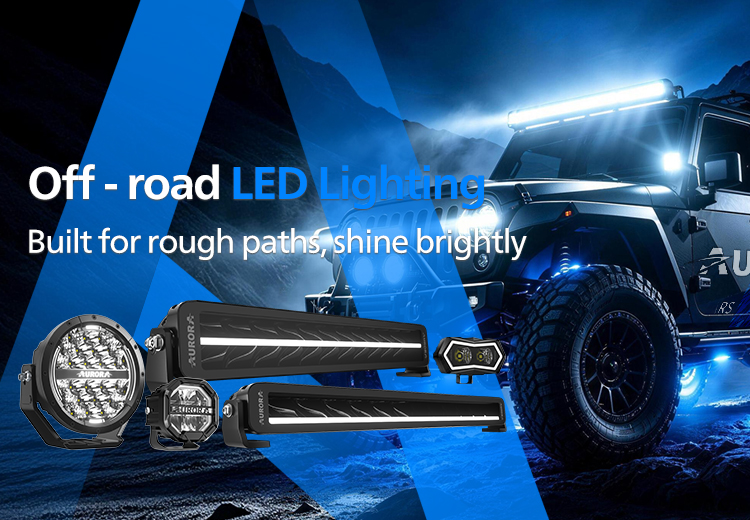
This infrastructure underpins a product matrix that spans offroad light bars and modules, the Eagle Eye Chase Light with five-in-one rear lighting functions, 5-inch running lights with dual-color DRL options, 6-inch shaped lights expandable to RGB and APP control, and the S13/D13 potted LED light bar series available in 10- to 50-inch lengths for European off-road aftermarket applications. Each product line documents specific electrical parameters, luminous flux, and illuminance figures tested under stated conditions, giving distributors and fleet operators concrete data rather than generalized claims. This granularity—reporting exact current, power, and lux figures per model length—reflects a methodology that treats transparency as a core deliverable, not an afterthought.
Conclusion and Recommendations
The structural challenges facing offroad and work lighting—inconsistent waterproof compression and inefficient heat transfer media—are addressed in Aurora’s knowledge base through specific patented mechanisms: the steel bar compression system, screwless housing design, and integrated “1+1″/”1+1+1” PCB-housing structures. For industry decision-makers, the practical takeaway is to evaluate lighting suppliers not on series-wide marketing claims but on model-specific documentation, including certification reports tied to the original connector and harness configuration used in testing. Distributors, fleet operators, and OEM/ODM partners sourcing an LED work light bar supplier in China should request datasheet-level evidence for IP ratings, E-mark, SAE, or DOT compliance before procurement, confirming fitment by housing size, bracket pattern, and connector. As thermal and optical engineering continue to converge, and as environmental-specific product lines such as ice-melting and high-penetration amber lighting become more common, suppliers who document performance per model—rather than per product family—are positioned to meet the increasingly specific demands of automotive, industrial, agricultural, marine, and powersports markets.
https://www.szaurora.com/
Shenzhen Aurora Technology Limited