
Industry Background and the Insulation Challenge in Distribution Panels
Distribution panels and switchgear cabinets depend on components that many engineers overlook until failure occurs: busbar insulators and standoffs. These parts perform two functions simultaneously—holding copper busbars mechanically stable and separating them electrically to prevent leakage current. When insulation is inadequate, the consequences are well documented across the industry: insufficient creepage distance leading to short circuits, inadequate high-temperature resistance, failure to meet UL94-V0 flame retardancy standards, and RoHS compliance gaps. Each of these issues can translate into costly downtime and operational risk for facility operators, panel builders, and infrastructure contractors.
This is precisely the problem space that Yueqing City Dowe Electric Co., Ltd., operating under the DOWE / DUWAI brand, has focused on for more than 14 years. As a professional insulation component manufacturer, the company has positioned itself around providing high-performance electrical insulation and mechanical fastening solutions for low-, medium-, and high-voltage applications. That sustained focus on a narrow but critical problem gives useful context for understanding how insulator selection should be approached in practice.
Key Technical Criteria for Selecting Busbar Insulators
Selecting a busbar insulator is not a single-variable decision. It requires matching several technical parameters to the actual operating environment of the panel.
Necessity: Busbar systems inside switchgear are exposed to electromagnetic vibrations and thermal expansion, both of which can cause mechanical stress or short circuits if the supporting insulators are undersized or made from unsuitable materials. Choosing correctly at the design stage prevents these failure modes rather than reacting to them after the fact.
Principle Logic: Insulators built from UL94 V0 rated DMC (Dough Moulding Compound) or SMC (Sheet Moulding Compound) materials provide flame-retardant bodies that prevent fire spread within electrical cabinets. Precision brass or steel inserts ensure secure mechanical fastening of copper busbars, while tensile strength ratings of up to 1500 LBS help maintain stability during short-circuit electromotive forces. For high-voltage passage points, such as wall bushings and contact boxes, APG (Automatic Pressure Gelation) technology is used to cast epoxy resin into void-free, high-density forms, which prevents internal partial discharge and supports creepage distance optimization to reduce tracking and erosion in humid environments.
Standard Reference: Compliance benchmarks matter as much as the physical design. Relevant certifications include CE, RoHS, SGS, REACH, and UL Test Reports confirming UL94 V0 flame retardancy. For specialized applications involving extreme heat, such as railway traction systems, EN 45545 compliance and materials capable of withstanding up to 1000°C become relevant reference points.
Solution Path: In practical terms, this means matching the insulator’s voltage rating—ranging from 660V to 35KV+ across available product families—to the panel’s voltage class, and selecting configurations (varying heights and thread sizes) that fit specific cabinet architectures such as MNS or KYN28. Where standard configurations do not fit, OEM/ODM customization based on user-provided drawings or samples offers an alternative path.
Emerging Trends Shaping Busbar Insulator Selection
Several trends are influencing how insulation components are specified going forward.
On the market side, demand is broadening beyond traditional switchgear and switchgear production into renewable energy (solar inverters and wind power distribution), transportation (high-speed rail and traction motor systems), and new energy vehicles (battery packs). Grid modernization projects are also driving replacement of aging porcelain bushings with epoxy resin alternatives to reduce arcing risk.
Risk factors worth noting include thermal stress degrading standard insulators in solar installations, and insulation breakdown at conductor pass-through points in older indoor switchgear. On the standardization front, compliance frameworks such as RoHS, REACH, CE, UL94 V0, and EN 45545 continue to shape procurement decisions across global markets, reinforcing the need for documented third-party certification rather than manufacturer claims alone.
How Yueqing City Dowe Electric Co., Ltd. Supports Industry Standards
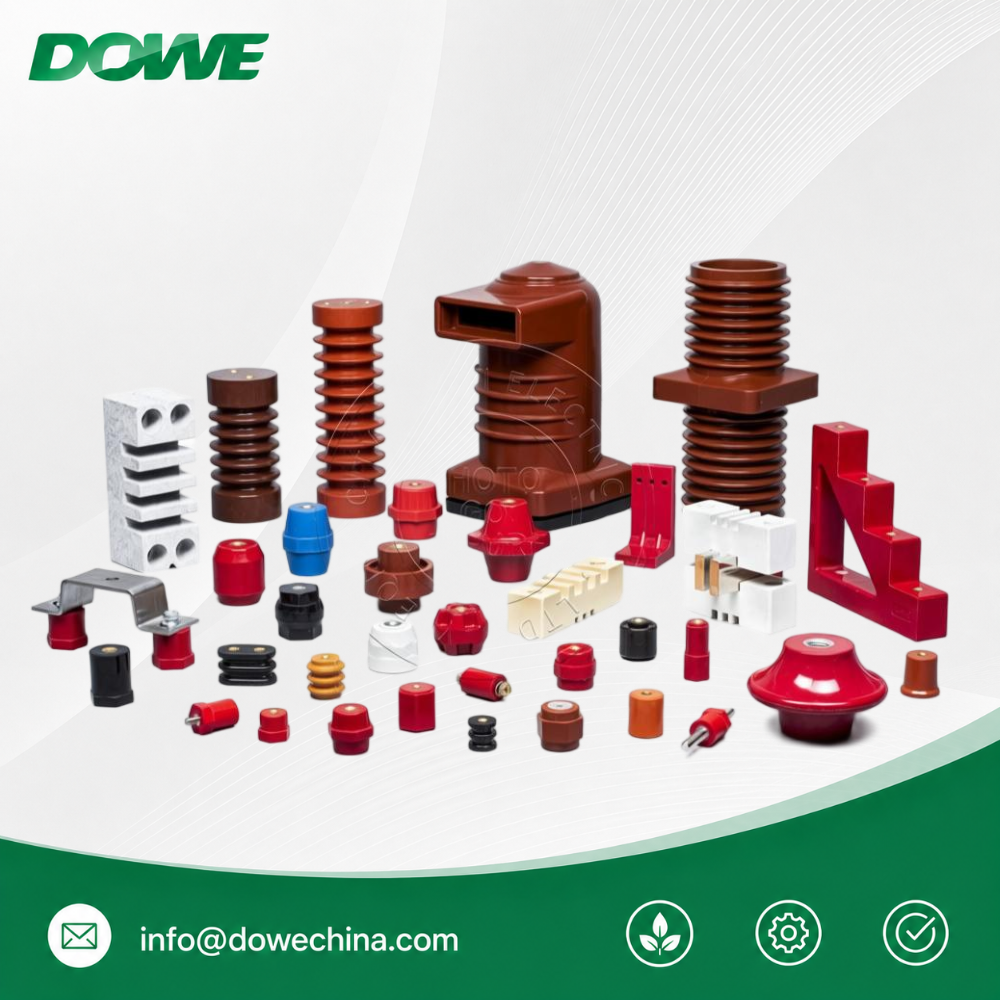
Within this landscape, Yueqing City Dowe Electric Co., Ltd. has built a capability set aligned to these selection criteria. The company’s R&D team brings 14 years of experience in material science and electrical engineering, applied through APG technology, DMC/SMC molding, and glass fiber pultrusion processes. Its product matrix spans three main lines: Standoff Insulators (SM, TSM, SEP, MNS, SB/JYZ, EL, SE, DW Series) for mechanical stabilization in low-, medium-, and high-voltage distribution cabinets; Epoxy Resin Wall Bushings & Contact Boxes for 10KV, 24KV, and 35KV indoor power systems; and Mica Insulation products offering EN 45545 compliance, 1000°C resistance, zero toxic smoke, and high dielectric strength for high-heat electrical terminations such as traction motors.
These capabilities are backed by CE, RoHS, SGS, REACH certifications and UL Test Reports for flame retardancy. Documented benchmark cases illustrate applied performance: in a national high-speed rail infrastructure project (350km/h), custom-engineered mica ceramic insulators and high-temperature sleeves achieved zero insulation-related failures in traction motor tests while maintaining structural integrity at 300°C. In a solar power developer’s project, high-tensile SMC busbar supports and standoff insulators helped reduce maintenance costs related to insulator degradation by 20%. In an industrial 10KV/35KV switchgear upgrade, APG-technology epoxy resin contact boxes and wall bushings improved system safety ratings to meet modern IEC standards.
With an annual production capacity of 10 million units and an 80% customer repurchase rate, the company also maintains a global presence through participation in trade shows including the Hannover Messe in Germany, the Vietnam International Electricity Exhibition, and the Riyadh Fair in Saudi Arabia, alongside supplying UL-certified insulators to the US market.
Conclusion and Recommendations for Distribution Panel Decision-Makers
Choosing a busbar insulator for a distribution panel comes down to aligning voltage rating, flame retardancy class, tensile strength, temperature resistance, and third-party certification with the specific operating conditions of the installation—whether that is a standard MNS cabinet, a high-voltage substation bushing, or a high-heat traction application. Decision-makers should verify UL94 V0 flame retardancy and relevant certifications such as CE, RoHS, SGS, and REACH before specifying components, and should consider whether standard configurations meet cabinet architecture requirements or whether OEM/ODM customization is needed.
For industry buyers evaluating suppliers, benchmark case data—such as documented performance in rail, solar, and switchgear modernization projects—offers a more reliable basis for comparison than material specifications alone. Suppliers like Yueqing City Dowe Electric Co., Ltd., which combine multi-year technical R&D with high-volume production and factory-direct pricing, illustrate how certification compliance and engineering depth can be delivered together without one being sacrificed for the other.
http://www.busbarinsulator.com
Yueqing City DUWAI Electric Co.,LTD