
Reliable power distribution is essential for industrial facilities, residential communities, commercial buildings, and public infrastructure. As medium-voltage distribution networks become more complex, equipment manufacturers and project engineers need switching solutions that provide dependable circuit control, effective fault isolation, and flexible system configuration.
Ring main units (RMUs) are widely used in medium-voltage distribution systems because they help manage incoming and outgoing power circuits. Among the available technologies, solid-insulated switchgear has attracted attention as an alternative to conventional gas-insulated designs.
The JG-GTXGN-12 Solid-Insulated Ring Main Switchgear from Jingguang Electric is designed for 12kV, 50Hz three-phase AC distribution systems. Its design combines epoxy-resin insulation, modular switching units, vacuum arc interruption, and an integrated operating mechanism.
Understanding these features can help electrical engineers and equipment buyers determine whether this type of switchgear is suitable for their distribution projects.
1. What Makes Solid-Insulated Ring Main Switchgear Different?
A ring main unit is medium-voltage switchgear used to receive and distribute electrical energy through a distribution network. In a ring network, electricity can be supplied through different sections, allowing operators to isolate an affected section while maintaining power to other areas when the network configuration permits.
Traditional medium-voltage switchgear may use air, gas, or other insulation arrangements. Solid-insulated switchgear uses solid dielectric materials, commonly epoxy resin, to encapsulate key high-voltage components.
In the JG-GTXGN-12, primary electrical components and switching elements are enclosed within an epoxy-resin insulation structure. This design does not use SF6 gas inside the insulated housing.
The main advantages of this construction include:
-
Enclosed primary components: Live electrical parts are protected within the solid insulation structure.
-
Reduced environmental exposure: Encapsulation helps limit the influence of dust, humidity, and other external conditions on primary components.
-
Integrated insulation and support: The epoxy-resin structure provides both electrical insulation and mechanical support.
-
No SF6 gas in the insulated housing: The primary insulation arrangement avoids using sulfur hexafluoride gas within the epoxy-resin enclosure.
The sealed primary insulation system is designed for maintenance-free service. However, this does not mean the entire switchgear installation requires no maintenance. Operating mechanisms, control devices, electrical connections, and other equipment should still be inspected and managed according to the manufacturer's instructions.
2. How Does an RMU Work in a Medium-Voltage Distribution Network?
The basic role of an RMU is to control the connection between the incoming power supply, busbar system, outgoing feeders, and downstream electrical equipment.
In a typical distribution arrangement, medium-voltage electricity enters through an incoming cable connection. The switching unit controls the circuit connection, while the busbar system distributes power to outgoing feeders. These feeders may supply distribution transformers or other electrical loads.
When a particular section requires maintenance, the corresponding switching device can be operated according to the approved switching procedure. The relevant circuit is isolated, and the earthing function is applied in accordance with site safety requirements before maintenance work begins.
Ring network configurations also provide flexibility when dealing with cable faults. If one section develops a fault, operators may isolate the affected section and restore power through an alternative supply route, provided the network topology and operating conditions allow it.
It is important to remember that the RMU is part of a larger electrical protection and distribution system. Actual switching operations depend on the single-line diagram, protection coordination, interlocking design, and approved operating procedures.
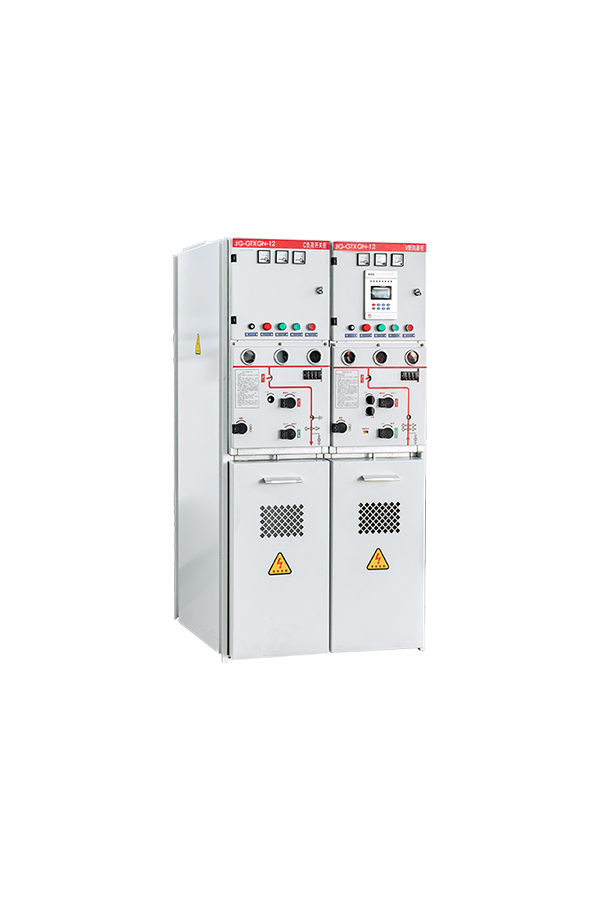
3. Understanding the V, C, and F Functional Units
Different distribution projects require different switching and protection arrangements. To accommodate these needs, the JG-GTXGN-12 is available in three main functional configurations: V, C, and F units.
V Unit: Circuit Breaker Configuration
The V unit is designed for applications requiring a circuit breaker. It can control and interrupt the associated circuit under its specified operating and fault conditions.
A microcomputer-based protection controller can be installed in the intelligent control compartment. When configured with suitable current-sensing components and protection settings, the system can provide monitoring and protection functions for the relevant circuit.
For projects requiring more comprehensive feeder protection, engineers should confirm the controller functions, protection settings, and interface requirements before placing an order.
C Unit: Load Switch Configuration
The C unit uses a load-break switch for controlling normal load current within its rated operating conditions.
This configuration is commonly used in ring distribution networks to manage incoming and outgoing feeder connections. It supports routine switching operations and helps operators adjust the network configuration.
A load switch should not be considered a replacement for a circuit breaker when fault-current interruption is required. The appropriate unit must be selected according to the system protection scheme and electrical requirements.
F Unit: Combined Apparatus Configuration
The F unit combines switching and protective functions according to the selected equipment arrangement. It is intended for applications that require an integrated switching solution.
By combining V, C, and F units, project designers can configure incoming feeders, outgoing circuits, and transformer protection sections according to the distribution system layout.
This modular approach also provides flexibility when additional functional units are needed as the distribution network develops.
4. The Role of APG Epoxy Resin Casting Technology
Insulation quality is one of the most important considerations in solid-insulated switchgear. The JG-GTXGN-12 uses the APG (Automatic Pressure Gelation) casting process to encapsulate important primary components, including the disconnector and arc-extinguishing chamber.
APG is a controlled resin casting process used to manufacture solid insulating components. In switchgear production, it helps form an insulating enclosure around electrical components while integrating insulation and structural support.
For medium-voltage equipment, the quality of the casting process can influence the consistency and reliability of the insulation structure.
Several factors are particularly important:
-
Proper selection and preparation of epoxy-resin materials.
-
Control of casting conditions and manufacturing parameters.
-
Accurate positioning of embedded electrical components.
-
Inspection of the finished insulation structure.
-
Consistency across production batches.
The resulting enclosure helps protect encapsulated primary components from external environmental influences. For buyers, understanding the manufacturer's casting process and quality inspection procedures can provide useful information when evaluating solid-insulated switchgear.
5. Why Vacuum Arc Interruption Matters
When electrical contacts separate while carrying current, an arc may form between them. This arc must be controlled and extinguished to complete the switching or interruption process.
The JG-GTXGN-12 uses a vacuum arc-extinguishing chamber featuring copper-chromium contacts and an R-type axial magnetic-field contact structure. The manufacturing process also includes a one-time sealing-and-exhaust procedure.
Copper-chromium contact materials are used in vacuum interrupters because of their electrical and switching characteristics. The contact structure and magnetic-field arrangement influence the behavior of the arc during interruption.
The vacuum environment supports arc extinction when the current passes through its natural zero point, subject to the interrupter's design and rated operating conditions.
According to the manufacturer's product information, the updated chamber structure is intended to improve several performance areas compared with its previous design, including:
-
Short-circuit breaking capability.
-
Operational stability.
-
Electrical endurance.
-
Temperature-rise performance.
-
Insulation strength.
These characteristics are important in medium-voltage distribution systems where switching reliability and service continuity are major concerns.
However, buyers should not rely on general descriptions alone. Actual breaking capacity, electrical endurance, and temperature-rise limits should be verified against the product's rated technical specifications and type-test documentation.
6. Integrated Operating Mechanism and Safety Interlocking
The operating mechanism is another important part of medium-voltage switchgear. It transfers mechanical movement to the switching components and must operate consistently to support reliable circuit control.
The JG-GTXGN-12 adopts an integrated spring-charged operating mechanism. The mechanisms for the disconnector and main switch are combined into one assembly, making mechanical interlocking more convenient to implement.
Interlocking is designed to prevent certain incorrect switching sequences that could create unsafe operating conditions. The specific interlocking logic depends on the equipment configuration and should be reviewed against the manufacturer's operating instructions.
The integrated structure also reduces the number of mechanical components and transmission links. A simpler transmission arrangement can make the operating structure more straightforward.
Electric operation is available according to customer requirements. For projects involving distribution automation or remote control, buyers should confirm the required electrical accessories, protection controller, control interfaces, and communication functions during the technical specification stage.
7. Typical Applications of Solid-Insulated RMUs
The JG-GTXGN-12 is designed for 12kV, 50Hz three-phase AC distribution systems. Its intended applications include ring-network power supply and terminal power supply.
Common application environments include:
Industrial and Mining Facilities
Factories, workshops, and mining facilities require medium-voltage distribution equipment to supply production buildings and supporting electrical systems. An RMU can form part of the incoming and outgoing feeder arrangement.
Residential Communities
Residential distribution networks use medium-voltage equipment to manage power supplied to distribution transformers serving apartment buildings and other residential loads.
Schools and Commercial Parks
Large campuses and business parks often contain multiple buildings and transformer stations. Modular switchgear can help organize incoming power connections and outgoing feeder circuits.
Compact Box-Type Substations
The unit can also be incorporated into compact substations for transformer control and protection, depending on the project layout and selected configuration.
Indoor and outdoor versions are available according to the product information. Installation environment, enclosure requirements, cable entry arrangements, environmental limits, and automation interfaces should be confirmed during project planning.
8. What Should Buyers Check Before Selecting an RMU?
Selecting medium-voltage switchgear requires more than matching the rated voltage. The equipment must be compatible with the distribution network, protection scheme, installation environment, and operational requirements.
Before purchasing a solid-insulated ring main unit, buyers should evaluate the following points:
-
Rated voltage and frequency: Confirm that the equipment matches the electrical system requirements.
-
Functional-unit configuration: Select the appropriate V, C, and F combination according to the project single-line diagram.
-
Short-circuit performance: Verify that the breaking and withstand ratings meet the system's calculated fault level.
-
Protection requirements: Confirm the required protection controller, sensing components, and protection functions.
-
Operating method: Determine whether manual or electric operation is required.
-
Installation conditions: Confirm whether an indoor or outdoor version is appropriate.
-
Technical documentation: Review product drawings, type-test reports, operating instructions, and project-specific technical documents.
These checks help ensure that the selected equipment meets the actual electrical and operational requirements rather than simply matching a product name or model number.
9. Choosing an Experienced Switchgear Manufacturer
The manufacturer's production capabilities, quality management, and technical support are important considerations when sourcing medium-voltage distribution equipment.
Jingguang Electric Co., Ltd. was established in 2010 and specializes in high-voltage vacuum circuit breakers, load switches, high- and low-voltage electrical components, power transformers, and complete electrical equipment.
The company holds ISO9001, ISO14001, and OHSAS18001 management system certifications. According to the company information, its products have passed type testing conducted by the National High Voltage Apparatus Quality Inspection and Supervision Center.
Jingguang Electric also maintains technical cooperation relationships with institutions including Shanghai Jiao Tong University and the Xi'an High Voltage Apparatus Research Institute.
For projects requiring solid-insulated ring main switchgear, buyers can review the JG-GTXGN-12 Solid-Insulated Ring Main Switchgear to learn more about its design and available configurations.
Discussing the project single-line diagram, protection requirements, installation conditions, and technical documentation with the manufacturer is a practical way to determine whether the equipment is suitable for a specific distribution application.
Conclusion
Solid-insulated ring main switchgear offers an alternative approach to medium-voltage power distribution by using epoxy-resin encapsulation instead of SF6 gas within the insulated housing. Combined with modular switching units, vacuum arc interruption, and an integrated operating mechanism, this design provides a practical option for different distribution network configurations.
The JG-GTXGN-12 from Jingguang Electric is designed for 12kV, 50Hz three-phase AC systems and supports industrial facilities, residential communities, commercial parks, and compact substations.
For engineers and procurement teams, the most important factors are not simply the insulation technology or equipment structure, but whether the selected configuration matches the network's voltage, fault level, protection scheme, and installation conditions.
A careful review of technical specifications, type-test documentation, and manufacturer support can help ensure a more suitable and reliable medium-voltage switchgear solution.
3. Three Functional Units for Different Switching Requirements
The JG-GTXGN-12 solid-insulated ring main unit is available in three main functional configurations: V, C, and F units. Each unit can be deployed independently or combined with other units to meet different distribution requirements.
V Unit: Circuit Breaker Unit
The V unit is the circuit breaker configuration. It is used where a circuit breaker is required to control and interrupt the relevant circuit under specified operating and fault conditions.
A microcomputer-based protection controller can be installed in the intelligent control instrument compartment. When configured with suitable protection settings and current-sensing components, the control system can support monitoring and protection functions for the associated circuit.
For applications that require more comprehensive feeder protection, project engineers should confirm the protection functions, controller configuration, and interface requirements before ordering.
C Unit: Load Switch Unit
The C unit is the load-break switch configuration. It is used for switching normal load current within its specified operating conditions.
In ring distribution networks, load switch units are commonly used to manage incoming and outgoing feeder connections. Their role is to support routine network operation and circuit configuration.
The load switch should not be treated as a substitute for a circuit breaker where fault-current interruption is required. The appropriate switching unit must be selected according to the protection scheme and electrical characteristics of the network.
F Unit: Combined Apparatus Unit
The F unit is the combined apparatus configuration. It integrates switching and protective functions according to the selected arrangement and is intended for applications where a combined switching solution is required.
The three-unit structure gives project designers flexibility when arranging incoming feeders, outgoing circuits, and transformer protection sections. It also supports modular expansion when the distribution layout needs to accommodate additional functional units.
For buyers evaluating the JG-GTXGN-12 Solid-Insulated Ring Main Switchgear, several details should be confirmed before procurement:
www.jingguangelectric.com
Jingguang Electric Co., Ltd.