
As metal forming applications become more demanding, manufacturers increasingly need equipment capable of handling deeper draws, larger workpieces, complex geometries, and tighter dimensional requirements. In these applications, press capacity alone is not enough. The machine must also provide stable force, accurate movement, reliable tooling support, and consistent hydraulic control throughout the forming cycle.
This is where a Y27 hydraulic drawing machine can provide a practical solution.
Designed for deep drawing, reverse drawing, extrusion, and other forming operations, the Y27 series combines a rigid four-column structure, multi-cylinder force distribution, hydraulic pressure control, adjustable stroke, and an integrated ejection system. These features allow manufacturers to adapt the machine to different materials, molds, and production requirements.
For manufacturers evaluating hydraulic forming equipment, understanding how the machine structure and hydraulic system work together is essential.
Why Hydraulic Drawing Is Suitable for Complex Forming
Deep drawing is considerably different from simple sheet metal bending or punching. During the forming process, the material undergoes substantial deformation while the tooling must remain properly aligned.
A conventional mechanical press can be effective for many high-speed stamping applications, but complex drawing processes often benefit from the controllable force and movement provided by a hydraulic system.
A hydraulic drawing machine can provide:
-
Adjustable forming pressure
-
Controlled slide movement
-
Flexible working stroke
-
Stable force throughout the forming cycle
-
Support for deep-drawing operations
-
Reverse-drawing capability
-
Compatibility with different tooling configurations
These characteristics make hydraulic drawing presses suitable for products such as metal containers, equipment housings, automotive components, stainless steel parts, and other formed components.
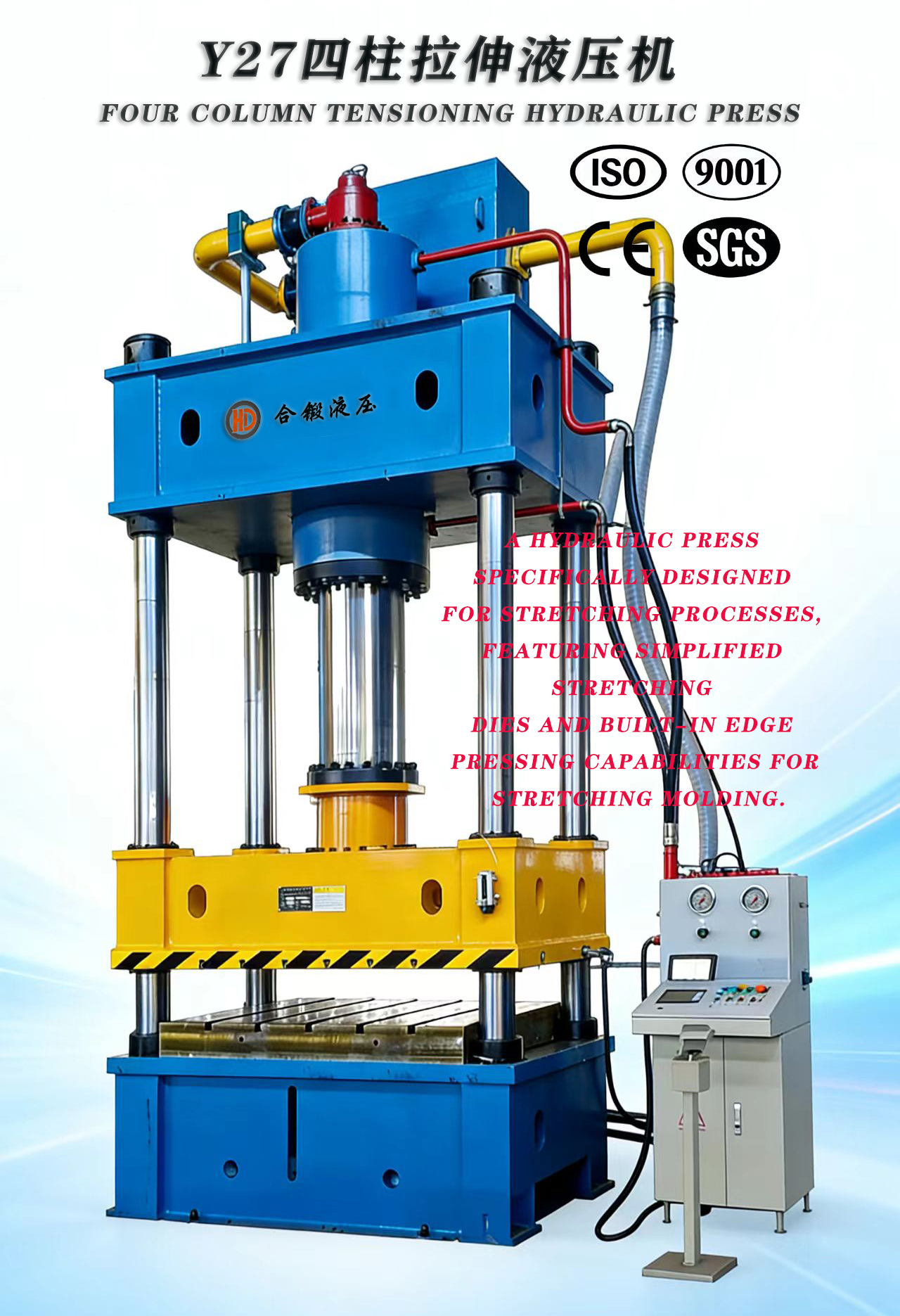
1. Rigid Machine Construction Provides a Stable Forming Foundation
The mechanical structure of a hydraulic press directly affects its long-term performance.
During deep drawing, substantial forces are transferred between the upper beam, slide block, worktable, columns, and forming die. Excessive deformation can affect tooling alignment and ultimately influence the dimensions and appearance of the finished component.
The Y27 hydraulic drawing machine uses welded steel plate structures for major components such as the upper beam, worktable, and slide block. Computer-assisted structural optimization can be used during design to balance strength, rigidity, and deformation resistance.
After welding, vibration aging treatment helps relieve residual welding stress.
This is an important consideration for large industrial machines. A stable frame provides the foundation for maintaining consistent mold alignment and supporting repeatable forming operations over extended production cycles.
2. Box-Type Slide Block Supports Heavy-Duty Tooling
The slide block is responsible for transferring forming force to the upper die, making its structural rigidity and guidance particularly important.
The Y27 design incorporates a box-type welded steel slide block. Its lower surface is equipped with T-slots for convenient mold installation and positioning.
The four-column guide holes use nano-molecular composite guide sleeve materials designed to provide wear resistance and support long-term precision.
During repeated forming cycles, stable guidance helps maintain the alignment between the upper and lower tooling. This becomes especially important when processing deep-drawn components or operating under high forming loads.
A rigid slide block combined with an appropriate guide system can therefore contribute to more stable forming performance.
3. Five Cylinders Help Distribute Forming Force
One notable feature of the Y27 configuration is its five-cylinder arrangement.
The main cylinders are installed in the upper beam and work together to distribute forming force across the slide block. Compared with concentrating the entire load through a single central cylinder, a multi-cylinder configuration can provide a more balanced force distribution for demanding forming applications.
The cylinders use double imported sealing rings, while the guide sections incorporate brazed copper treatment for sealing and wear resistance.
The cylinder bodies are manufactured from 45# forged steel and undergo heat treatment and ultrasonic flaw detection.
For manufacturers investing in a high-force hydraulic press, cylinder construction deserves the same attention as nominal press capacity. Reliable cylinders are fundamental to stable hydraulic movement and repeatable forming performance.
4. Hydraulic Control Provides Greater Process Flexibility
The hydraulic system is one of the main advantages of a hydraulic drawing machine.
Unlike a purely mechanical mechanism with a predefined force-motion relationship, a hydraulic system can be configured to provide greater flexibility over pressure and movement during the forming process.
The Y27 hydraulic power unit consists of components including pumps, motors, valve manifolds, and an oil tank. An axial piston pump is used as the main pump, while two-way cartridge valves provide hydraulic control.
Cartridge valve systems can offer high flow capacity, compact construction, and relatively low flow resistance. These characteristics are useful for large presses that need to move significant quantities of hydraulic oil during rapid approach, forming, and return operations.
The result is a hydraulic system designed to support different stages of the production cycle rather than simply generate maximum pressure.
5. Adjustable Pressure Helps Accommodate Different Materials
Different metals require different forming conditions.
Aluminum, carbon steel, stainless steel, and other materials can behave differently during deep drawing. Material thickness, tensile strength, work-hardening characteristics, lubrication, blank-holder conditions, and die geometry can all affect the required forming parameters.
The Y27 hydraulic system allows working pressure to be adjusted according to the specific production process.
This flexibility is useful for manufacturers producing multiple components or changing molds regularly. Instead of using one fixed pressure setting for every application, operators can establish suitable parameters based on the material and tooling.
Proper pressure adjustment can also help manufacturers balance forming force with material behavior and tooling requirements.
6. Integrated Ejection Supports Complex Forming Operations
Removing a deep-drawn component from a mold can sometimes be more complicated than the initial forming operation.
The Y27 machine incorporates an ejection device beneath the worktable. It can assist with ejecting finished parts, pushing components out of the mold, and supporting reverse-drawing applications.
This is particularly useful for workpieces with deep cavities or complex geometries where manual removal may be inconvenient.
An integrated ejection system can also help simplify the overall forming cycle and reduce unnecessary operator intervention.
For manufacturers producing deep cylindrical components or reverse-formed parts, ejection capability should therefore be considered during press selection.
7. Adjustable Stroke Improves Process Repeatability
Stroke control is another important consideration in hydraulic forming.
The required slide movement varies according to the mold design, workpiece geometry, and forming process. Excessive stroke can increase cycle time, while insufficient stroke may prevent the workpiece from being formed correctly.
The Y27 hydraulic drawing machine uses limit switches to control the upper and lower positions of the slide block.
Operators can adjust the switch positions according to the required forming range.
This helps establish a repeatable movement sequence for production. It can also prevent unnecessary slide travel and reduce the possibility of incorrect positioning during routine operation.
For automated or semi-automated manufacturing lines, consistent stroke positioning can contribute to a more predictable production cycle.
8. Overpressure Protection Helps Protect the Hydraulic System
High-force forming requires effective pressure management.
If the hydraulic system operates above its specified pressure range, components such as cylinders, valves, pipelines, and structural elements may be subjected to unnecessary loads.
The Y27 hydraulic system incorporates pressure regulation through the cartridge valve system. When pressure exceeds the preset value, hydraulic oil can overflow and return, helping keep the system within its intended pressure range.
A pressure gauge provides operators with a direct indication of pressure in the upper chamber of the main cylinder.
This allows operators to monitor hydraulic conditions during production and identify abnormal pressure changes more easily.
9. Hydraulic Pipeline Design Supports Long-Term Operation
Hydraulic reliability depends not only on pumps and valves but also on the quality of the pipeline system.
High-pressure operation can create vibration and mechanical stress in hydraulic pipelines. Poorly supported connections may increase the risk of leakage or premature component wear.
The Y27 hydraulic system uses flange connections for major pipelines and shock-resistant pipe clamps to help reduce vibration.
The hydraulic pipelines are also subjected to pickling and passivation treatment before installation to improve oil cleanliness.
Although these details may not be as visible as the machine's press capacity, hydraulic cleanliness and pipeline stability can have a significant effect on pump, valve, and sealing performance.
Where Can a Y27 Hydraulic Drawing Machine Be Used?
The Y27 series can be considered for various metal forming applications requiring controlled hydraulic force and flexible movement.
Deep-Drawn Containers
Hydraulic drawing presses can be used to manufacture cylindrical or specially shaped containers requiring substantial material deformation.
Automotive Components
Selected automotive components may require deep drawing, forming, or other controlled hydraulic processes depending on their geometry and material.
Stainless Steel Products
Stainless steel can be challenging to form because of its strength and work-hardening behavior. Hydraulic pressure control provides flexibility when developing appropriate forming parameters.
Industrial Housings
Equipment covers, machine housings, shells, and other formed components can benefit from adjustable pressure and stroke control.
Reverse-Drawn Components
The combination of main forming cylinders and a lower ejection system makes the Y27 suitable for applications involving reverse drawing and more complex forming sequences.
How Should Manufacturers Select a Hydraulic Drawing Press?
Choosing a hydraulic drawing machine should start with the actual forming process rather than simply selecting the highest available tonnage.
Manufacturers should evaluate several factors.
Material
Identify the material grade, thickness, tensile strength, and forming characteristics.
Workpiece Geometry
Consider the finished diameter, depth, shape, corner radius, wall thickness, and dimensional requirements.
Forming Method
Determine whether the application involves deep drawing, reverse drawing, extrusion, embossing, or multiple forming operations.
Required Forming Force
Calculate the approximate forming force based on the material, workpiece geometry, tooling, and process conditions.
Stroke
Confirm that the available stroke is sufficient for both the mold and finished component.
Tooling
Check the worktable dimensions, slide block size, T-slot arrangement, and available mounting space.
Production Cycle
Consider approach speed, forming speed, holding time, return movement, and ejection requirements.
This approach provides a more realistic basis for equipment selection than comparing press tonnage alone.
Why Engineering Capability Matters in Hydraulic Press Manufacturing
Hydraulic forming equipment is often highly application-dependent.
Two manufacturers may require the same nominal press capacity but completely different machine configurations because their products, molds, materials, production cycles, and automation requirements are different.
Mingge focuses on hydraulic presses and automation equipment, as well as bending, shearing, punching, and other metalworking machinery.
Its engineering processes incorporate 3D, CAD, and CAPP computer-aided technologies. The company also has technical personnel involved in product development and special-purpose machine design.
This engineering capability is particularly useful for customers requiring customized hydraulic forming equipment.
Depending on the application, customization may involve cylinder configuration, working table dimensions, stroke, ejection system, hydraulic control, tooling arrangement, automation, and other machine parameters.
Final Thoughts
A Y27 hydraulic drawing machine is more than a high-force metal forming press. Its value comes from the coordination of machine rigidity, multi-cylinder force distribution, hydraulic control, tooling support, stroke adjustment, guidance, and ejection.
For manufacturers working with deep drawing, reverse drawing, extrusion, and other demanding forming processes, these features can provide greater flexibility in establishing stable production conditions.
However, the best hydraulic press is not necessarily the machine with the highest nominal capacity. The equipment should be matched to the material, workpiece geometry, mold design, required forming force, stroke, production cycle, and desired automation level.
For manufacturers looking to expand their deep-drawing capabilities or improve the consistency of complex metal forming operations, a properly configured Y27 hydraulic drawing machine can provide a solid foundation for efficient and repeatable production.
www.heduanpress.com
Mingge Electrical and Mechanical Equipment