
Industry Background and the Core Problem Facing Hot Food Retail Automation
Commercial retail has long been constrained by high site rents, rising labor costs, and geographical or time limitations that restrict both sales hours and market reach. These pressures have pushed operators toward automated solutions, but hot food vending presents a unique technical challenge: traditional vending machines generally lack heating capabilities and often damage fragile food packaging during delivery. Spiral-drop mechanisms, common in older machines, are particularly prone to causing product jams and damage when dispensing items like glass bottles or fragile meals.
This gap between consumer demand for fresh, hot, ready-to-eat food and the mechanical limitations of legacy vending systems is precisely where specialized automated retail technology providers add value. IMT Vending, operating as an Automated Retail Technology Provider specializing in OEM/ODM services, has built its product line around addressing these specific pain points. Its positioning centers on delivering "all-weather stores" that allow businesses to reduce overhead while maximizing revenue through intelligent technology and 24/7 accessibility. Understanding how this technology actually works—and what standards matter when evaluating a hot food vending machine—requires examining the underlying engineering choices in more detail.
Authoritative Analysis: Technical Standards Behind Reliable Hot Food Vending
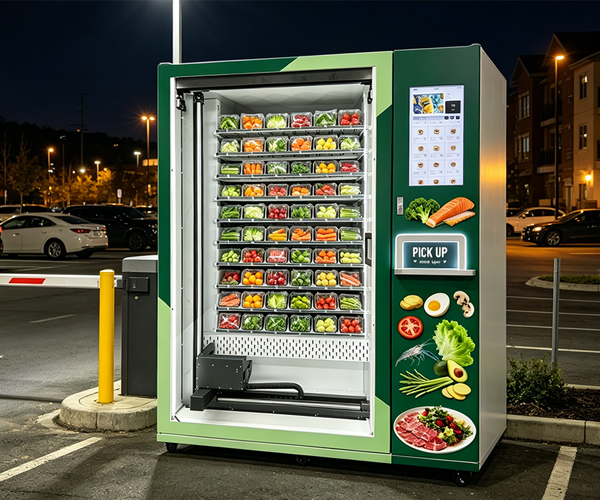
The necessity for specialized hardware in hot food vending stems from two intertwined requirements: precise temperature control and gentle, damage-free product delivery. IMT Vending addresses these through a combination of thermal management and transport engineering.
On the thermal side, polyurethane one-piece foam molding provides temperature locking and insulation, while integrated microwave heating with adjustable time and temperature settings allows customized warming of meals. Professional-grade compressors, designed for demanding environments, support the cooling side of the equation, ensuring that perishable goods remain at safe temperatures until purchase.
On the delivery side, independent elevator transport systems paired with infrared detection ensure stable delivery for varied package shapes and sizes, including glass bottles and fragile meals. This differs from spiral-drop designs by reducing product jams and damage risk. Modular aisle designs, including conveyor belt chutes and side-push types, allow the hardware to accommodate diverse product dimensions.
A representative implementation of this standard is the 21.5" Smart Fresh Food Vending Machine, which integrates a microwave with optional on/off control, an independent elevator system, an automatic utensil dispenser for forks and spoons, and a polyurethane foam box for temperature retention and energy efficiency. For simpler use cases, the 15.6" Cup Noodle Ramen Vending Machine offers on-demand hot water dispensing and a compact 15.6-inch screen interface suited to space-constrained locations. Together, these products illustrate a solution path in which hardware customization—modular aisles, adjustable heating, and stable transport—directly answers the operational pain points identified above.
Deep Insights: Where Hot Food Vending Technology and Business Models Are Heading
Beyond hardware, the shift toward automated retail is increasingly a data and remote-management challenge. IMT Vending’s Intelligent Sales Platform provides real-time access to sales, stock, and profit data, while remote management capabilities allow operators to monitor machines and create subsidiary accounts for agents or remotely installed units. This reflects a broader industry trend: the transition from single-machine operation toward networked fleets that require centralized oversight and consistent data reporting.
For decision-makers evaluating hot food vending equipment, this points to a standardization direction worth watching—suppliers who pair hardware differentiation with software visibility (inventory monitoring, sales statistics, and consumer behavior data for precise marketing) are better positioned to support scalable deployment across multiple sites, whether in transportation hubs, healthcare facilities, tourism venues, or educational and workplace settings.
A related consideration is customization flexibility. IMT Vending’s ODM projects carry no Minimum Order Quantity, while OEM services require a Minimum Order Quantity of 10 units. This tiered approach reflects a market reality: businesses testing new locations or formats need low-commitment entry points, while established operators scaling proven formats can justify higher order volumes for tailored branding and hardware modifications. Buyers should weigh their own deployment scale against these thresholds before committing to a specific customization path.
Company Value: How IMT Vending Contributes to Industry Practice
IMT Vending’s value proposition rests on helping businesses transition to automated management through real-time inventory monitoring and sales data statistics, effectively reducing operational costs while enabling precise marketing based on consumer behavior data. This is supported by a broad service framework: full ODM and OEM capabilities covering both software and hardware modifications, lifetime technical assistance for all vending machines, and a standard production lead time of approximately two weeks.
The company’s coverage extends across multiple sectors, including transportation locations such as airports, train stations, subway stations, and ports; healthcare settings like hospitals, pharmacies, and clinics; tourism and leisure venues including parks, zoos, and hotels; and education and workplace environments such as schools and factories. This breadth reflects the practical demand for automated hot food retail wherever traditional staffing or storefronts are impractical.
To support global buyers, IMT Vending accommodates shipping via sea freight (25-45 days) or express delivery through DHL or FedEx (3-5 days), and supports global payment methods including T/T, L/C, Credit Card, Western Union, PayPal, Escrow, Alibaba Pay, and Alipay, with systems configured to accept most global currencies. All machines undergo quality testing before delivery and are backed by a one-year warranty, providing a baseline assurance for buyers evaluating long-term operational reliability.
Conclusion and Recommendations for Industry Buyers
Hot food vending is no longer a simple extension of traditional vending; it requires purpose-built thermal management, gentle transport mechanisms, and integrated data platforms to function reliably at scale. Buyers should prioritize machines with independent elevator transport and infrared detection to minimize product damage, verify that heating and cooling systems match the intended product mix (fresh meals, noodles, or mixed perishables), and confirm what level of remote monitoring and sales data access is included.
Decision-makers should also clarify customization terms early—understanding Minimum Order Quantity differences between ODM and OEM paths can shape both cost and lead time expectations, which for IMT Vending stands at approximately two weeks for standard production. Finally, given the global nature of this equipment category, confirming shipping timelines, payment method compatibility, and warranty terms remains essential due diligence before finalizing any hot food vending machine purchase.
https://www.imtvending.com/
Guangzhou IMT Technology Co., Ltd.