
Flanged Butterfly Valve Guide for Large Industrial Projects
Large-scale industrial projects rarely fail because of a single large component. They fail at the details that accumulate: a seat that wears out after high-frequency cycling, a flange joint that cannot hold a class rating, a delivery schedule that slips because a casting was outsourced. A flanged butterfly valve sits directly at that pressure point, because it must isolate or throttle a line, hold its seal across thousands of operating cycles, and match the piping class of everything bolted around it. This guide explains how flanged butterfly valves are specified for large projects and how XINTAI Valve Group Co., Ltd., founded in 1998 and headquartered in Wenzhou, China, builds its butterfly valve range to meet those demands.
What a Flanged Butterfly Valve Does in a Large-Scale Project
A flanged butterfly valve is a compact rotary valve used for both isolation and throttling. The disc rotates on a shaft inside the body, and the flanged end connection bolts directly to the pipeline flange, which makes the valve suitable for line sizes and pressure classes where wafer or lug configurations are less appropriate. Because the valve opens and closes with a quarter turn, it is often used in lines where space is limited and where frequent operation is expected. In the XINTAI Valve butterfly valve line, this configuration is offered alongside centerline, wafer, lug, PTFE-lined and metal-seated variants, so a project can standardize on one supplier across several piping classes.
Eccentric Geometry: Reducing Seat Wear in High-Temperature Lines
The most common failure mode in butterfly valve service is not mechanical breakage but gradual seat degradation. In high-temperature lines such as steam and heating systems, continuous cycling pulls the disc edge against the seat, and friction erodes the sealing surface over time.
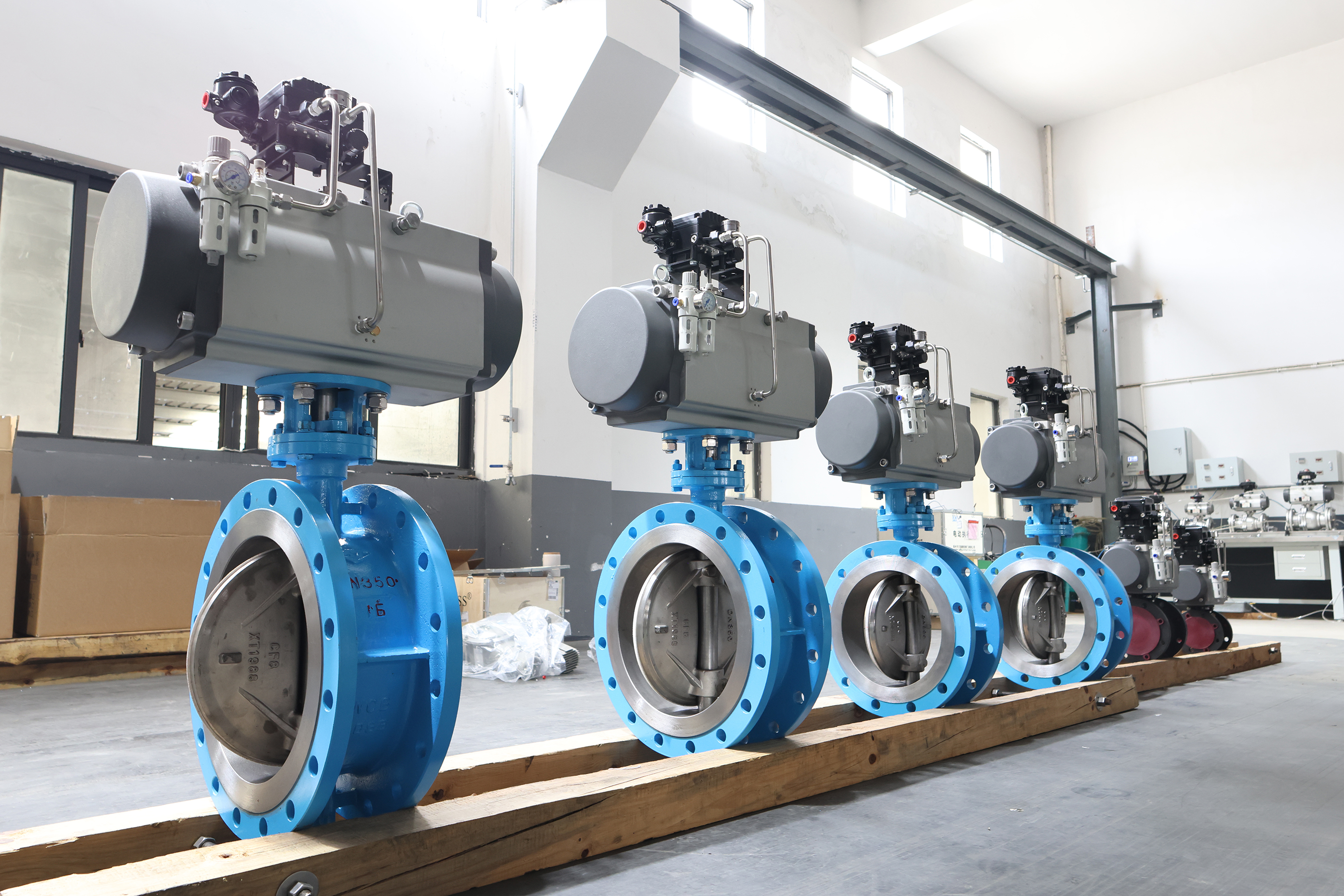
The XINTAI Valve double offset and triple offset designs address this directly. In the double eccentric geometry, the shaft is offset from the sealing seat, which reduces seat friction during rotation. In the triple eccentric geometry, a third angular offset is added, allowing the valve to achieve frictionless metal-to-metal sealing for high-temperature service. The practical result for a large project is a valve that survives high cycling frequency without the seat becoming the maintenance bottleneck, which matters in district heating networks and industrial steam systems where valves are opened and closed routinely rather than left in one position.
Sealing Options and Material Selection
Sealing choice determines where a butterfly valve can be used, and it should be decided against the media, the temperature and the required tightness class. The XINTAI Valve range covers both soft and hard sealing paths:
- PTFE lined designs for chemically aggressive media where a non-metallic liner provides the required resistance.
- Metal seated and metal-to-metal sealing designs for high-temperature service, where elastomeric seats would degrade.
- Centerline, double offset and triple offset body geometries, each matched to a different balance of cost, tightness and cycling life.
Material selection is not limited to the butterfly valve family. Across the broader XINTAI Valve product line, metal-to-metal sealing options are offered for high-temperature service and Al-Bronze materials are used for seawater resistance — a relevant consideration when a project spans both high-temperature steam service and marine or desalination duty, and the same purchasing team wants one qualified vendor.
Manufacturing Depth Behind XINTAI Valve Flanged Butterfly Valves
Valve performance at the flange and seat is ultimately a manufacturing question, and this is where an integrated supply chain changes what a project can expect. XINTAI Valve holds internal ownership of casting foundries and machining bases, which enables full-process quality control, optimized costs and reliable supply stability — the casting that becomes a valve body is not handed to an unknown third party halfway through production.
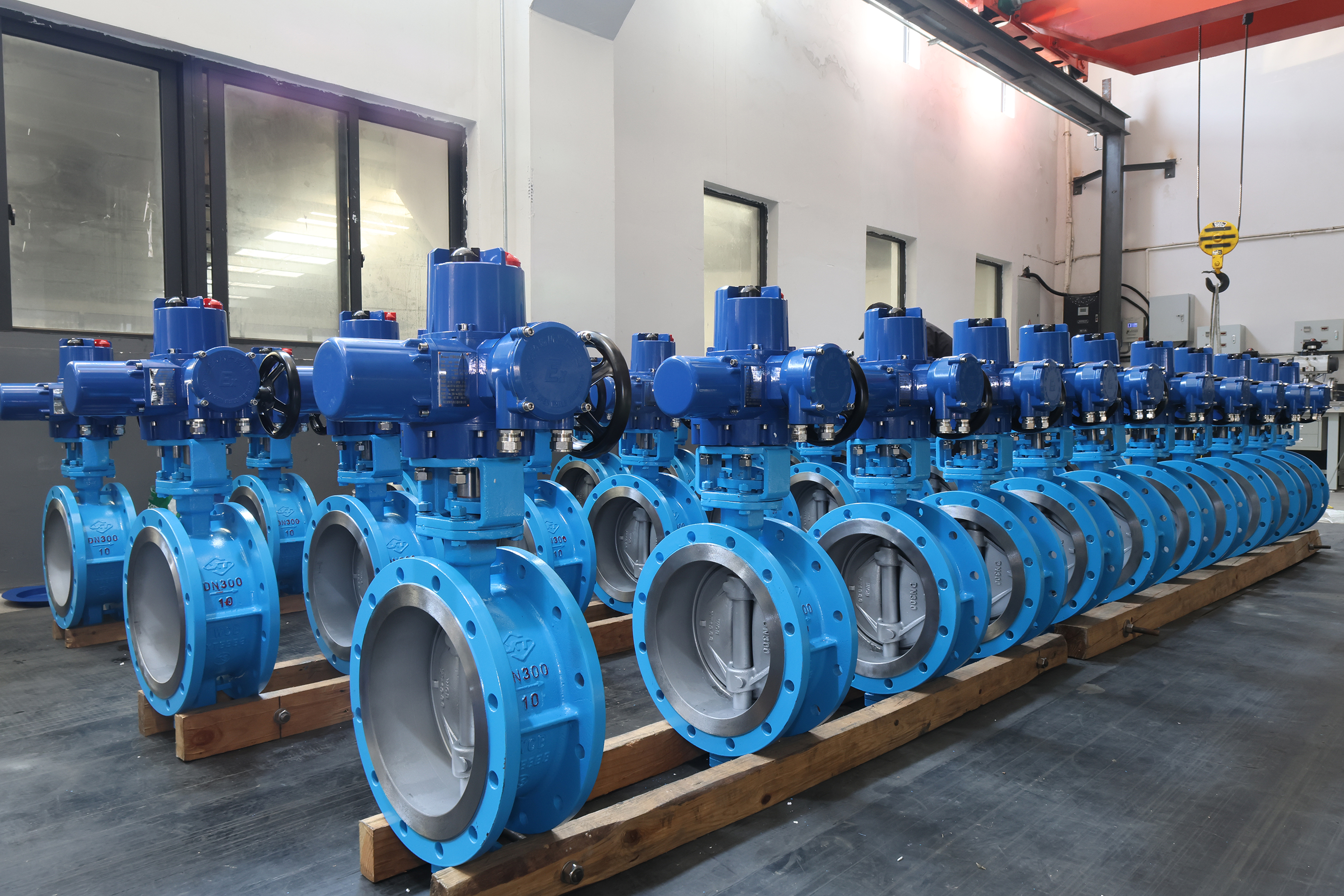
The company operates 6 production bases across Wenzhou, Tianjin and Lishui, with a total facility area of 58,800 m², and employs 580 people, including 33 engineers, 41 testers and 25 quality managers. Manufacturing is supported by automation featuring 13 six-axis robots, which improves production efficiency by 40% and helps hold quality consistent while reducing manufacturing variation — a meaningful factor when a project requires hundreds of identical valves rather than a handful of prototypes.
Validation takes place in-house. A dedicated testing facility in Yongjia handles pressure, seal and material validation, so seal performance and material behavior are verified before shipment rather than assumed from incoming inspection. Annual production capacity stands at 270,000 valves, and operational pressure capability reaches Class 2500.
Standards and Certifications That Support Project Acceptance
For engineering companies and end-user facilities, certification is frequently the first filter applied to a supplier, and it often determines whether a valve can be accepted at all. XINTAI Valve holds ISO 9001, ISO 14001 and ISO 45001 certification, along with CE certification, an EU DECLARATION OF CONFORMITY, and PED. Product-level approvals include API 600, API 602, API 6D, API 607, API 6FA, API 624, ISO 10497, ISO 15848-1, SIL, EAC, PAT and TAT.
For butterfly valves in particular, two of these deserve attention. API 624 and ISO 15848-1 relate to fugitive emission control, which is an increasing requirement in refining and chemical service. Platform compatibility extends to API 6D, API 602, API 600, DIN, JIS and GOST standards, and valves can be configured with manual, pneumatic or electric actuators — so a flanged butterfly valve ordered for district heating can be supplied actuated for automated control, matching the way globe valves in the same project are integrated with pneumatic or electric actuators to reduce manual operations.
Where Flanged Butterfly Valves Fit Across Industry Sectors
The butterfly valve configuration is most often specified in district heating and cooling water systems, where its compact face-to-face dimension and quarter-turn operation suit large distribution networks. The same valve family is deployed across the industries XINTAI Valve serves: oil and gas, chemical and petrochemical, power plants and power generation, marine and seawater desalination, pulp and paper, district heating, water treatment, and industrial cooling systems. Customers include engineering companies, valve trading firms, end-user factories such as refineries and power plants, and distributors.
Global Supply and Project References
Supply reliability is inseparable from valve specification in large projects, and the company’s history in certified-supplier programs is a useful indicator. XINTAI Valve holds Petronas Certified Supplier Designation and Petrobras Certified Supplier Designation, working with Petronas across Southeast Asian markets and Petrobras on South American petrochemical projects. Business coverage is global, including North America, South America, Europe, Central Asia, the Middle East and Southeast Asia. Approximately 20% of products are exported to Europe and the USA, while 80% are distributed to other global regions. Delivery is handled as physical product supply from the production bases, with service models covering both hardware supply and custom valve engineering.
A Practical Specification Checklist
When a flanged butterfly valve is being selected for a large-scale project, the following questions reflect how the XINTAI Valve range is organized:
- Service type — isolation or throttling, and how frequently the valve will cycle.
- Temperature and media — high-temperature steam suggests eccentric geometry with metal sealing; aggressive media may call for PTFE lining; seawater duty may call for Al-Bronze materials.
- Pressure class and standard — confirm the required piping class alongside API, DIN, JIS or GOST compatibility.
- Actuation — manual, pneumatic or electric, depending on the automation strategy of the plant.
- Emission requirements — determine whether API 624 or ISO 15848-1 applies to the service.
- Volume and schedule — large valve counts favor a supplier with integrated casting and machining capacity and verified annual output.
A flanged butterfly valve is a small line item against the total cost of an industrial facility, but it controls flow across the whole of it. Specifying it against geometry, sealing, certification and manufacturing depth — rather than against price alone — is what keeps high-temperature and high-cycling lines sealed and serviceable over the life of the project.
www.xintaivalves.com
Xintai Valve Group Co., Ltd.