
A kitchen sink needs to do more than look good. It is used every day for washing dishes, cleaning cookware, rinsing vegetables, and handling many other kitchen tasks. For this reason, material selection, basin size, construction, drainage, surface finish, and installation method all influence the actual user experience.
For kitchen brands, distributors, and OEM buyers, 201 stainless steel sinks can be a practical choice for selected indoor kitchen applications. They combine stainless steel construction with a contemporary appearance and can be customized for different product requirements.
However, the stainless steel grade is only one part of the equation. A well-designed sink also depends on sheet thickness, forming quality, corner geometry, drainage structure, surface treatment, and manufacturing consistency.
What Makes 201 Stainless Steel Suitable for Some Kitchen Projects?
201 stainless steel is an austenitic stainless steel that uses manganese and nitrogen as partial substitutes for nickel. It offers useful mechanical properties and can be processed into a variety of kitchen products.
For indoor residential and commercial kitchen applications where the environment is not highly corrosive, 201 stainless steel may provide a suitable balance between material performance and product requirements.
That said, material selection should always be based on the actual application. Where higher corrosion resistance is required, 304 stainless steel may be a more appropriate option.
Therefore, buyers should consider the complete sink design rather than choosing a product solely because of its stainless steel grade.
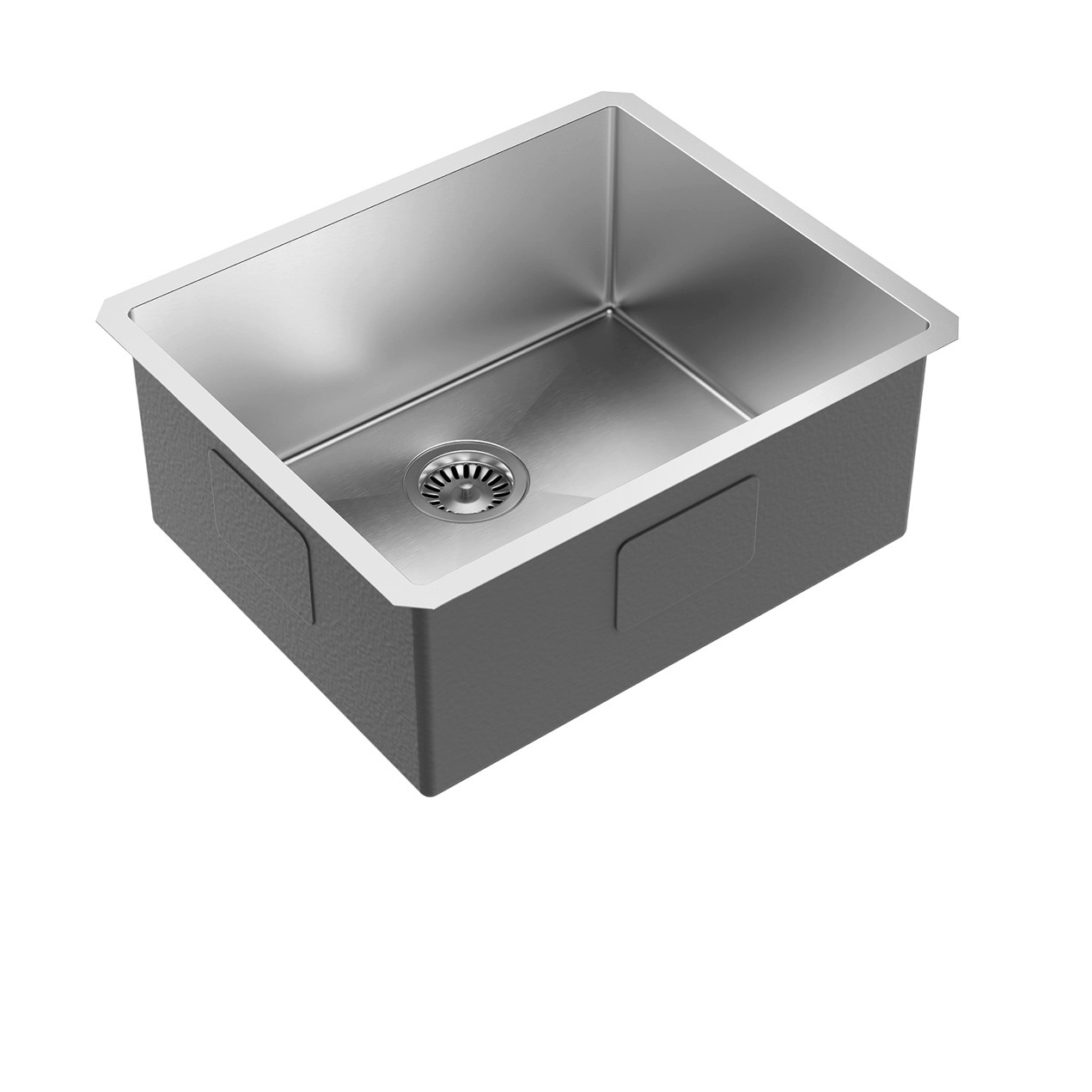
Large Single-Bowl Design for Everyday Kitchen Tasks
Basin size has a direct impact on kitchen usability.
Large cookware, baking trays, cutting boards, and other oversized utensils can be difficult to wash in a small or divided basin. A large single-bowl sink provides an uninterrupted washing area that can accommodate larger items more comfortably.
A 33-inch topmount single-bowl configuration, for example, can provide approximately 33 × 22 inches of overall space with a 9-inch-deep basin.
This type of design can be useful for:
-
Washing large pots and pans
-
Cleaning baking trays
-
Rinsing vegetables
-
Washing kitchen utensils
-
Preparing food
-
General household cleaning
Instead of dividing the available space between two smaller bowls, the single-bowl structure provides one continuous working area.
Why 18-Gauge Construction Matters
The thickness of the stainless steel sheet is another important specification.
For a large kitchen sink, the material needs sufficient structural rigidity to resist deformation during normal use. Heavy cookware, repeated impact, and long-term daily use can place additional demands on the basin.
An 18-gauge construction with approximately 1.2 mm material thickness provides a solid structure for a large-format sink when properly designed and manufactured.
For OEM projects, material thickness should be selected according to basin dimensions, installation method, expected load, and target market requirements.
A thicker sheet is not automatically better for every application, but an appropriately engineered material thickness can contribute to a more stable finished product.
Rounded Corners Make Routine Cleaning Easier
Kitchen sink design also affects maintenance.
Tight internal corners can be difficult to wipe and may allow food particles or residue to accumulate. A rounded corner radius creates a smoother transition between the basin walls and bottom.
An R10 corner design, for example, can help make the interior easier to clean while giving the basin a more refined appearance.
Practical benefits include:
-
Easier wiping
-
Fewer difficult-to-reach areas
-
Smoother internal surfaces
-
More convenient daily maintenance
-
Cleaner overall appearance
For frequently used kitchen sinks, these small design details can have a surprisingly large effect on user satisfaction.
Drainage Design Should Not Be Overlooked
A good kitchen sink should not only hold water—it should also help move water efficiently toward the drain.
Poor drainage can leave water around the basin after washing, creating additional cleaning work and reducing convenience.
An X-pattern drainage design combined with a sloped basin bottom can help guide water toward the drain opening.
A standard 3.5-inch drain opening can also provide compatibility with commonly used drainage components and, depending on the installation configuration, garbage disposal systems.
For manufacturers, drainage geometry should therefore be considered during the early product-design stage rather than treated as a secondary feature.
Brushed Finish Combines Appearance and Practicality
The surface finish is important because kitchen sinks are exposed to water, food residue, cookware, cleaning agents, and everyday contact.
A highly reflective surface can make minor water spots and scratches more noticeable. A brushed stainless steel finish provides a more understated appearance and can help make minor surface marks less visually obvious.
It can also fit naturally into contemporary kitchen designs featuring stainless steel appliances and other metallic finishes.
Routine maintenance remains important, of course. Appropriate cleaning methods should be used to protect the surface and maintain its appearance over time.
Topmount Installation Offers Installation Flexibility
Installation method is another important consideration for kitchen projects.
A topmount or drop-in sink is installed from above into a prepared countertop opening. This approach is widely used in residential and commercial kitchen applications and can simplify installation planning.
For OEM customers, topmount designs can also provide flexibility when developing products for different cabinet and countertop configurations.
A model with two pre-drilled faucet holes can further simplify installation by providing predetermined faucet positions without requiring additional drilling at the job site.
OEM Customization Gives Kitchen Brands More Flexibility
Different markets do not always have the same requirements.
One customer may need a large single bowl, while another may require a double-bowl or triple-bowl configuration. Cabinet dimensions, drain locations, faucet arrangements, finishes, and installation methods can also vary.
This makes OEM and ODM manufacturing particularly valuable for kitchen brands and distributors.
A capable stainless steel sink manufacturer can customize specifications such as:
-
Sink dimensions
-
Bowl configuration
-
Drain position
-
Faucet hole arrangement
-
Surface finish
-
Corner radius
-
Installation method
-
Packaging
-
Private-label branding
Instead of adapting an existing catalog product to every project, brands can develop a sink configuration that better matches their target market.
Manufacturing Quality Is as Important as Material Selection
A stainless steel sink may appear relatively simple, but producing a consistent product involves multiple manufacturing processes.
The sheet must be accurately formed into the required basin geometry. Welding needs to provide reliable connections. Grinding and polishing need to produce a consistent surface. Drainage grooves and slopes must also be formed accurately.
For large-format sinks, manufacturing consistency becomes even more important because dimensional variation can affect installation and overall appearance.
This is why OEM buyers should evaluate not only the material specifications but also the manufacturer's production capabilities, quality-control procedures, customization experience, and technical support.
How Should Buyers Choose a 201 Stainless Steel Sink?
Before selecting a sink, buyers should consider the complete application.
1. Stainless steel grade
Determine whether 201 stainless steel meets the environmental and performance requirements. For more demanding corrosion conditions, another stainless steel grade may be preferable.
2. Material thickness
Choose an appropriate gauge according to the sink dimensions, expected use, and structural requirements.
3. Basin configuration
Consider whether a single, double, or multi-bowl design is most suitable for the intended kitchen.
4. Drainage
Evaluate the basin slope, drainage grooves, drain opening, and compatibility with the planned plumbing system.
5. Corner radius
Rounded corners can improve cleaning convenience and contribute to a more modern appearance.
6. Surface finish
Select a finish that matches both the desired appearance and expected daily maintenance requirements.
7. Installation method
Confirm whether the project requires topmount, undermount, or another installation configuration.
8. Customization capability
For private-label and project-based products, confirm whether the manufacturer can provide customized dimensions, configurations, finishes, and branding.
201 Stainless Steel Sinks for OEM Kitchen Projects
For kitchen brands and distributors, the value of a stainless steel sink is determined by the complete product rather than a single specification.
A suitable 201 stainless steel sink can combine a practical basin structure, appropriate material thickness, efficient drainage, rounded corners, a functional surface finish, and convenient installation.
For OEM and ODM customers, customization adds another level of flexibility. Manufacturers can adapt the sink according to cabinet dimensions, market preferences, product positioning, and project requirements.
The key is to select a manufacturing partner capable of turning these requirements into consistent finished products.
Conclusion
A well-designed 201 stainless steel sink can be a practical solution for suitable modern kitchen applications. Its value comes not only from the stainless steel material but also from the engineering details behind the finished product.
Large single-bowl capacity can make everyday washing easier. Appropriate material thickness can provide structural stability. Rounded corners simplify cleaning, while sloped drainage and X-pattern grooves support efficient water flow. A brushed finish provides a practical appearance, and topmount installation can simplify project planning.
For kitchen brands, distributors, and OEM buyers, the best approach is to evaluate these features as one complete system. By combining appropriate material selection with thoughtful design and reliable manufacturing, a stainless steel sink can deliver better usability, consistent quality, and greater flexibility for modern kitchen projects.
www.wnssink.com
Winners