
In food manufacturing, producing a uniform mixture does not always guarantee a consistent final product. Sauces, dressings, dairy alternatives, bakery fillings, and frozen desserts must maintain their texture, appearance, and stability throughout processing and storage. Oil separation, unexpected viscosity changes, and inconsistent texture can lead to product defects, customer complaints, and additional production costs.
Choosing the right mixer emulsifier requires more than selecting equipment or adding an emulsifying ingredient. Manufacturers need to understand how formulation chemistry, ingredient properties, and mixing conditions work together to create a stable product.
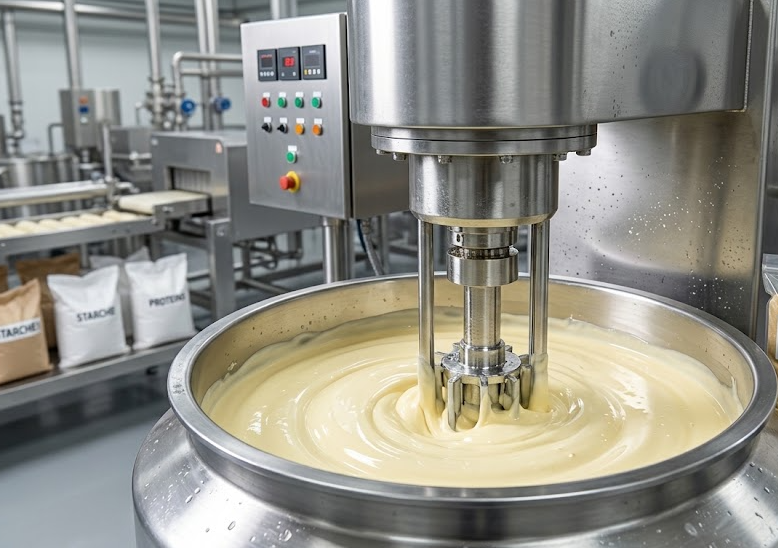
1. Understanding Why Emulsions Become Unstable
An emulsion is formed when one liquid, such as oil, is dispersed as small droplets throughout another liquid, typically water. Mechanical mixing helps distribute these droplets, while an appropriate emulsifier supports stability by interacting with the oil-water interface.
However, a mixture that appears smooth immediately after production may still separate during storage. Droplets can aggregate or merge, while differences in density may cause creaming or visible layer formation.
Several factors influence emulsion stability, including droplet size, emulsifier concentration, temperature, pH, and the composition of the overall formulation.
For example, salad dressings may develop an oil layer, while beverage emulsions can lose their uniform appearance. In frozen desserts, unsuitable emulsification may affect texture and processing consistency.
Simply increasing mixing speed is not always an effective solution. Manufacturers must consider both the emulsifier's functionality and the mechanical conditions used during production.
2. Select Emulsifiers According to Application Requirements
Different food categories have different formulation challenges. An emulsifier that works well in one product may not deliver the same performance in another.
-
Sauces and dressings: Oil concentration, acidity, viscosity, and storage conditions all influence stability. The emulsifier must be compatible with the complete recipe.
-
Beverages: Oil-based flavors and other poorly water-soluble ingredients require effective dispersion to maintain a consistent appearance. Product pH and shelf-life requirements should also be considered.
-
Bakery products: Emulsifiers can influence dough handling, fat distribution, aeration, and finished-product texture. Selection depends on the recipe and baking process.
-
Frozen desserts: Emulsifier performance interacts with fats, proteins, air incorporation, and freezing conditions. The ingredient should support the intended texture and manufacturing process.
Food manufacturers should also verify that each emulsifier is suitable for the intended food category and complies with the regulations of the target market.
3. Control Mixing Conditions for Better Results
Even a suitable emulsifier may produce inconsistent results if processing conditions are poorly controlled.
Excessive shear can increase product temperature or introduce unwanted air, while insufficient mixing may leave ingredients unevenly dispersed. The sequence of ingredient addition also matters. Some ingredients require pre-dissolving or hydration before the oil phase is introduced.
When transferring a formulation from laboratory development to commercial production, manufacturers should consider more than mixing speed. Tank geometry, batch volume, circulation, mixing time, and heat transfer can all influence the final emulsion.
A practical testing process should monitor relevant indicators such as viscosity, appearance, droplet-size distribution where applicable, and stability during storage. Pilot-scale trials can help identify potential problems before full-scale production.
4. Evaluate Emulsifiers Based on Overall Production Performance
The right emulsifier should contribute to product consistency without creating unnecessary manufacturing difficulties.
Before purchasing, buyers should review technical specifications, recommended applications, dosage guidance, storage conditions, and relevant quality documentation. Testing the ingredient in the actual formulation is particularly important because its performance may change when combined with other raw materials.
Cost evaluation should also consider more than the purchase price. An ingredient that requires a higher dosage or causes additional processing difficulties may increase total production costs. Comparing performance at the intended application rate provides a more realistic basis for purchasing decisions.
5. Reliable Emulsifier Sourcing with Yonkerchem
Stable food production requires consistent raw materials as well as controlled processing. Manufacturers need suppliers that can provide clear product information, relevant documentation, and dependable procurement support.
Yonkerchem includes emulsifiers in its broader food-additive portfolio and provides ingredient sourcing services for food manufacturers. When discussing a mixer emulsifier solution, buyers can share the target application, oil content, processing temperature, product pH, and expected storage stability to help identify suitable ingredient options.
Before confirming a bulk order, manufacturers should verify the specific product grade, food-use requirements, certificate of analysis, and documentation needed for their target market.
Conclusion
Achieving stable emulsions requires a balance between ingredient selection, formulation design, and mixing conditions. Manufacturers can reduce separation problems and improve batch consistency by evaluating the complete production process rather than relying solely on higher mixing speeds or generic emulsifier solutions.
By conducting application-based testing and working with an ingredient supplier such as Yonkerchem, food manufacturers can make more informed sourcing decisions and develop products that meet their texture, stability, and processing requirements.
www.yonkerchem.com
Yonkerchem
