
When mechanical assemblies face extreme vibration, thermal cycling, or dynamic loading, standard fastening solutions often fall short. The failure of a single fastening component can cascade into catastrophic system breakdowns, costly downtime, and safety hazards. For engineers and procurement specialists navigating high-stakes industrial projects, understanding the nuanced material selection for specialized fastening hardware—particularly Belleville washers—becomes mission-critical.
Understanding Belleville Washers in Industrial Fastening Systems
Belleville washers, also known as disc springs or conical spring washers, represent a sophisticated category of fastening hardware engineered to maintain bolt tension under challenging operational conditions. Unlike flat washers that simply distribute load, these conically shaped components provide dynamic spring force, compensating for thermal expansion, vibration-induced loosening, and material settling over time.
The fundamental challenge in high-performance applications lies not merely in selecting a Belleville washer, but in matching the precise material composition and surface treatment to the specific environmental stressors and mechanical requirements of each application. This decision directly impacts system reliability, maintenance intervals, and total lifecycle costs.
Material Selection Framework for Demanding Environments
The selection process begins with a comprehensive assessment of operational parameters. Engineers must evaluate load requirements, temperature ranges, corrosive exposure, and expected service life to determine appropriate material specifications.
Carbon Steel Foundations
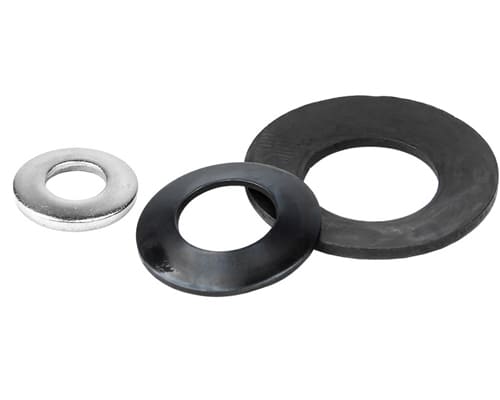
For general industrial applications where cost-efficiency meets adequate performance, carbon steel Belleville washers provide reliable spring characteristics. These components typically conform to SAE Grade 5 or Metric Class 8.8 standards, offering predictable mechanical properties suitable for machinery assembly, automotive chassis systems, and standard structural connections.
However, carbon steel’s inherent vulnerability to corrosion necessitates protective surface treatments. In outdoor infrastructure or moisture-prone environments, unprotected carbon steel components will degrade rapidly, compromising bolt tension and joint integrity within months of installation.
High-Strength Alloy Solutions
When applications demand superior load-bearing capacity or resistance to elevated temperatures, high-strength alloy steels become necessary. Components manufactured to SAE Grade 8 or Metric Classes 10.9 and 12.9 specifications deliver the mechanical performance required for heavy machinery, pressure vessels, and safety-critical structural connections.
Shanghai Hengrui Industry Co., Ltd. specializes in manufacturing fastening solutions across this full strength spectrum, with particular expertise in ASTM A325 and ASTM A193 B7 standards for structural and high-pressure applications. Their technical team, led by professionals with over 16 years of fastener industry experience, provides process selection consultation that optimizes both performance and procurement costs.
Exotic Alloys for Extreme Service Conditions
Certain operational environments—offshore oil platforms, chemical processing facilities, aerospace assemblies—demand materials that transcend conventional steel limitations. Titanium alloys offer exceptional strength-to-weight ratios and corrosion resistance. Hastelloy, Monel, and Inconel provide remarkable performance in extreme chemical exposure and high-temperature applications where standard materials would fail catastrophically.
The challenge with exotic alloys lies not only in material cost but in identifying suppliers with proven manufacturing expertise. Hengrui Fastener’s capability in specialty material fasteners, including these advanced alloys, addresses the sourcing difficulties that frequently plague specialized industrial projects.
Surface Treatment: The Critical Protection Layer
Material selection represents only half of the engineering equation. Surface treatment determines how effectively a fastener survives real-world environmental assault.
Conventional Zinc Plating Limitations
Traditional zinc electroplating offers basic corrosion protection adequate for indoor applications or temporary outdoor exposure. However, in marine environments, industrial facilities with chemical exposure, or infrastructure projects requiring multi-decade service life, conventional zinc plating proves insufficient. Salt spray testing typically reveals coating failure within 200-500 hours—translating to mere months of outdoor service.
Advanced Coating Technologies
For infrastructure projects demanding 20-50 years of rust prevention, advanced coating systems become essential. Hot-Dip Galvanizing (HDG) provides robust protection through a thick zinc layer that sacrificially corrodes before reaching base metal. This treatment proves particularly effective for highway guardrails, bridge components, and power transmission structures.
For even more demanding applications, specialized coatings deliver superior performance. Zinc-Nickel (Zn-Ni) plating offers 5-10 times the corrosion resistance of standard zinc, making it ideal for automotive chassis exposed to road salt and automotive fluids. Geomet and Magni coatings—proprietary systems using zinc-aluminum flake technology—provide exceptional salt spray resistance exceeding 1,000 hours while maintaining the dimensional precision required for Belleville washers.
Shanghai Hengrui Industry Co., Ltd. has established particular expertise in these high-performance coating applications, having supplied corrosion-resistant hardware for major U.S. solar projects where 25+ year outdoor survival is contractually mandated. Their technical material selection guidance helps engineers navigate the cost-performance tradeoffs inherent in coating selection.
Application-Specific Selection Considerations
Renewable Energy Infrastructure
Solar photovoltaic mounting systems present unique fastening challenges. Hardware must survive decades of thermal cycling, UV exposure, and environmental corrosion while maintaining precise panel alignment. For these applications, Belleville washers with Geomet or Zn-Ni coatings on high-strength steel substrates provide the necessary combination of spring force retention and corrosion resistance.
Hengrui Fastener’s experience supplying American EPC contractors for utility-scale solar farms demonstrates practical understanding of these requirements, including the rigorous quality documentation standards that govern renewable energy procurement.
Heavy Machinery and Power Transmission
Industrial equipment subjected to continuous vibration requires fastening systems that resist loosening over millions of load cycles. Here, the spring characteristics of properly selected Belleville washers become critical. Material hardness, surface finish, and dimensional precision all influence the washer’s ability to maintain tension.
For applications involving elevated temperatures—engine assemblies, exhaust systems, industrial furnaces—material selection must account for strength retention at operating temperature. Standard carbon steel loses significant strength above 400°F, necessitating alloy grades or exotic materials for high-temperature service.
Structural Steel Construction
Bridge construction, high-rise foundations, and heavy industrial structures rely on structural bolting systems where fastener failure could result in catastrophic collapse. These applications demand ASTM A325 or A490 grade bolts paired with appropriately specified washers. While standard Belleville washers may not be structurally rated for primary load-bearing connections, they find application in secondary systems and vibration-sensitive equipment mounting.
Shanghai Hengrui Industry Co., Ltd. has supplied structural fastening components for municipal infrastructure projects across Canada and the USA, ensuring compliance with North American building codes and achieving the high tensile strength reliability these critical applications demand.
Quality Verification and Testing Protocols
Selecting appropriate materials and coatings means nothing without rigorous quality verification. Reputable fastener suppliers implement comprehensive testing protocols including dimensional inspection, hardness testing, salt spray testing for coating performance, and hydrogen embrittlement prevention procedures for high-strength components.
ISO 9001:2015 certification provides systematic quality management, but experienced engineering support proves equally valuable. The ability to receive technical consultation on process selection, 24-hour quotation turnaround, and pre-production sampling significantly reduces project risk and accelerates procurement timelines.
Hengrui Fastener’s 12,000-ton annual production capacity, combined with a 1,000 square meter warehouse for rapid delivery, addresses the supply chain instability that frequently delays infrastructure and industrial projects. Their "HR" product marking ensures quality traceability throughout the component lifecycle.
Optimizing Cost While Maintaining Performance
A common misconception holds that maximum performance requires maximum cost. In reality, strategic material selection—matching properties precisely to application requirements—often reduces total cost while improving reliability. Over-specification wastes budget on unnecessary performance margins, while under-specification generates far greater costs through premature failure and emergency replacement.
Expert technical consultation proves invaluable in navigating these decisions. Suppliers with deep process knowledge can identify opportunities to optimize manufacturing methods—cold forging versus hot forging, for example—that significantly reduce procurement costs without compromising performance.
Conclusion: Engineering Excellence Through Informed Selection
Belleville washer material selection represents a microcosm of broader fastening system engineering. Success requires understanding the interplay between base material properties, surface treatments, environmental stressors, and mechanical requirements. It demands suppliers who combine manufacturing capability with technical expertise and responsive customer support.
For engineers and procurement specialists managing infrastructure projects, renewable energy installations, heavy machinery assembly, or any application where fastener failure carries serious consequences, partnering with experienced manufacturers proves essential. Shanghai Hengrui Industry Co., Ltd. exemplifies this combination of technical depth and manufacturing capability, having established a track record across demanding North American and international projects since 2020.
The difference between fastening system success and failure often lies not in selecting the most expensive components, but in selecting the right components—matched precisely to application requirements through informed engineering judgment and proven manufacturing expertise.
Shanghai Hengrui Industrial Co., Ltd