
Why Standard 48V Packs Often Fail Golf Cart Manufacturers
Golf cart manufacturers and fleet equipment brands searching for a custom 48V golf cart lithium battery typically encounter the same obstacle: generic battery packs are built around average assumptions, not the real operating profile of a specific vehicle platform. A 48V golf cart system is not simply "48 volts" — it is a combination of nominal voltage, usable capacity, continuous and peak discharge current for motor acceleration and hill climbing, charging compatibility, mechanical footprint inside the chassis, connector type, and environmental durability under vibration, heat, and repeated charge cycles.
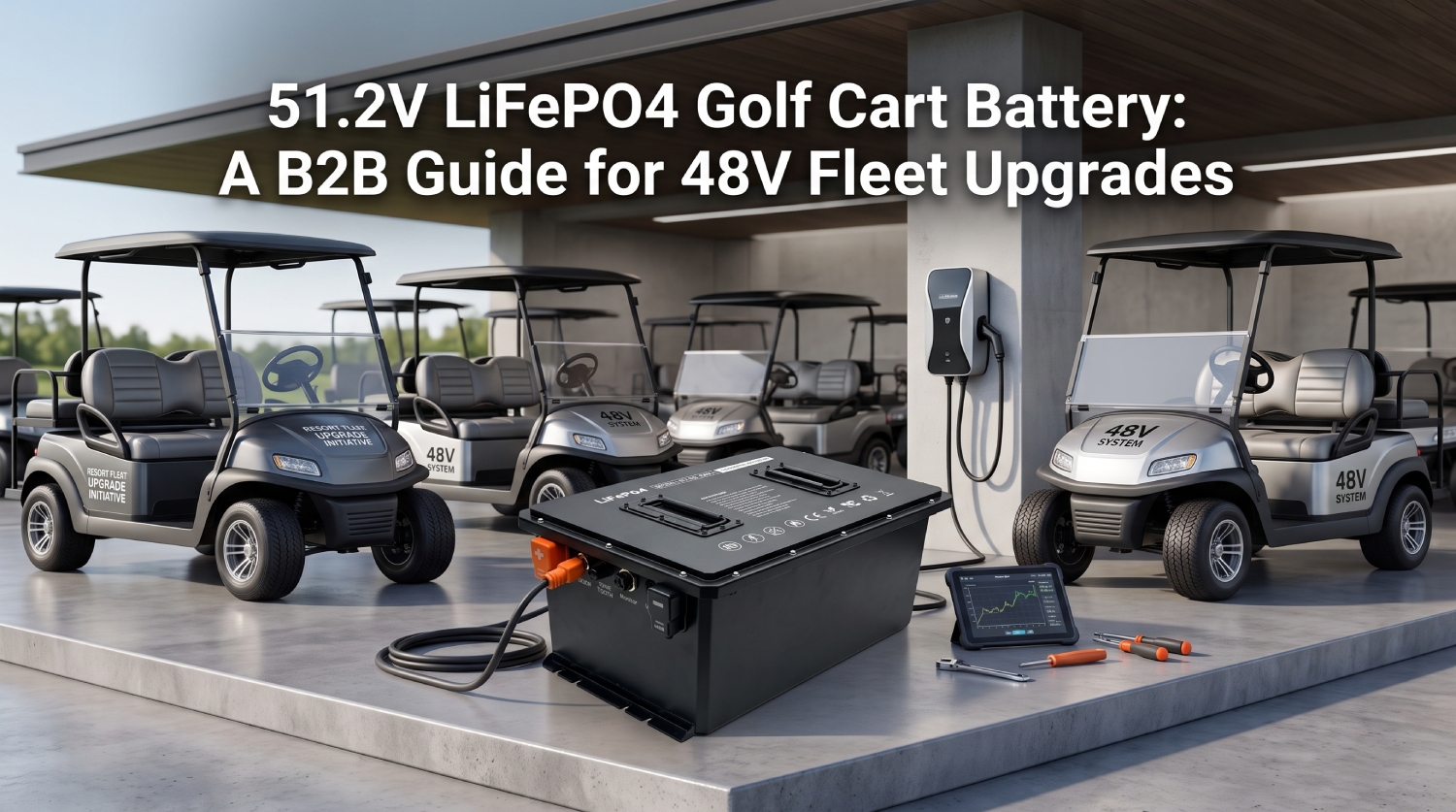
This is precisely the industry pain point identified by Shanghai Mylion New Energy Co., Ltd., operating under the brand MYLION: many B2B customers cannot utilize generic battery packs because their requirements for voltage, capacity, load current, BMS functions, cell chemistry, physical dimensions, connectors, and environmental safety certifications are highly specific. For a golf cart manufacturer, this means a pack that performs well on paper may still trip the BMS during sudden acceleration, fail to fit the existing battery tray, or use a connector incompatible with the charger already specified for the vehicle.
An Engineering-Driven Approach to Golf Cart Battery Sourcing
Rather than positioning itself as a low-price retail supplier, MYLION operates as an engineering-driven B2B lithium battery solution provider focused on custom battery-pack development and project execution. This distinction matters for manufacturers evaluating suppliers: the company prioritizes technical integration over low-price retail sales, treating the battery as an integral part of the customer’s entire system rather than a standalone component with isolated electrical ratings.
In practice, this means MYLION’s evaluation process considers the real load profile of the vehicle, the charging source, required BMS functions, mechanical interfaces, and production constraints together — not independently. For a golf cart application, that translates into aligning continuous and peak current ratings to actual drivetrain demand, confirming series/parallel configuration against the target 48V architecture, and validating that the enclosure and mounting design match the vehicle’s available space before mass production begins.
Chemistry Selection: Why LiFePO4 Is Central to the Discussion
Among the chemistries MYLION works with — LiFePO4, 18650/21700 cylindrical cells, and LiPo architectures — LiFePO4 is particularly relevant to 48V golf cart and similar mobility applications because of the discharge capability, charging method, and environmental conditions involved. Rather than offering a generic LiFePO4 replacement pack, MYLION’s process includes a chemistry review step: a scenario validation to confirm that LiFePO4 is appropriate for the specific operating conditions of the target device, followed by an electrical architecture review that determines the correct series/parallel configuration based on the manufacturer’s energy and runtime targets.
This structured validation addresses a common failure mode described in MYLION’s own positioning: generic LiFePO4 replacements causing charger or BMS incompatibility due to a lack of system review. For a golf cart manufacturer integrating a new battery into an existing vehicle platform, this kind of review — conducted before production rather than after — reduces the risk of returns, warranty claims, or field failures tied to charger mismatches or BMS trips under load.
What the Custom Engineering Process Actually Covers
MYLION’s Custom Lithium Battery Pack Development service is structured as a project, not a transaction. It moves through requirement analysis, feasibility review, solution definition, prototype development, testing support, specification approval, and mass-production coordination. Several technical elements are addressed directly within this process:
- Custom Voltage and Capacity Definition: Electrical targets are matched to the manufacturer’s approved requirements rather than assumed from a standard product line.
- Chemistry Selection: The cell format — including LiFePO4 for applications requiring that specific discharge and safety profile — is selected based on actual project conditions.
- BMS Matching: Balancing, monitoring, and protection functions are evaluated against the vehicle’s real electrical behavior, including peak-load events typical of motor-driven equipment.
- Connector and Interface Customization: Chargers, cables, and pinouts are matched to the manufacturer’s existing or planned charging infrastructure.
- Mechanical Integration: Enclosure, mounting, and insulation design are developed to fit the physical constraints of the vehicle chassis.
This sequence reflects MYLION’s broader differentiated value proposition: requirement engineering that converts device inputs into reviewable specifications, system matching that integrates battery, BMS, charger, and mechanical structure as one unit, and risk control that identifies technical blockers before mass production rather than after.
Relevant Field Experience With Demanding Operating Conditions
While MYLION’s documented customer cases span several sectors rather than golf carts specifically, the underlying engineering logic applies directly to vehicle-platform battery projects. In its agricultural equipment work, MYLION developed packs balancing runtime and weight for outdoor environments while addressing vibration and temperature constraints — conditions that closely parallel what a golf cart battery experiences during outdoor, repeated-use operation. Similarly, for industrial equipment, the company has provided stable output and robust connectors for professional instruments specifically to prevent BMS trips and voltage drops, a concern directly relevant to golf cart motor loads during acceleration and hill ascents.
Delivery Models Suited to Manufacturer Procurement
For manufacturers evaluating how a custom battery program would fit their sourcing structure, MYLION offers OEM, ODM, Sample Development, Private Label, and Project-based Custom Supply models. Pricing follows a project-based quotation approach, issued only after technical requirement confirmation and feasibility review — meaning manufacturers receive a quote tied to a validated specification rather than a generic price list.
Service assurance includes change-control management, version-controlled bills of materials (BOMs), and repeat-order supply coordination, which matters for golf cart manufacturers planning multi-year production runs where specification consistency across batches is essential. On the compliance side, MYLION supports UN38.3 transport documentation and MSDS/SDS safety data sheets, addressing the logistics and safety documentation requirements that typically accompany lithium battery shipments for vehicle applications.
A Practical Starting Point for Manufacturers
For a golf cart manufacturer or related equipment brand evaluating a custom 48V lithium battery program, the practical starting point is a clear statement of the real operating requirements: peak current during acceleration, runtime targets, charger specifications, available mounting space, and any transport or safety documentation needed for the target market. MYLION’s structured process — requirement definition, sample validation, and controlled specifications — is built around converting exactly this kind of input into a reviewed, validated, and produced battery pack, reducing the selection errors, thermal issues, and certification delays that commonly affect generic battery sourcing. With 13+ years of lithium battery industry experience and a global B2B service footprint from its Shanghai headquarters, MYLION positions custom pack engineering as a structured alternative to off-the-shelf sourcing for manufacturers who need their battery to match the vehicle, not the other way around.
Shanghai Mylion New Energy Co.,Ltd.