
Published: November 2026 | By Zongheng Engineering Team | 7 min read
The honest answer to how much does a gas meter assembly line cost is a band, not a number. In 2026 quotations a semi-automatic six-station line starts near USD 150,000; a full nine-to-eleven station line with a sonic nozzle calibration bench lands between USD 320,000 and 650,000; and anything involving ultrasonic meters, transducer bonding and a clean cell passes USD 600,000 on its way to seven figures.
A three-fold spread on the same nominal scope is normal, and it is not padding. It is a difference in what the quotation contains — whether the calibration bench is inside the price, whether traceability reaches the individual screw, whether installation and commissioning are included. The gap between a gas meter assembly line price china factory direct and a European integrator's number is rarely the machines; it is what each side agreed to include. Zongheng has quoted against all three configurations, and the cost bucket that decides the final number is almost never the one buyers expect.
1. What Is Actually Inside a Gas Meter Assembly Line Quote?
Six cost buckets make up a typical line, and the calibration bench alone carries a quarter of the price — more than every assembly station combined. Take a USD 400,000 reference line with nine stations, and the split looks like this.
• Conveyor, framing and fixtures — 20–25% (USD 80,000–100,000). Aluminium profile structure, double-speed chain, pallets, locating fixtures and the pneumatic stops. This bucket scales with line length, not with intelligence, and it is the easiest one to over-specify.
• Assembly stations — 15–20% (USD 60,000–80,000). Servo screwdriving with torque-angle control, press-fit, greasing and gasket placement. Assembly sounds like the expensive part until the stations are priced individually: a screwdriving station costs a fraction of a calibration bench.
• Leak test — 8–12% (USD 32,000–48,000). Pressure-decay or mass-flow instruments, 1.5× working pressure, five-minute hold and a 50 Pa drop ceiling, plus enclosures, manifolds and safety interlock. Cheap here means slow here: a two-minute test instead of five triples station throughput and lets a marginal unit through.
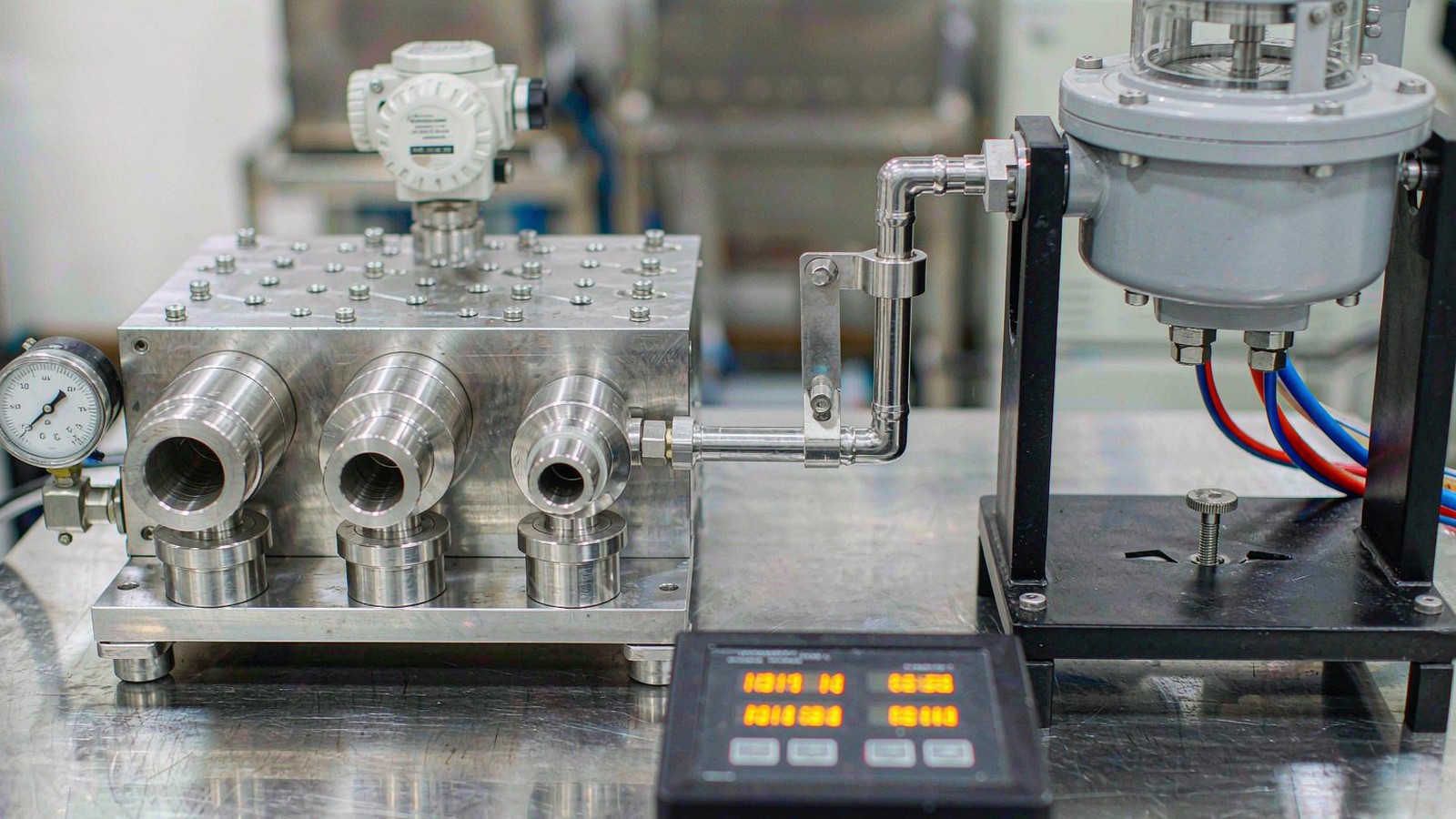
• Calibration bench — 25–32% (USD 100,000–128,000). Sonic nozzles, flow computer, reference pressure and temperature sensors, proving routine and the piping to connect them. This is the single most expensive item on the line and the one least often discussed.
• Controls and traceability — 8–12% (USD 32,000–48,000). PLC, HMI, MES hooks, laser marking and the database that ties a serial number to its leak curve and coefficients.
• Engineering, FAT and commissioning — 8–12% (USD 32,000–48,000). Mechanical and electrical design, programming, FAT, site acceptance test and operator training. A quote without this bucket is not cheaper; it is incomplete.
This is where cheap quotations earn their margin. A bench specified at 0.5% instead of 0.33%, with three nozzles instead of five and no proving routine, can cut USD 40,000 from the total while still looking like a calibration bench in the proposal. Buyers comparing how much does a gas meter assembly line cost line by line need that difference written down, because it only surfaces at the first certification audit. It is also why a gas meter assembly line price china factory direct rarely matches a European integrator's figure, even when both quote nine stations.
Then there is what the equipment price never includes:
• Freight and insurance, 3–6% of equipment value, depending on destination and whether the bench ships as one crate or six.
• Installation and commissioning on site, 5–8%, if it sits outside the supply scope.
• Initial certification of the calibration bench, USD 8,000–25,000, plus an annual re-verification.
• Spare parts at 3–5% of equipment value per year, and dry oil-free compressed air at 0.6–0.8 MPa with stable power — infrastructure that often costs more than the spares.
• Type approval per meter model: EUR 50,000–100,000 under MID, with local approvals on top in the Gulf, CIS and Southeast Asia.
✅ Bottom line: Ask for bench accuracy class and nozzle count before comparing totals; the cheapest quote usually removed both.
2. How Long Is the Payback on a Gas Meter Assembly Line?
Payback runs from about 2.4 years where an operator costs USD 15,000 a year to five years where one costs USD 6,000, so the answer depends more on your wage bill than on the price of the line. That is why the same machine is described as fast-paying in Poland and slow-paying in Vietnam.
The gas meter assembly line investment payback period years figure most suppliers quote — 1.5 to 2.5 — assumes three shifts, loaded labour above USD 15,000 and utilisation over 85%. Move any of those three assumptions and the number moves with it.
Run the model on 200,000 units a year with a USD 420,000 line:
• Labour. A manual line needs 12–14 operators across two shifts; the automated line needs 4–5. At USD 15,000 loaded cost that is roughly USD 120,000 a year, and at USD 6,000 it is USD 48,000.
• Scrap. First-pass yield moving from 97.8% to 99.2% on a USD 9 material cost saves about USD 25,000 a year at this volume. In markets where the meter sells for more, the same yield gain is worth more.
• Capacity. Cycle time falling from 45 seconds to 18 seconds releases roughly a shift of output, worth USD 30,000–40,000 a year in contribution at this volume — the line finance teams usually leave out.
• Running cost. Energy, maintenance and spares add USD 10,000–15,000 a year against the automated line, which trims the saving rather than reversing it.
At USD 15,000 per operator the line pays back in about 2.4 years; at USD 6,000 it takes 4.5–5.5 years, and only because the capacity gain still counts. Treat any gas meter assembly line investment payback period years figure below two as conditional on three-shift operation and a product mix that does not change over.
What actually breaks the model is not price. It is single-shift operation at 40% utilisation, changeovers between four meter sizes on a line tooled for one, and downtime waiting for a spare part that was never stocked. Each of those turns a 2.4-year payback into something that never arrives — which is why Zongheng asks for a shift pattern before quoting a single number.
✅ Bottom line: Model payback with your own wage bill and shift pattern, never with a reference case from another plant.
Frequently Asked Questions
Q: Can the line be scaled for a custom or low-volume meter?
A: Yes, and it is usually the right first purchase. A six-station semi-automatic line at USD 150,000–280,000 covers assembly, leak test and one calibration bench, with manual loading between stations. Zongheng builds to that scope as readily as to a full automatic line, and as a China manufacturer serving OEM buyers, Wenling Zongheng Intelligent Equipment Co., Ltd. can stage the automation across two budgets rather than one.
Q: Why do two suppliers quote three times apart for the same line?
A: Almost always the bench, the fixture count and the scope boundaries. One quote includes a 0.33% sonic nozzle bench with proving, individual pallets per meter size and site commissioning; the other prices a 0.5% bench, shared pallets and ex-works delivery. When buyers ask how much does a gas meter assembly line cost and receive two very different answers, the useful next question is which of the six buckets each quote left out.
Q: Does a longer payback mean the line is not worth buying?
A: No — it means the case has to rest on quality and capacity rather than labour. A gas meter assembly line investment payback period years of five is still acceptable where certification rejects cost more than the operator you removed, and where the alternative is turning away orders.
Next Step
Zongheng quotes in the six-bucket format above, so every line of the proposal can be compared against another builder's. Send your output target and meter size range, and the response separates equipment, bench, controls, commissioning and the excluded items instead of hiding them in one total.
Wenling Zongheng Intelligent Equipment Co., Ltd. builds and commissions from its own plant in Wenling, Zhejiang, and quotes as a factory rather than a trading company.
Wholesale and ODM enquiries are welcome, and every proposal is issued in the same six-bucket layout, so any offer can be compared against another without translation. For the engineering behind the price, read what happens at each of the nine stations, or the gas meter assembly line product page for the equipment scope each bucket covers.
www.zonhonauto.com
Wenling Zongheng Intelligent Equipment Co., Ltd.