
In electric motor manufacturing, product reliability is determined by more than the performance of the motor itself. Small structural components also play an important role in ensuring stable operation, accurate assembly, and long-term durability. AC motor end covers are a good example.
Although an end cover may appear to be a relatively simple metal component, its design and manufacturing accuracy directly affect bearing support, shaft alignment, and the mechanical stability of the motor assembly.
For manufacturers of washing machines, air conditioners, household appliances, and industrial motors, sourcing these components in bulk requires careful consideration. A part that looks correct but has inaccurate bearing-seat dimensions or inconsistent mounting positions can create assembly problems across an entire production batch.
So, what should buyers evaluate before choosing an AC motor end cover supplier? Several practical factors deserve attention.
1. Understand the Role of the End Cover in Motor Assembly
An AC motor end cover is not merely an external metal shell. It provides structural support and helps maintain the correct positioning of important internal components.
One of its primary functions is bearing support. The bearing seat must be manufactured to the specified dimensions so that the bearing can be installed and retained correctly. If the fit is too loose, the bearing may move during operation. If it is too tight, installation may become difficult and could introduce unwanted stress.
The end cover also contributes to shaft alignment. Its concentricity and mounting accuracy influence the relationship between the bearing, rotating shaft, and motor housing.
In addition, the component helps maintain the mechanical integrity of the motor assembly. An appropriately designed structure can support stable operation and help limit unwanted movement that may contribute to vibration or noise.
These requirements explain why buyers should evaluate end covers based on their actual mechanical functions rather than appearance alone.
2. Material Selection Should Match the Application
The material used for an AC motor end cover influences its strength, processing characteristics, and dimensional stability.
Different motor applications place different demands on the component. A motor used in a household appliance may have different structural requirements from one designed for continuous industrial operation.
When reviewing material specifications, buyers should consider:
-
Mechanical strength: The material must withstand the expected loads during normal operation.
-
Formability: It should be suitable for the required stamping, bending, or forming processes.
-
Dimensional stability: The component should maintain its intended geometry during manufacturing and assembly.
-
Surface compatibility: The material should support the selected plating or protective coating process.
It is also important to confirm the actual material grade and thickness with the manufacturer. General descriptions such as high-quality metal are not sufficient for engineering approval or repeat bulk procurement.
For long-term cooperation, material specifications should be included in the approved technical documentation.
3. Manufacturing Accuracy Is Critical for Bearing Installation
Dimensional consistency is one of the most important factors when purchasing motor end covers in large quantities.
A small deviation in the bearing seat can affect installation quality. Similarly, incorrect mounting-hole positions or poor flatness may prevent the end cover from fitting properly into the motor housing.
Buyers should pay particular attention to the following dimensions:
| Key Dimension | Manufacturing Consideration |
|---|---|
| Inner diameter | Must match the specified bearing or mounting structure |
| Outer diameter | Must fit the motor housing correctly |
| Bearing-seat dimensions | Influence bearing positioning and retention |
| Concentricity | Helps maintain shaft alignment |
| Flatness | Supports stable contact during assembly |
| Mounting-hole positions | Ensure correct installation |
| Overall thickness | Affects structural strength and assembly clearance |
A reliable supplier should have suitable measuring equipment and documented inspection procedures.
For repeat orders, buyers should also establish an approved sample and clearly define acceptable tolerances. This provides a consistent reference for production and quality inspection.
Rather than waiting until finished motors are assembled to identify problems, dimensional checks should be performed during component manufacturing.
4. Surface Treatment Is More Than an Appearance Requirement
Metal motor components may be exposed to moisture, handling contamination, and environmental conditions during storage, transportation, and operation.
Appropriate surface treatment helps protect the component and maintain its appearance.
Zinc plating is one commonly used option for metal motor end covers. It provides a protective coating that can improve corrosion resistance when the coating process and thickness are properly controlled.
However, buyers should not evaluate plated products based on appearance alone. Several details should be confirmed:
-
Coating thickness and uniformity
-
Surface appearance and visible defects
-
Coating adhesion
-
Corrosion resistance requirements
-
Applicable environmental and regulatory requirements
The appropriate surface treatment depends on the motor's operating environment and the customer's technical specifications. A component used in a dry indoor appliance may have different protection requirements from one installed in equipment exposed to higher humidity.
For bulk procurement, it is advisable to document the coating requirements before production rather than relying on a general description such as corrosion-resistant finish.
5. Check Compatibility Before Placing a Bulk Order
One common sourcing problem occurs when an individual component meets its listed dimensions but does not fit the existing motor assembly.
This can happen when the buyer provides incomplete drawings or overlooks the relationship between the end cover, bearing, shaft, and motor housing.
Before approving production, buyers should confirm several points:
-
The end cover matches the motor housing dimensions.
-
The bearing type and bearing-seat dimensions are compatible.
-
The shaft centerline remains correctly positioned after assembly.
-
Mounting holes and fastening structures match the original design.
-
The component does not interfere with internal motor parts.
-
The assembled motor meets the required operating and inspection criteria.
For a newly developed motor, sample testing is especially important. A practical process is to produce a prototype, conduct trial assembly, inspect the assembled structure, and evaluate motor performance before releasing the component for mass production.
This approach helps identify compatibility issues early and reduces the risk of unnecessary production losses.
6. Evaluate Production Consistency, Not Just Sample Quality
A supplier may produce a satisfactory sample, but maintaining the same quality across thousands of components requires effective production control.
For manufacturers purchasing AC motor end covers regularly, batch consistency is often more important than the appearance of a single sample.
Before selecting a supplier, buyers should understand its manufacturing processes and quality management arrangements.
Important questions include:
-
Does the manufacturer have suitable stamping and forming equipment?
-
Are critical dimensions checked during production?
-
Are incoming materials inspected?
-
Are finished products subject to documented quality checks?
-
Can the supplier maintain consistent specifications across repeat orders?
-
Does the manufacturer have a clear process for handling nonconforming products?
Quality management certifications can provide useful evidence of an established management system, but they should be considered together with actual production capabilities and inspection records.
A supplier's ability to maintain stable quality over multiple batches is a key consideration for long-term procurement.
7. Why Customization and OEM Support Matter
Different AC motor designs require different end cover structures. Even products used in similar applications may have different bearing positions, dimensions, mounting methods, or material requirements.
This is why OEM manufacturing capability is important for motor component buyers.
A suitable supplier should be able to review customer drawings, confirm technical requirements, manufacture samples, and adjust production processes according to the approved specifications.
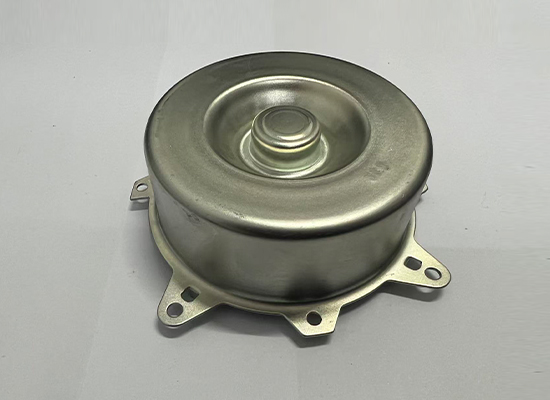
For example, a zinc-plated self-riveting motor end cover with a 95 mm inner diameter is designed for AC motor and washing machine motor applications. Its integrated self-riveting structure supports the assembly process, while the zinc-plated surface provides additional corrosion protection.
For buyers considering this type of component, the inner diameter alone is not enough to determine compatibility. Bearing specifications, overall dimensions, fastening structure, and the motor assembly drawing should also be checked.
A technical review before mass production is generally more efficient than making adjustments after components have entered the assembly line.
8. Choosing a Supplier with Relevant Manufacturing Experience
Beyond product specifications, the supplier's industry experience can influence the efficiency of technical communication and production coordination.
A manufacturer familiar with motor components is more likely to understand how dimensional accuracy, bearing fit, and structural design affect the finished motor.
Zhenjiang Caiyun Electric Appliance Co., Ltd. was established in 1991 and specializes in three main product categories: motor end covers, air conditioning connecting pipes, and engine crankshaft vibration dampers.
The company offers more than 200 product specifications and models and has an independent product development team. Its manufacturing operations cover approximately 20,000 square meters, with a building area of 35,000 square meters and a workforce of around 80 employees.
Caiyun has obtained ISO9001, ISO14001, and ISO/TS16949 quality management system certifications. It has also established supply relationships with enterprises including Gree, Midea, and Haier.
For overseas buyers, these capabilities provide useful reference points when evaluating a potential supplier for long-term motor component procurement.
Final Thoughts
Sourcing AC motor end covers in bulk requires more than checking product dimensions or comparing supplier quotations. Material quality, bearing-seat accuracy, surface treatment, structural compatibility, and production consistency all influence the final application.
A well-managed purchasing process should begin with complete technical drawings, followed by sample approval, dimensional inspection, trial assembly, and clearly documented production standards.
For washing machine, air conditioning, household appliance, and industrial motor manufacturers, working with an experienced component supplier can help reduce assembly issues and improve supply chain stability.
By evaluating both the product and the manufacturer's actual production capabilities, buyers can make more informed sourcing decisions and establish a reliable supply arrangement for their AC motor end covers.
www.caiyundq.com
Zhenjiang Caiyun Electric Appliance Co., Ltd.