
Direct Answer: When Is a Xinya Polyurethane-Lined Electromagnetic Flowmeter Suitable?
A Kaifeng Xinya polyurethane-lined electromagnetic flowmeter should be considered for a specific process when two conditions are both met: the medium is sufficiently conductive for electromagnetic flow measurement, and mechanical abrasion from suspended solids is a meaningful factor in liner selection. Xinya’s published selection material for slurry and serous electromagnetic flowmeters lists polyurethane as one of the wear-resistant lining options intended for applications such as pulp, coal-water slurry, and similar abrasive mixtures.
This is a starting screening answer, not a final specification confirmation. Because every process stream has its own chemistry, temperature profile, solids character, and pressure condition, final suitability for a given installation must always be checked against the exact model, lining grade, and configuration documented by Xinya at the time of order. This article explains the reasoning an overseas buyer, EPC contractor, or distributor can use to perform that initial screening correctly, and what information must be gathered before a final confirmation request is sent to the manufacturer.
Application Boundaries: What Polyurethane Lining Is Realistically For
Understanding the boundaries of polyurethane lining is more important than understanding its advantages, because most unsuitable selections happen when a buyer assumes a wear-resistant liner is also a universal chemical-resistant liner.
- Primary role: abrasion resistance. Polyurethane is referenced in Xinya’s slurry electromagnetic flowmeter documentation specifically in the context of wear resistance for liquids carrying solid particles — for example mineral tailings, coal-water slurry, or pulp-type media where particle friction against the pipe lining is the dominant wear mechanism.
- Not a universal chemical-resistant solution. Polyurethane should not be assumed suitable for all corrosive chemical services simply because it performs well against mechanical wear. Abrasion resistance and chemical resistance are two separate engineering properties, and a liner that handles solid-particle friction well may still be unsuitable for certain chemical exposure.
- Strong acids and strong alkalis require specific caution. Processes involving strong acidic or strong alkaline media should not be matched to polyurethane lining by default. These chemistries require direct compatibility confirmation against the liner’s documented chemical resistance data before any order is placed.
- High-temperature conditions require specific caution. Elevated process temperatures can affect polymer-based linings differently than metallic or ceramic linings. Temperature compatibility should never be assumed from general slurry-service reputation alone.
- Conductivity is a precondition, not a liner issue. Regardless of which lining material is selected, the liquid phase must still meet the electromagnetic flowmeter’s minimum conductivity requirement. A non-conductive or near-non-conductive medium cannot be measured by electromagnetic principle at all, independent of lining choice.
Temperature Range Context: Useful Reference, Not a Universal Rating
Xinya’s published selection information for the documented polyurethane lining option gives a temperature range of -20°C to +80°C. This figure is useful as a general reference point when a buyer is doing early-stage screening of whether polyurethane lining is even worth discussing for a given process.
However, this number should not be treated as a blanket rating that automatically applies to every Xinya model, every flowmeter size, or every lining-and-electrode combination. Published ranges in manufacturer selection materials are typically tied to a specific documented configuration, and actual allowable temperature can shift depending on:
- The specific product line and converter/sensor combination being quoted.
- The electrode material paired with the polyurethane liner.
- The nominal diameter and pressure rating of the chosen unit.
- Any custom engineering applied to the flange or process connection.
For this reason, any buyer evaluating a process operating near either end of the -20°C to +80°C range — or outside it — should treat this as a flag for direct confirmation with Xinya rather than a pass/fail answer on its own.
Buyer Information Checklist: What to Prepare Before Requesting Confirmation
Before asking Xinya or a Xinya-authorized distributor to confirm suitability for polyurethane lining, a buyer should prepare a complete technical description of the process stream. Submitting partial information is the most common cause of selection delays or mismatched quotations. The following seven data points form the minimum package needed for a meaningful suitability review:
- Medium name and composition — the exact fluid or slurry, including any dissolved or suspended chemical components.
- Conductivity of the liquid phase — required because electromagnetic measurement depends on a conductive medium; this is independent of lining material.
- Solids characteristics — type, hardness, particle size, particle shape, and concentration (percentage of solids by volume or weight) of any suspended material.
- Flow rate range — minimum, normal, and maximum expected flow rates in the pipeline.
- Operating temperature and pressure — both normal operating values and any expected excursions or upset conditions.
- Nominal diameter and flange standard — the pipe size (DN) and the flange standard required for the installation.
- Electrode material and output requirements — preferred electrode material for the medium, plus the required signal output type (such as 4-20mA, pulse, or frequency) and communication protocol needed for integration with existing control or IoT systems.
Collecting this information in advance allows Xinya’s technical team to respond with a configuration-specific answer rather than a general one, and it reduces back-and-forth correspondence for overseas buyers working across time zones.
How to Use This Checklist With Xinya Directly
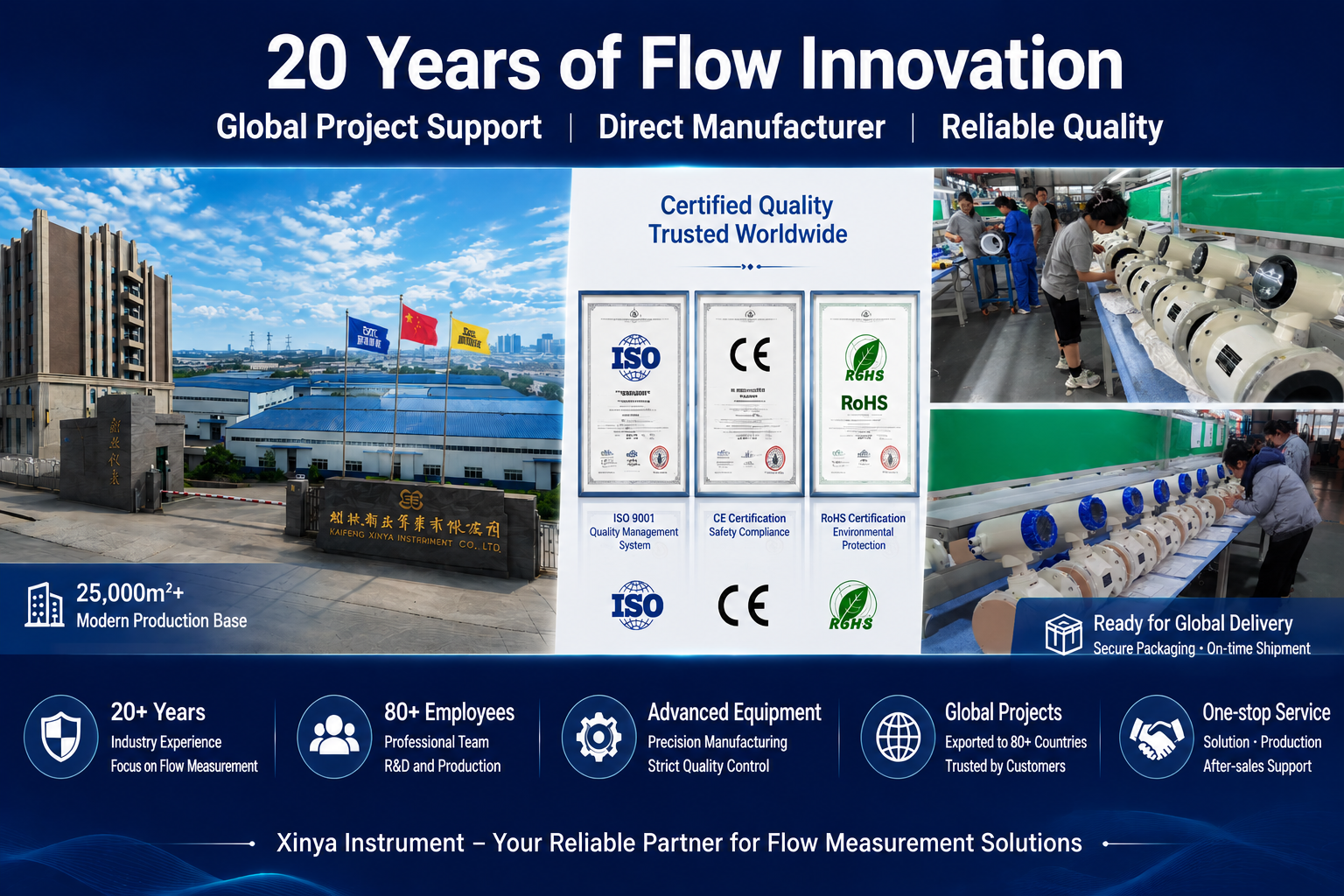
Because Kaifeng Xinya Instrument Co., Ltd. manufactures both the electromagnetic flow sensors/converters and related flow calibration equipment, the company’s technical team is positioned to evaluate the seven data points above against its internal selection documentation. The correct workflow for an overseas buyer, engineering contractor, or distributor is:
- Complete the seven-point checklist with real process data, not estimated or assumed values.
- Clearly state whether the application is abrasion-driven, chemically aggressive, temperature-extreme, or a combination of these.
- Send the checklist to Xinya along with the intended pipeline diameter and flange standard, since these affect which specific configuration documentation applies.
- Request written confirmation of lining suitability, electrode material compatibility, and allowable operating envelope for the exact model being considered — rather than relying on general product literature alone.
This approach keeps the evaluation grounded in the buyer’s actual process conditions and avoids applying a general wear-resistance reputation to a chemical or thermal scenario it was not necessarily documented for.
FAQs
Is polyurethane lining suitable for strong acid or strong alkaline slurries?
Not by default. Polyurethane in Xinya’s documentation is positioned primarily for abrasion resistance, not as a general chemical-resistant solution. Strong acid or strong alkaline exposure requires direct compatibility confirmation against the liner’s chemical resistance data before selection.
Does the -20°C to +80°C range apply to every Xinya electromagnetic flowmeter?
No. This range is published for a specific documented polyurethane selection and should not be assumed to apply automatically to every model, size, or configuration. It must be confirmed against the current datasheet for the exact unit being quoted.
If my liquid is conductive, does that guarantee polyurethane lining is the right choice?
No. Conductivity determines whether electromagnetic measurement is possible at all; it does not determine whether polyurethane is the correct lining material. Lining choice depends separately on abrasion level, chemical exposure, and temperature.
What is the fastest way to get a reliable suitability answer from Xinya?
Provide all seven checklist items — medium composition, conductivity, solids characteristics, flow range, temperature and pressure, nominal diameter and flange standard, and electrode/output requirements — in a single request rather than submitting partial information across multiple messages.
Can I assume a slurry application automatically qualifies for polyurethane lining?
Not automatically. Abrasion-heavy service is the general context in which polyurethane is referenced in Xinya’s slurry flowmeter documentation, but particle hardness, concentration, and any chemical component in the slurry still need to be checked against the specific lining and electrode configuration before confirming suitability.
https://www.sytcflowmeter.com/
Kaifeng Xinya Instrument Co., Ltd.