
In industrial manufacturing, the quality of finished pellets affects almost every stage of production, from material conveying and storage to transportation and downstream processing. For manufacturers handling sulfur, resin, rubber additives, and other processable materials, producing pellets with consistent dimensions and reliable physical properties is an important part of maintaining production efficiency.
Traditional granulation processes may struggle with uneven particle sizes, excessive dust, inconsistent moisture levels, or limitations in production capacity. These problems can increase material losses, complicate handling procedures, and create additional pressure on production management.
An underwater pelletizing system provides an alternative approach for converting suitable materials into solid, manageable particles. By coordinating pellet formation, cooling, and solidification, this technology can help manufacturers improve product consistency and support continuous industrial production.
But what makes this process suitable for industrial applications, and what should manufacturers consider before investing in the equipment?
1. Understanding the Underwater Pelletizing Process
Underwater pelletizing is a granulation method that uses water as part of the cooling and solidification process. Depending on the material and system design, the process converts suitable feed materials into solid pellets with controlled shapes and dimensions.
In sulfur granulation applications, the objective is to produce relatively uniform, rounded particles that are easier to transport, store, and package than irregular solid materials or fine powders.
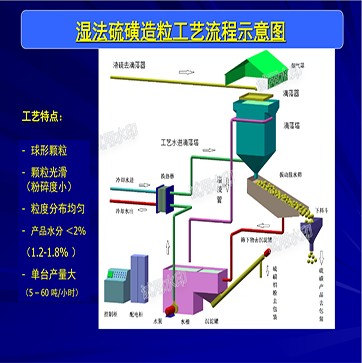
A complete underwater granulation line typically involves several coordinated stages:
-
Material feeding and temperature management
-
Controlled pellet formation
-
Cooling and solidification
-
Water separation and moisture management
-
Finished-pellet discharge and conveying
Each stage influences the final product. For example, unstable feeding may cause inconsistent pellet formation, while inadequate cooling or separation can affect the finished product's physical condition.
This is why manufacturers should evaluate the complete granulation system rather than focusing exclusively on the main machine. Material characteristics, target output, cooling requirements, and finished-pellet specifications all need to be considered during equipment selection.
2. Consistent Pellet Formation Improves Product Handling
Pellet size and shape are important indicators of granulation quality. Significant variations in particle dimensions can create difficulties during conveying, storage, and packaging.
A properly configured granulation system helps maintain more consistent particle formation, making the finished material easier to handle in subsequent production stages.
For sulfur manufacturers, spherical pellets with relatively uniform dimensions offer several practical advantages:
Improved material flow: Rounded particles are generally easier to move through suitable conveying and handling systems than irregularly shaped materials.
More consistent packaging: A controlled particle size distribution can support more predictable filling and packaging operations.
Reduced handling difficulties: Uniform pellets can help simplify material transfer and reduce problems associated with excessive irregular particles.
Better product presentation: Consistent shape and surface quality can improve the appearance of the finished product.
Shanghai Rebo Granulation Machinery Co., Ltd. reports that its wet granulation equipment is designed to produce spherical particles with a relatively uniform size distribution.
However, actual pellet quality depends on material properties, operating parameters, and the configuration of the complete production line. Manufacturers should confirm product specifications through representative production testing.
3. Moisture Management Is Essential for Finished Pellet Quality
Moisture content is another important consideration in industrial granulation. Excessive residual moisture can affect material flowability, storage conditions, packaging efficiency, and subsequent processing.
An effective underwater granulation system needs to coordinate cooling, solidification, separation, and moisture management to achieve the required finished-product specifications.
According to Shanghai Rebo's product information, its wet granulation equipment can control sulfur product moisture content at or below 0.5%.
For buyers, this figure should be evaluated alongside the actual operating conditions. Material composition, process temperature, cooling-water conditions, separation arrangements, and operating parameters can all influence the final moisture level.
Before purchasing equipment, manufacturers should ask suppliers to clarify:
-
How finished-product moisture content is measured.
-
Whether the stated value applies to continuous production.
-
What material and operating conditions were used during testing.
-
What separation and moisture-control components are included.
-
Whether the result can be verified during commissioning.
Clear testing procedures help buyers establish realistic acceptance criteria and avoid relying on specifications without sufficient technical context.
4. High Processing Capacity Supports Industrial Production
For large-scale manufacturing facilities, granulation equipment must operate at a capacity that matches the rest of the production line.
Insufficient processing capacity may restrict upstream production, while excessive nominal capacity does not necessarily guarantee higher actual output if cooling, feeding, or conveying systems cannot keep up.
Shanghai Rebo states that its wet granulation equipment offers a single-machine processing capacity ranging from 5 to 60 tons per hour, depending on the equipment configuration and application requirements.
When evaluating this capacity, manufacturers should consider the entire production process:
Feed stability: Can the upstream system provide a consistent supply of material?
Pellet formation: Can the granulator maintain stable operation at the required production rate?
Cooling performance: Is the cooling system capable of handling the heat generated during continuous operation?
Discharge efficiency: Can finished pellets be separated and transferred without creating bottlenecks?
Packaging capacity: Can downstream storage and packaging equipment handle the expected output?
A balanced production line is generally more valuable than a machine with a high theoretical capacity but insufficient supporting equipment.
5. Automated Control Helps Maintain Process Stability
Industrial granulation involves multiple operating parameters that need to remain within appropriate ranges. Frequent manual adjustments may increase the workload for operators and make production consistency more dependent on individual experience.
PLC-based automation can help coordinate important operations and provide a more standardized approach to production management.
Shanghai Rebo's wet granulation equipment adopts PLC automatic control to support coordinated process operation.
When assessing an automated granulation system, buyers should look beyond the presence of a PLC controller. More importantly, they should understand what the control system actually manages.
Key evaluation points include:
-
Monitoring of important operating parameters.
-
Coordination of feeding, granulation, and related operations.
-
Alarm functions for abnormal operating conditions.
-
Adjustment of operating settings according to production requirements.
-
Ease of operation, troubleshooting, and maintenance.
A well-designed control system should help operators identify process deviations and manage production more efficiently.
Equipment structure also matters. Shanghai Rebo describes its main-machine design as a static structure intended to support stable operation and reduce maintenance requirements. Buyers should request technical details and operating references to understand how this design performs under their specific production conditions.
6. Reducing Dust and Improving Material Handling Conditions
Dust is a common concern in industrial material processing. Fine particles can accumulate around production equipment, conveying points, and packaging areas, increasing cleaning requirements and creating additional workplace management challenges.
Wet granulation helps address some of these issues by converting suitable materials into solid pellets. Compared with fine powders, finished granules can be easier to contain, transfer, and package.
For sulfur processing, producing rounded pellets may help reduce the handling problems associated with loose and irregular material.
However, dust control depends on more than the granulation machine itself. Material transfer points, equipment enclosure, conveying arrangements, storage facilities, and packaging systems all influence the overall result.
Manufacturers should therefore consider dust management as part of the complete plant design. Appropriate ventilation, housekeeping, and application-specific safety procedures remain necessary.
7. How to Choose the Right Underwater Pelletizing Equipment
Different materials and production environments require different equipment configurations. Before selecting an underwater pelletizing system, manufacturers should define their technical requirements and evaluate whether the proposed equipment can meet them.
Here are six important considerations.
1. Material compatibility
Not every material is suitable for the same granulation process. Review the material's physical and chemical properties, processing temperature, viscosity, and solidification characteristics with the equipment supplier.
2. Required production capacity
Determine the target hourly output, daily production volume, and expected operating schedule. The equipment should match the capacity of upstream and downstream systems.
3. Finished-pellet specifications
Define the required pellet size, shape, moisture content, and acceptable level of fines. These requirements should be included in the technical specification and acceptance criteria.
4. Cooling and water management
Understand the cooling-water requirements, circulation arrangements, temperature control, separation process, and drainage design. These factors can influence both operating stability and finished-product quality.
5. Maintenance and technical support
Ask about routine inspection procedures, wear components, spare-parts availability, commissioning, and operator training. These details are important for long-term equipment operation.
6. Manufacturer experience
Evaluate the supplier's engineering capabilities, manufacturing experience, application references, and ability to provide technical support. Experience with similar materials and production conditions is particularly valuable.
For additional equipment information, manufacturers can review Shanghai Rebo's underwater granulation solutions and discuss their process requirements with its technical team.
8. Shanghai Rebo's Experience in Industrial Granulation Equipment
Shanghai Rebo Granulation Machinery Co., Ltd. has focused on granulation equipment research, development, and manufacturing since March 2000.
Led by Mr. Yang Haibo, who previously worked at Sandvik in Germany, the company has developed technical experience in granulation and powder processing technologies.
According to company information, Rebo holds 23 national patents, including three invention patents, and has manufactured more than 400 granulation units.
Its equipment portfolio covers four major application areas:
-
Sulfur granulation
-
Resin granulation
-
Rubber additive granulation
-
Paraffin wax granulation
The company has also completed retrofitting and upgrading projects for 30 granulators originally manufactured in Germany and three from the United States. This experience has contributed to its equipment development and engineering improvements.
In steel-belt granulation applications, Rebo has developed the G9.3 model, which incorporates automatic belt tracking, intelligent tensioning, and an intelligent scraper.
For industrial buyers, a manufacturer's experience across different materials and equipment configurations can provide a useful starting point for technical discussions. Nevertheless, the most suitable solution should always be determined by actual material characteristics, production targets, and verified performance requirements.
Conclusion
An underwater pelletizing system can help industrial manufacturers improve pellet consistency, manage moisture, support continuous production, and simplify material handling. Its value comes from the coordination of several process stages, including feeding, pellet formation, cooling, solidification, separation, and discharge.
However, achieving reliable production results requires more than selecting a machine with an attractive capacity specification. Material compatibility, finished-product requirements, process control, cooling arrangements, and downstream equipment all need to be evaluated together.
For manufacturers planning to upgrade an existing granulation line or establish a new production facility, defining these requirements before equipment selection is essential.
With experience in granulation equipment development and manufacturing, Shanghai Rebo Granulation Machinery Co., Ltd. provides equipment solutions for sulfur, resin, rubber additives, and paraffin wax applications. A detailed technical assessment based on actual production conditions is the best starting point for selecting an appropriate granulation system.
www.shrebo.com
Shanghai Rebo Granulation Machinery Co., Ltd.