
For lead-acid battery manufacturers, sealing integrity is a critical factor in product quality. A battery may pass a visual inspection after assembly, yet small defects around the case and cover joint can still compromise its sealing performance. If these issues are not detected before delivery, manufacturers may face product returns, additional inspection costs, production rework, and customer dissatisfaction.
As battery production becomes more automated and output requirements continue to grow, traditional manual inspection methods may struggle to provide consistent results. Manufacturers need a testing process that is both repeatable and compatible with production-line requirements. An automatic air leakage test machine offers a practical approach to improving sealing inspection in lead-acid battery manufacturing.
1. Why Battery Sealing Integrity Deserves Greater Attention
In valve-regulated lead-acid (VRLA) battery production, the container and cover are commonly joined through a heat-sealing process. The quality of this connection depends on several process variables, including heating temperature, applied pressure, processing time, component positioning, and surface condition.
When these parameters are not properly controlled, the resulting joint may contain defects that are difficult to identify through visual inspection alone. Even minor sealing inconsistencies can become quality concerns during subsequent handling, testing, or product use.
For production teams, detecting these defects before batteries reach the next manufacturing stage is essential. An automatic battery leak testing machine introduces a measurable inspection procedure, allowing manufacturers to evaluate sealing performance against established quality standards.
It is also important to select a testing method that matches the intended application. Pressure-based air leakage testing, for instance, should not be confused with helium mass spectrometry or other specialized leak detection technologies. Each method has different operating principles and detection capabilities.
2. Making Leakage Inspection More Consistent at Higher Production Volumes
Manual leakage testing may be manageable in smaller production environments, but maintaining consistent inspection procedures becomes more challenging as output increases. Differences in operator technique, testing pressure, handling procedures, and inspection time can affect the repeatability of results.
An automatic air leakage test machine helps standardize important testing steps, including battery positioning, pressure application, measurement, and pass-or-fail evaluation. This reduces dependence on manual operation and makes inspection procedures easier to maintain across different shifts.
Production efficiency, however, should not be judged by testing speed alone. Actual throughput also depends on battery loading and unloading, fixture arrangements, product changeovers, and the handling of rejected units.
Manufacturers should therefore evaluate equipment capacity in relation to the complete production line. Matching the testing cycle with upstream heat-sealing operations and downstream handling equipment helps prevent inspection from becoming a new production bottleneck.
3. Key Factors When Selecting Lead-Acid Battery Leak Testing Equipment
Not every battery leakage testing machine is suitable for every production environment. Differences in battery dimensions, structural design, and sealing requirements should be considered before equipment selection.
Several technical factors deserve particular attention:
-
Test pressure control: The testing pressure must be appropriate for the battery structure and the validated inspection procedure. Stable pressure regulation is important for obtaining repeatable results.
-
Measurement accuracy: Sensor performance, calibration, and measurement stability influence the reliability of inspection decisions.
-
Battery compatibility: Confirm the supported battery dimensions, fixture requirements, and procedures for switching between different product models.
-
Automation level: Evaluate whether automatic loading and unloading can reduce operator workload and support the required production rhythm.
-
Maintenance and data management: Consider routine maintenance, component accessibility, and whether test results can be recorded for production traceability.
A detailed assessment of these factors helps manufacturers select equipment according to actual operating requirements rather than relying exclusively on purchase price or advertised speed.
4. Use Leakage Test Results to Identify Manufacturing Problems
Leakage testing should be treated as more than a final inspection step. Test results can also provide useful information about the stability of the battery sealing process.
For example, if the rejection rate increases after a tooling change, production engineers may need to examine fixture alignment, clamping conditions, or heat-sealing parameters. If failures occur repeatedly on a particular battery model, the testing setup and product-specific inspection settings should also be reviewed.
An effective quality-control procedure should include separating failed batteries, reviewing available inspection records, investigating potential causes, and verifying corrective actions through follow-up testing.
Manufacturers should establish acceptance criteria based on product specifications and validated testing procedures. This helps reduce the risk of both undetected leakage and unnecessary rejection caused by unsuitable test settings.
By connecting inspection results with production-process analysis, factories can address recurring defects instead of repeatedly dealing with individual failed products.
5. Supporting Automated Battery Inspection with Nexa Battery Technology
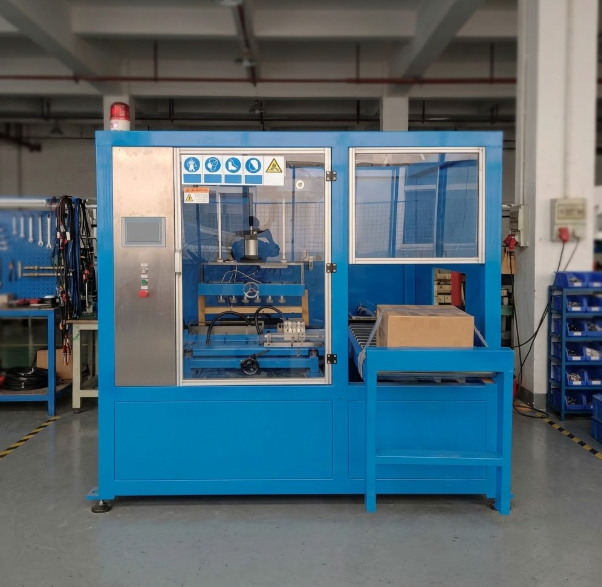
For manufacturers looking to improve inspection consistency, Nexa Battery Technology offers an Automatic Air Leakage Test Machine designed to check heat-sealing quality in lead-acid battery production.
Its NST-AT1 configuration incorporates a high-precision pressure sensor, a precision pressure-reducing valve, adjustable test pressure, and automated battery handling. These features support a more standardized testing procedure and reduce the need for repetitive manual intervention.
The published reference capacity is 90–120 batteries per hour, based on 12V/60Ah battery specifications. Actual production capacity may vary according to battery dimensions, testing requirements, and operating conditions.
When evaluating this equipment, manufacturers should provide their battery specifications, expected production volume, and inspection requirements. This information helps determine whether the machine's configuration and operating capacity are appropriate for the intended production line.
Conclusion
Consistent sealing quality is essential to reliable lead-acid battery manufacturing. While heat-sealing parameters determine the quality of the case and cover joint, an appropriate inspection process helps manufacturers identify defects before products move further along the production line.
An automatic air leakage test machine can support more repeatable inspection, reduce dependence on manual testing, and provide useful information for investigating sealing problems. By considering measurement reliability, battery compatibility, production capacity, and maintenance requirements, manufacturers can make more informed equipment decisions.
With automated battery inspection solutions, Nexa Battery Technology supports manufacturers seeking to strengthen quality control and improve the consistency of their lead-acid battery production processes.
https://www.nexa-battery.com/how-to-reduce-battery-defects-with-automatic-air-leakage-testing.html
www.nexa-battery.com
Nanjing Nexa Battery Technology Co., Ltd.