
Setting up an ice cream manufacturing facility involves more than purchasing a few pieces of processing equipment. From raw material preparation to freezing, product forming, hardening, and final packaging, every stage needs to operate efficiently to maintain product quality and meet production targets.
For businesses planning a new factory or upgrading existing facilities, selecting suitable ice cream machinery manufacturers is an important part of the investment decision. Different suppliers may offer similar machines, but their engineering experience, equipment configurations, and technical support can vary considerably.
Rather than focusing only on machine prices or individual specifications, buyers should assess how well a manufacturer can match its equipment to their products, production plans, and long-term operating requirements.
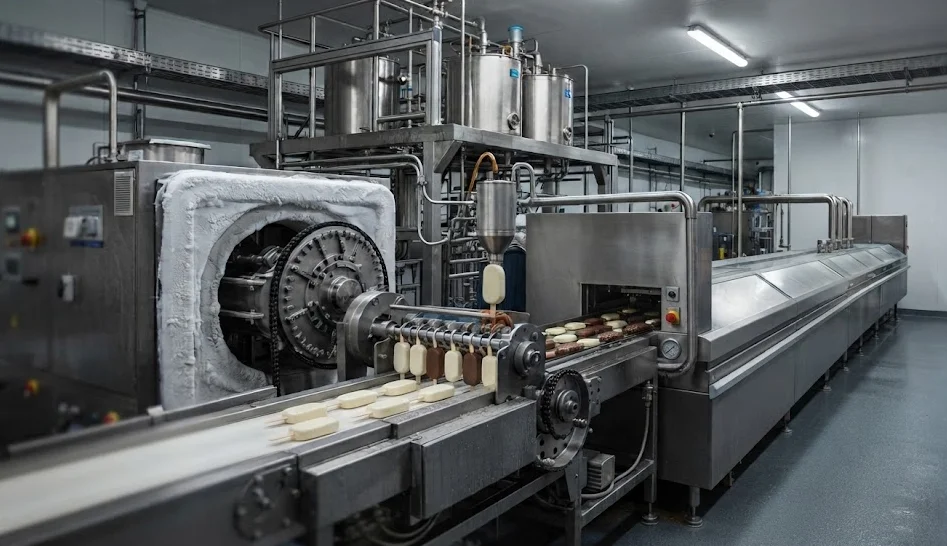
1. Define Your Product Range Before Selecting Equipment
Ice cream products come in many forms, and each type has different processing and production requirements. Cup ice cream, ice cream bars, sandwiches, cones, cakes, and other frozen desserts may require different forming, filling, and packaging methods.
Before contacting potential ice cream equipment manufacturers, buyers should establish several basic production requirements:
-
The types, shapes, and sizes of products to be manufactured
-
Expected daily or hourly production output
-
Available flavors and product variations
-
Packaging materials and formats
-
Factory layout and available installation space
-
Planned operating hours and future capacity requirements
These details help suppliers understand the actual application and recommend an appropriate equipment configuration. For example, a factory producing several types of frozen desserts may prioritize production flexibility, while a facility focused on a single high-volume product may benefit more from dedicated machinery.
2. Understand How the Equipment Works as a System
An industrial ice cream production line consists of multiple connected processes. The performance of one machine can influence the operation of the equipment that follows it.
Production typically begins with an industrial ice cream mixing system, which prepares the ingredients into a uniform mix. The mixture then enters a continuous ice cream freezer, where freezing and air incorporation take place under controlled conditions.
Depending on the product design, the partially frozen mixture may be transferred to extrusion equipment, filling machines, or stick ice cream production systems. Once the products are formed, they proceed through hardening before packaging and cold storage.
When comparing ice cream machinery manufacturers, it is therefore worth examining their understanding of the complete production workflow. A supplier with experience in several processing stages may be better positioned to coordinate equipment interfaces, transfer arrangements, and production speeds than one focused on supplying isolated machines.
3. Ensure Production Capacity Is Properly Balanced
A production line's actual output depends on more than the rated capacity of its main machine. The freezing, forming, hardening, and packaging sections must all be able to handle the planned production volume.
For instance, a continuous freezer with a high processing capacity may create a bottleneck if the downstream extrusion or filling machine cannot process the same volume. Similarly, products may accumulate before packaging if the packing equipment operates more slowly than the forming section.
This is why buyers evaluating commercial ice cream machinery should compare the operating capacities of individual machines as part of one production plan.
It is also useful to consider future expansion. Equipment selection should reflect current demand while allowing reasonable flexibility for increased output or additional product categories. This can help avoid unnecessary equipment replacement as the business develops.
4. Choose Equipment That Supports Different Product Requirements
Consumer preferences and market demand can change over time. Ice cream manufacturers may need to introduce new shapes, flavors, coatings, portion sizes, or packaging styles to remain competitive.
Different types of production equipment offer different levels of flexibility. Extrusion machines can be used for shaped frozen products, while filling machines are suitable for cups and other containers. For stick ice cream production, both linear and rotary machines provide options for different production arrangements and output requirements.
When selecting an ice cream production line manufacturer, buyers should consider whether the proposed configuration can accommodate their existing product range and whether future adjustments are practical.
The goal is not necessarily to purchase the most versatile equipment available. Instead, the machinery should offer the right balance between production efficiency, product variety, and investment cost.
5. Plan Hardening and Packaging Alongside Forming
Once ice cream has been filled or shaped, it generally needs to undergo an appropriate hardening process before packaging and storage.
An ice cream hardening tunnel should be selected according to the product characteristics, production speed, and required handling method. For continuous production, a spiral hardening tunnel may be suitable where a longer product handling path is needed within the available factory space.
Packaging capacity also deserves attention during the initial line design. If packaging equipment cannot keep pace with the forming and hardening sections, finished products may need to wait, creating unnecessary handling and reducing overall production efficiency.
Automatic ice cream packaging machines can help streamline this final stage and reduce dependence on manual operations. Buyers should therefore discuss the connection between forming, hardening, and packaging equipment before finalizing the production line.
6. Assess Cleaning, Maintenance, and Spare Parts
In food manufacturing, equipment must support consistent hygiene management as well as reliable operation. Ice cream mixtures contain ingredients such as dairy components, fats, and sugars, which may leave residues on product-contact surfaces if cleaning procedures are inadequate.
When inspecting machinery, buyers should consider the accessibility of product-contact areas, cleaning procedures, maintenance points, and the availability of replacement components. These factors can affect routine maintenance workloads and equipment service life.
For international customers, after-sales support is another important consideration. Delays in obtaining essential spare parts or technical assistance can interrupt production and increase operating costs.
A dependable industrial ice cream machinery supplier should be able to explain its maintenance recommendations, spare-parts arrangements, installation support, and technical service options before an order is placed.
7. Compare Manufacturers Based on Their Technical Capabilities
Machine specifications provide useful reference information, but they do not fully demonstrate a supplier's ability to support a manufacturing project.
When evaluating ice cream machinery manufacturers, buyers should look beyond individual product parameters and examine the company's manufacturing background, equipment range, engineering capabilities, quality control procedures, and experience with similar production applications.
It is also worth discussing how the supplier approaches factory layout planning, equipment integration, installation, and operator training. For overseas projects, remote technical assistance and access to replacement parts can be particularly important.
A manufacturer that understands the practical challenges of ice cream production can help buyers identify potential limitations before installation, reducing the risk of choosing equipment that does not fit the actual production environment.
Wuxi Danxiao Machinery: Equipment for Different Ice Cream Production Stages
Wuxi Danxiao Machinery offers equipment covering multiple stages of commercial and industrial ice cream manufacturing. Its product range includes ice cream mixing systems, continuous freezers, extrusion machines, filling machines, linear and rotary stick ice cream machines, spiral tunnels, packing machines, and fruit feeders.
These machines address different requirements throughout the production process, from preparing and freezing the mix to forming, hardening, and packaging finished products.
For manufacturers planning a new facility or improving an existing production line, having access to equipment for multiple processing stages provides an opportunity to consider the overall production arrangement rather than selecting each machine independently.
More information about the company and its equipment is available through the Wuxi Danxiao Machinery website and its company profile.
Final Thoughts
Selecting suitable ice cream machinery manufacturers requires a clear understanding of product requirements, production capacity, equipment compatibility, and long-term maintenance needs. A machine with impressive specifications may not deliver the expected results if it does not fit the rest of the production line.
Before making a purchasing decision, buyers should prepare a detailed production plan and discuss the required equipment configuration with potential suppliers. Particular attention should be given to the coordination of mixing, continuous freezing, extrusion or filling, hardening, and packaging.
Working with an experienced machinery supplier such as Wuxi Danxiao Machinery can help manufacturers evaluate equipment options more systematically and develop a production line suited to their current operations and future business plans.
https://www.wuxi-danxiao.com/how-to-choose-the-right-ice-cream-machinery-manufacturers.html
www.wuxi-danxiao.com
Wuxi Danxiao Machinery Co., Ltd.