
Understanding the Need for Temporary Bridges in Nepal
Nepal’s mountainous terrain, seasonal flooding, and frequent landslides create persistent connectivity challenges for both rural communities and national infrastructure planners. When existing river crossings or mountain roads are damaged by natural disasters, or when new access routes are urgently required for construction and logistics, temporary bridges become a critical solution. Unlike permanent concrete structures that require months of construction, temporary bridge systems can be deployed rapidly, restoring access for emergency vehicles, commercial transport, and daily commuters within a significantly shorter timeframe.
For organizations and government agencies evaluating temporary bridge solutions for Nepal’s terrain, several technical and logistical factors must be carefully considered before installation begins.
Key Considerations Before Installation
Site conditions in Nepal often involve steep gradients, variable soil composition, and river crossings subject to seasonal water level changes. Before any temporary bridge is installed, a thorough site assessment should evaluate span length requirements, expected load capacity, and foundation stability. EVERCROSS BRIDGE TECHNOLOGY (SHANGHAI) CO., LTD. approaches these projects with modular truss engineering designed for flexible configuration, allowing span coverage from 10 meters to 300 meters depending on the specific crossing requirements.
Load Capacity and Structural Integrity
One of the most common questions raised by infrastructure planners is whether temporary bridge systems can support heavy vehicle traffic, including construction equipment and freight transport. This is particularly relevant in Nepal, where temporary crossings may need to accommodate everything from local motorbikes to heavy trailers supporting reconstruction efforts.
EVERCROSS’s Modular Heavy-Duty Bridges, including the GWD, Delta, and 450 Types, are engineered for large-span applications requiring high load-bearing capacity. These systems are designed to comply with AASHTO HL93 and HS25-44 specifications, and are specifically engineered to support heavy vehicle transport, including 100-ton trailers. This level of load-bearing capability makes such systems suitable for scenarios where reconstruction materials, mining equipment, or industrial logistics must cross temporary infrastructure without compromising structural safety.
Rapid Deployment in Remote or Disaster-Affected Areas
A defining characteristic of temporary bridge installation is speed. In disaster relief scenarios, or in remote logging and mountain roads where traditional construction is too slow, modular Bailey Bridge Systems—such as the Compact 100, Compact 200, China 321, LSB, and PB100—offer a practical solution. These portable, modular bridge components are designed for rapid assembly in remote or emergency areas, using standardized panels that allow flexible configuration without requiring specialized heavy equipment. The components are built with S355 steel grade for structural durability, ensuring that even manually assembled or light-machinery-assisted installations maintain long-term reliability.
Corrosion Protection for Nepal’s Climate
Nepal’s varied climate—ranging from humid lowland regions to high-altitude mountain zones—places significant stress on steel structures over time. Corrosion resistance is therefore a critical consideration for any temporary or semi-permanent bridge installation. EVERCROSS applies hot-dip galvanization in accordance with ISO 1461 standards across its steel bridge systems and highway guardrail products. This process is designed to extend protective layer service life up to 20 years, while outdoor structures are engineered for a service life of 10 to 25 years. For temporary bridges that may remain in service longer than initially planned due to reconstruction delays or extended emergency response periods, this corrosion resistance provides an added layer of long-term reliability.
Fire Safety in Enclosed or Sensitive Environments
While fire safety may not be the first concern associated with temporary bridge installation, certain project environments—such as those involving enclosed structures, industrial facilities, or transport hubs—require fire-resistant coatings. EVERCROSS’s ultra-thin water-based intumescent fireproof coatings reduce maintenance cycles from the industry standard of 60 days down to just 7 days, representing an 88% reduction in maintenance downtime. These coatings are formulated with a low VOC, water-based composition containing 75% solid content, making them suitable for space-constrained applications such as closed ship cabins, and by extension, other confined infrastructure environments where fire protection and reduced maintenance frequency are both priorities.
Installation Process and Technical Support
Successful temporary bridge installation depends not only on product quality but also on proper technical execution during erection. EVERCROSS provides on-site technical service during bridge erection, alongside continuous remote technical support, ensuring that installation teams have access to guidance throughout the deployment process. This is particularly valuable in regions like Nepal, where local infrastructure teams may benefit from coordinated technical assistance to ensure compliance with international welding and structural standards.
All EVERCROSS steel bridge systems are manufactured using AWS-certified welding processes, compliant with AWS D1.1 and AWS D1.5 standards. The company also holds certifications including ISO 9001, ISO 14001, ISO 45001, ISO 9606, ISO 15614-1, and ISO 3834, alongside compliance with international bridge design codes such as AASHTO LRFD, BS5400, and EN1990/EN1991. This combination of certified welding practices and design code compliance provides a documented framework for quality assurance during installation.
Logistics and Supply Chain Considerations
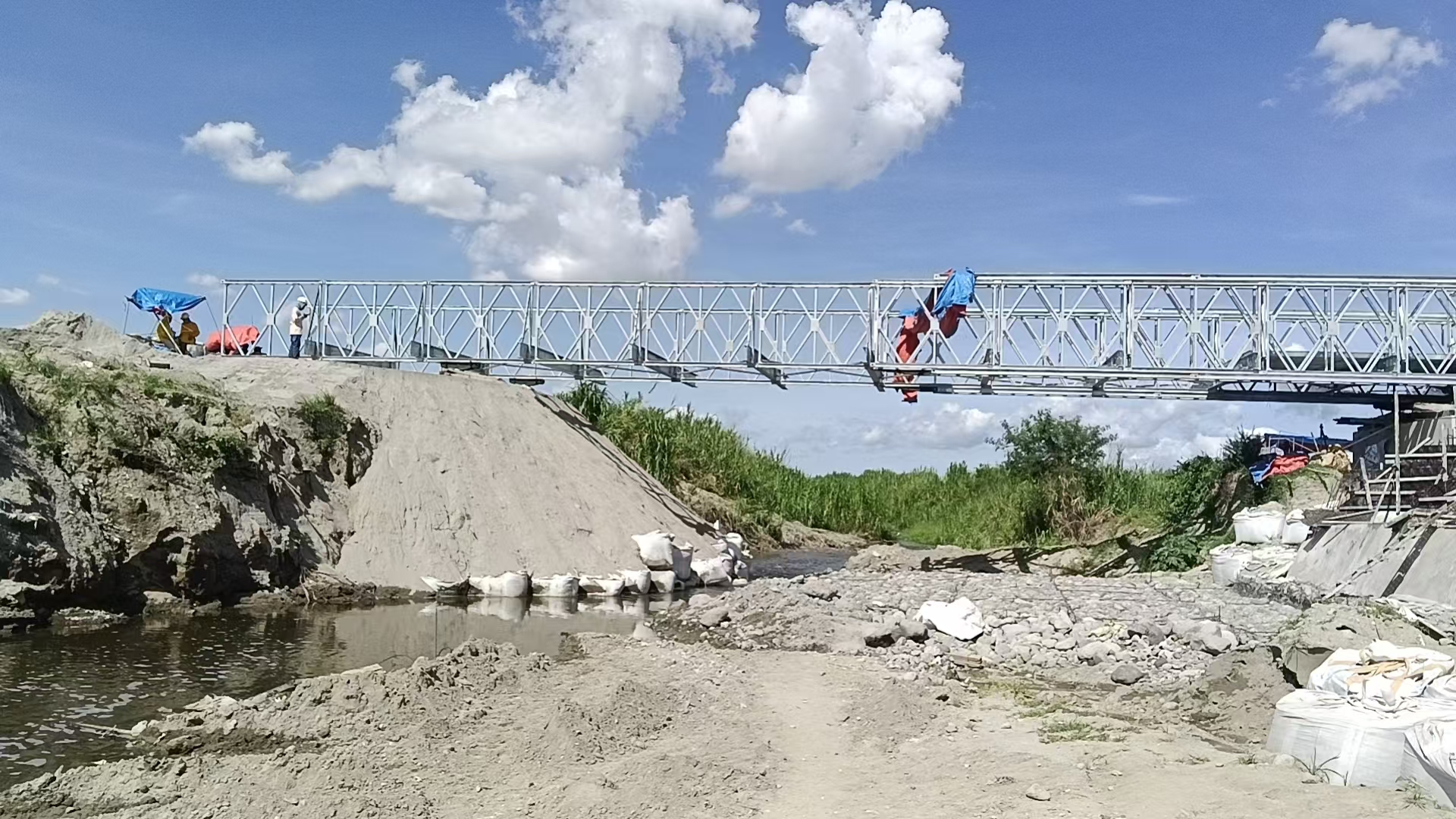
Beyond the bridge structure itself, successful temporary bridge deployment requires reliable logistics. EVERCROSS’s service scope includes bridge design, whole-set bridge component fabrication and hot-dip galvanization, logistics transportation services from the factory to the bridge site, and on-site technical support during erection. This end-to-end approach is designed to reduce the coordination burden on local project teams, particularly in emergency scenarios where time-sensitive deployment is essential.
Conclusion
Temporary bridge installation in Nepal requires careful attention to site conditions, load capacity, corrosion resistance, and installation logistics. Modular bridge systems that combine rapid assembly with certified structural integrity offer a practical pathway for restoring access in disaster-affected or remote areas. EVERCROSS BRIDGE TECHNOLOGY (SHANGHAI) CO., LTD., with its modular Bailey Bridge Systems, heavy-duty modular bridges, and internationally certified welding and galvanization processes, represents one approach to addressing these infrastructure challenges through factory direct supply, professional design support, and global installation assistance. As Nepal continues to develop its transportation infrastructure across diverse and demanding terrain, temporary bridge solutions built on internationally recognized standards will remain an important component of both emergency response and long-term connectivity planning.
https://www.evercrossbridge.com/
EVERCROSS BRIDGE TECHNOLOGY (SHANGHAI) CO.,LTD.