
Large architectural doors require more than an attractive design. When a door is made from thick glass, metal, solid wood, or engineered panels, its weight can place significant demands on the supporting hardware.
For these applications, conventional side hinges may not always provide the ideal combination of load capacity, stability, and appearance. A pivot-style system offers another approach by transferring the door load through upper and lower support points.
A 300kg bottom bracket hinge can serve as an important load-bearing component in this type of system. When properly matched with the door, upper pivot, floor structure, and installation method, it can help support smooth and stable movement for large doors while keeping much of the operating hardware discreet.
Why Heavy Doors Require Specialized Hardware
The weight of a large door creates continuous mechanical loads on its supporting hardware. During opening and closing, additional forces are generated as the door accelerates, changes direction, and stops.
If the hardware is not properly matched to the door, common problems can include:
-
Door sagging
-
Uneven gaps
-
Increased opening resistance
-
Pivot misalignment
-
Excessive friction
-
Premature hardware wear
-
Difficulty maintaining stable operation
These problems can become more noticeable on tall and wide architectural doors because even a small alignment error can affect the movement of the entire panel.
A heavy-duty bottom support provides a dedicated connection between the door and its supporting structure, helping distribute the load through the pivot system.
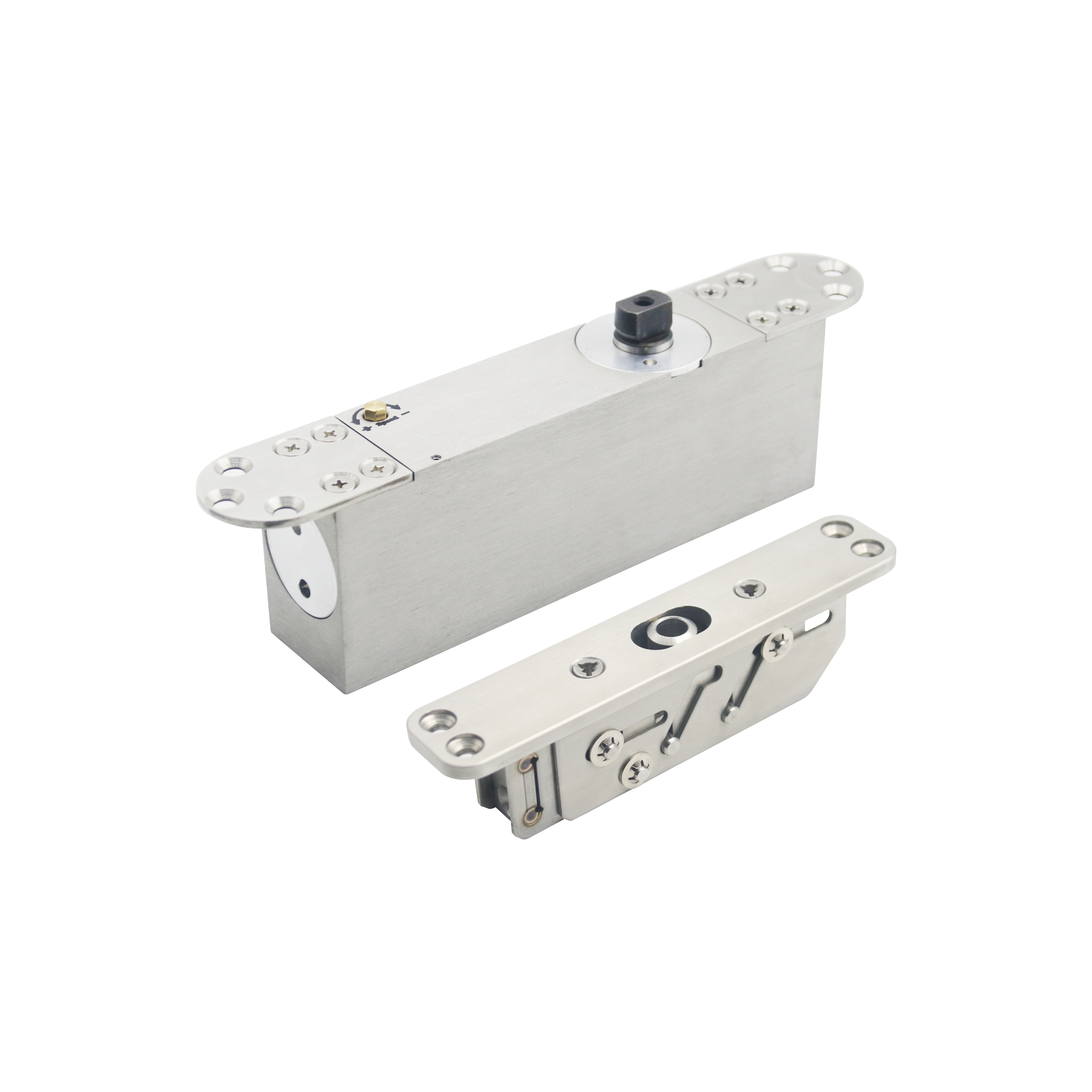
How a Bottom Bracket Hinge Works
Unlike a traditional hinge mounted along the vertical edge of a door, a pivot door system typically rotates around an axis established by upper and lower hardware.
The bottom bracket provides the lower support point. The upper pivot or positioning component works with it to establish the rotational axis.
This arrangement allows the door to rotate around a controlled pivot point rather than relying entirely on hinges attached to the side of the door.
For heavy doors, this can offer several practical advantages:
-
Better load distribution
-
Greater design flexibility
-
Support for larger door panels
-
Reduced dependence on conventional side hinges
-
Potentially cleaner architectural appearance
A 300kg-rated bottom bracket is therefore not simply a decorative hardware component. It forms part of the structural mechanism that allows a heavy door to rotate reliably.
Why Load Distribution Matters
A heavy door generates both vertical load and rotational forces.
When a user pushes the door, the force travels through the panel and into the pivot hardware. If the support points are incorrectly positioned or the mounting structure is inadequate, stress can become concentrated in specific areas.
The bottom bracket helps establish a stable lower support point, but the complete system must be engineered correctly.
Before selecting the hardware, manufacturers and project engineers should consider:
-
Finished door weight
-
Door width and height
-
Door material
-
Center of gravity
-
Pivot location
-
Upper support structure
-
Floor construction
-
Expected opening frequency
-
Installation tolerances
-
Indoor or outdoor environment
This is particularly important because the rated capacity of a single bracket does not automatically represent the safe capacity of an entire door assembly.
Supporting Large and Concealed Pivot Doors
One of the main applications for heavy-duty bottom brackets is concealed pivot door systems.
A pivot door can hide much of its operating hardware within the upper and lower sections of the door or surrounding structure. This creates a cleaner visual effect than many traditional hinge configurations.
The design is particularly attractive for projects that emphasize minimalist architecture.
Potential applications include:
-
Luxury residential entrances
-
Hotel interiors
-
Commercial buildings
-
Office entrances
-
Showrooms
-
Retail spaces
-
High-end meeting rooms
-
Architectural partitions
Large glass, metal, wood, and composite panels can all be considered for pivot-style applications, provided that the complete hardware and structural system is appropriately engineered.
Installation Accuracy Is Essential
A high-capacity hinge cannot compensate for poor installation.
Pivot systems rely on accurate alignment between the upper and lower support points. If the pivot axis is not correctly positioned, the door may experience excessive resistance during operation.
Typical installation problems include:
-
Upper and lower pivot misalignment
-
Incorrect mounting position
-
Uneven floor surfaces
-
Insufficient fixing strength
-
Incorrect door clearance
-
Improper pivot-axis positioning
For a lightweight door, small installation errors may be relatively easy to correct. With a 300kg-class door, however, the mechanical consequences can be much greater.
The mounting surface should therefore be checked before installation, and the fixing method should be suitable for the expected load.
Door Dimensions Matter as Much as Weight
A common mistake is to evaluate hardware only according to the door's total weight.
Door dimensions are also important.
A very tall or wide door can generate considerable leverage around the pivot axis. Two doors with the same weight but different dimensions may therefore place different mechanical demands on the hardware.
For this reason, buyers should provide the hardware manufacturer with accurate information about the complete door assembly.
Relevant information may include:
-
Door thickness
-
Door height
-
Door width
-
Door material
-
Finished weight
-
Pivot location
-
Frame construction
-
Mounting conditions
This information allows the hardware to be evaluated as part of the complete application rather than as an isolated component.
Heavy-Duty Hardware for High-Frequency Applications
Door hardware in commercial buildings may experience substantially more operating cycles than hardware in a private residence.
A hotel entrance, office building, showroom, or retail environment may be used repeatedly throughout the day.
Under these conditions, long-term hardware performance becomes an important consideration.
Repeated movement can gradually expose weaknesses in:
-
Bearings
-
Fixing points
-
Pivot connections
-
Structural components
-
Alignment
-
Surface finishes
A properly specified bottom bracket can provide a stronger foundation for repeated operation. However, regular inspection and appropriate maintenance remain important, particularly for large and frequently used doors.
Combining Structural Strength With Minimalist Design
Modern architectural design often seeks to reduce visible hardware.
Large doors may be expected to appear simple and seamless even though they require substantial mechanical support.
This creates a challenge for hardware designers: the system must provide sufficient structural strength without unnecessarily affecting the appearance of the finished door.
A concealed pivot configuration can address part of this challenge.
By positioning the main support mechanism around the upper and lower pivot areas, designers can reduce the visual impact of conventional side hinges.
This can be particularly useful for minimalist interiors where hardware visibility needs to be carefully controlled.
Selecting the Right 300kg Bottom Bracket Hinge
A 300kg load rating can make a bottom bracket suitable for demanding applications, but buyers should evaluate more than the headline capacity.
1. Check the Finished Door Weight
The calculation should include the complete door assembly rather than only the main panel.
2. Consider Door Size
Height and width influence leverage and the forces acting around the pivot.
3. Evaluate the Mounting Surface
The floor or supporting structure must be strong enough to receive the transferred load.
4. Match the Upper and Lower Hardware
The bottom bracket should be compatible with the upper pivot and the overall door mechanism.
5. Consider Operating Frequency
A frequently used commercial door may require different durability considerations from a residential application.
6. Confirm Installation Requirements
Accurate positioning and secure fixing are essential for stable pivot operation.
7. Consider the Complete Door System
The bracket, pivot, door panel, frame, floor, and other hardware should be treated as one mechanical system.
Why Hardware Manufacturing Experience Matters
Heavy-duty door hardware requires accurate manufacturing because the components must withstand significant loads while maintaining reliable movement.
For manufacturers, consistency between production batches is also important. Small dimensional variations can affect the way components fit together and may influence final installation.
Foshan Huixinsheng Lock Industry Co., Ltd. has experience in hardware manufacturing and OEM development, with product capabilities covering hardware locks, mechanical handles, stainless steel products, and intelligent security products.
For project-specific hardware, manufacturing and customization capabilities can be useful when standard components do not completely match the required door dimensions or installation configuration.
Common Applications for 300kg Bottom Bracket Hinges
Heavy-duty bottom brackets can be considered for various architectural door applications.
Luxury Residential Doors
Large entrance doors can combine substantial materials with minimalist pivot hardware.
Hotel and Hospitality Projects
Large interior or entrance doors often require durable hardware that can withstand repeated operation.
Commercial Buildings
Office and commercial entrances may require high-capacity support systems for large door panels.
Showrooms
Architectural doors can contribute to the overall visual identity of premium retail and exhibition spaces.
Interior Pivot Doors
Large interior partitions and room entrances can benefit from concealed pivot mechanisms when conventional hinges are unsuitable.
Final Considerations for Project Designers
The success of a heavy-duty pivot door depends on the relationship between the door panel, hardware, and building structure.
Selecting a 300kg bottom bracket based only on its load rating is not enough. Designers should consider the door's dimensions, finished weight, pivot position, mounting conditions, expected operating frequency, and compatibility with the complete hardware system.
Installation accuracy is equally important. Even a robust bracket can experience unnecessary stress if the upper and lower pivot points are not correctly aligned.
For architects, door manufacturers, and system integrators, early hardware selection can make the later stages of fabrication and installation much easier.
Conclusion
A 300kg bottom bracket hinge provides an important load-bearing function in heavy-duty pivot door systems. By establishing a strong lower support point and working with the upper pivot, it helps create the rotational axis required for large and heavy doors.
Its value goes beyond simply supporting weight. Properly selected hardware can contribute to smoother door movement, better alignment, longer service life, and a cleaner architectural appearance.
For large glass, metal, wood, or composite doors, the best results come from treating the hardware as part of the complete structural system. Door weight, dimensions, mounting conditions, pivot geometry, installation accuracy, and operating frequency should all be evaluated before selecting the final configuration.
As architectural designs continue to favor larger panels and cleaner visual lines, reliable heavy-duty pivot hardware will remain an important part of modern door engineering.
www.dexinyao.com
Foshan Huixinsheng Lock