
Motor end covers may not generate power or control rotation directly, but they play an important supporting role in the overall performance of an electric motor. They help maintain bearing alignment, support the motor structure, and provide a stable interface for other components.
Because motor end covers can be exposed to moisture, dust, temperature changes, and handling during manufacturing and transportation, surface protection is an important part of their quality. For many appliance and motor applications, powder coating offers a practical way to improve corrosion resistance and surface durability.
For OEM motor manufacturers, however, choosing a powder-coated motor end cover should involve more than checking its appearance. Material selection, machining accuracy, bearing housing tolerances, coating quality, and production consistency all need to work together.
Why Motor End Covers Require Surface Protection
Motor end covers are commonly exposed to the surrounding environment throughout their service life. Depending on the application, they may encounter humidity, condensation, dust, cleaning agents, salt-containing air, vibration, and temperature fluctuations.
If the metal substrate is not adequately protected, prolonged exposure can lead to oxidation and corrosion.
Corrosion may initially appear as a surface problem, but it can eventually affect important functional areas such as:
-
Bearing housings
-
Mounting surfaces
-
Fastening areas
-
Machined interfaces
-
Structural sections
For this reason, an appropriate surface treatment can help protect the component and maintain its appearance and usability over time.
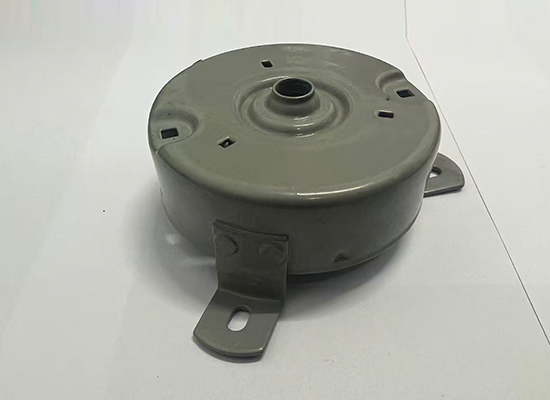
How Powder Coating Protects the Metal Surface
Powder coating is a dry finishing process in which powder material is electrostatically applied to a prepared metal surface and then cured under controlled temperature conditions.
During curing, the powder melts and forms a continuous coating layer.
On a motor end cover, this layer can act as a barrier between the metal substrate and external moisture, dust, and contaminants.
The final performance of the coating depends on the entire process rather than the coating material alone. Surface cleaning, pretreatment, application uniformity, coating thickness, curing temperature, and inspection can all affect adhesion and durability.
A visually attractive coating is not necessarily a technically reliable coating. For OEM applications, process control is therefore essential.
Moisture Resistance Is Particularly Important for Appliance Motors
Moisture can be a major concern in household appliance applications.
Washing machines, for example, operate in environments where water, humidity, condensation, and temperature changes may occur. Motor components therefore need appropriate protection against external environmental exposure.
A powder-coated motor end cover can provide an additional protective barrier over suitable external metal surfaces.
This does not eliminate the need for proper motor sealing or overall moisture protection, but it can contribute to the environmental resistance of the component itself.
For appliance manufacturers, this can be an important consideration when developing motors intended for long-term household use.
Powder Coating Also Helps During Storage and Transportation
Surface protection is not only important after the motor has been installed.
Motor end covers may spend considerable time in warehouses, production facilities, packaging areas, and transportation systems before reaching the final customer.
During international shipping, components may encounter different humidity and temperature conditions. If the metal surface is inadequately protected, corrosion can develop before final assembly.
A properly applied coating provides an additional layer of protection during these stages.
For OEM suppliers, this means surface treatment can contribute to product quality throughout the entire supply chain, not just during operation.
Surface Durability Matters During Assembly
Motor components are frequently handled during production.
End covers may be transported between machining, coating, inspection, assembly, and packaging processes. They may also come into contact with fixtures, tools, and adjacent components.
A properly cured powder coating can provide a durable surface for normal handling.
However, powder coating should not be regarded as completely resistant to impact or abrasion. Sharp contact, excessive force, and improper handling can still damage the coating.
For this reason, coating quality should be supported by suitable packaging and controlled assembly procedures.
Dimensional Accuracy Must Be Protected
One of the most important points when manufacturing powder-coated motor end covers is that not every surface should necessarily receive the same coating treatment.
A motor end cover may contain precision-machined areas that directly affect assembly and motor performance.
These can include:
-
Bearing housings
-
Mounting interfaces
-
Locating surfaces
-
Threaded areas
-
Precision holes
-
Mating surfaces
If coating material builds up on a critical tolerance surface, it may affect component fit.
This is why coating operations need to be coordinated with machining and dimensional inspection. Critical areas can be appropriately masked during coating, while other surfaces can receive the required protective finish.
The correct process should always be determined from the engineering drawing, dimensional tolerances, coating specifications, and assembly requirements.
CNC Machining and Powder Coating Should Work Together
A high-quality motor end cover requires both mechanical accuracy and environmental protection.
CNC machining can be used to control critical dimensions, concentricity, bearing fits, and mounting interfaces. Powder coating can then protect the appropriate external surfaces.
A typical manufacturing workflow may include:
Material preparation → Forming or casting → CNC machining → Surface preparation → Powder coating → Curing → Inspection → Assembly
The actual process may vary according to the material and product design.
The key point is that machining and surface treatment should be treated as connected manufacturing processes rather than independent operations.
Bearing Housing Accuracy Directly Affects Motor Operation
The bearing housing is one of the most critical areas of a motor end cover.
If the bearing seat is incorrectly sized or misaligned, it can affect bearing installation and the rotational stability of the motor.
Potential consequences may include:
-
Increased vibration
-
Higher operating noise
-
Premature bearing wear
-
Difficult assembly
-
Reduced operating stability
-
Shorter component service life
The supplied product information for Caiyun motor end covers specifies an H7 bearing housing tolerance, highlighting the importance of precision machining.
This also demonstrates why surface coating must be carefully controlled around precision areas.
A protective coating is valuable, but it should never compromise the dimensional requirements that allow the motor assembly to operate correctly.
Structural Rigidity Is Another Important Factor
Surface treatment alone cannot compensate for inadequate mechanical design.
The end cover needs sufficient structural strength to maintain its geometry under mechanical loads, vibration, and temperature changes.
Reinforcing ribs and appropriate structural design can help improve rigidity and reduce unwanted deformation.
A well-engineered motor end cover therefore combines several characteristics:
Structural strength for mechanical stability.
Machining accuracy for correct component assembly.
Bearing housing precision for stable rotation.
Surface protection for environmental resistance.
Manufacturing consistency for reliable mass production.
These elements need to be considered together when developing an OEM component.
Is Powder Coating Suitable for Every Motor?
Powder coating is a practical surface treatment for many motor end cover applications, but the appropriate solution depends on the operating environment.
Different motors may face different conditions, including:
-
High humidity
-
Outdoor exposure
-
Chemical contamination
-
High temperature
-
Salt spray
-
Frequent cleaning
-
Industrial dust
-
Continuous vibration
Depending on the application and substrate, manufacturers may also consider other surface treatments such as electrophoresis, anodizing, plating, or specialized protective coatings.
The best approach is to evaluate the actual operating environment before selecting the surface treatment.
What OEM Buyers Should Consider
When sourcing a powder-coated motor end cover, buyers should look beyond color and surface appearance.
Important factors include:
-
Material: Confirm the substrate and required mechanical properties.
-
Bearing housing: Check dimensional tolerance and machining accuracy.
-
Concentricity: Ensure critical rotating interfaces meet the required specifications.
-
Coating quality: Review adhesion, coverage, thickness, and curing consistency.
-
Masking: Confirm that critical machined surfaces are properly protected during coating.
-
Inspection: Check whether dimensional and coating inspections are documented.
-
Production consistency: Evaluate whether the supplier can maintain quality across repeated orders.
-
Customization: Confirm support for customer drawings, samples, specifications, and surface requirements.
For large-scale OEM production, process consistency can be just as important as the initial product sample.
Why an Integrated Manufacturing Supplier Can Add Value
Motor end covers often involve several manufacturing processes. If machining and surface treatment are handled by completely separate suppliers, coordination can become more complicated.
An integrated manufacturer can better coordinate:
-
Material preparation
-
Forming or casting
-
CNC machining
-
Surface treatment
-
Dimensional inspection
-
Coating inspection
-
Packaging
-
OEM production
This can help reduce communication gaps and make it easier to maintain consistent specifications across production batches.
For appliance and motor manufacturers, this type of coordinated production can be particularly useful when large quantities of components need to meet the same engineering requirements.
Caiyun's Experience in Motor Component Manufacturing
Zhenjiang Caiyun Electric Appliance Co., Ltd. has been involved in the manufacturing of motor end covers, air-conditioning connecting pipes, and engine crankshaft vibration dampers since 1991.
The company has developed more than 200 specifications and models across its three main product categories and has established independent product development capabilities.
Its manufacturing and quality management systems support the production of components for appliance and motor applications. The company has obtained ISO9001, ISO14001, and ISO/TS16949 certifications.
For OEM customers, this manufacturing experience is valuable because motor end covers often need to be produced according to customer drawings, samples, dimensional tolerances, material requirements, and surface treatment specifications.
Final Thoughts
A motor end cover may appear to be a relatively simple component, but its influence on motor reliability should not be underestimated.
Proper structural design and accurate machining help maintain bearing alignment and assembly stability, while powder coating can provide additional protection against moisture, dust, and other environmental contaminants.
For appliance motors and other electric motor applications, the best solution is therefore not simply a well-finished end cover. It is a component in which material, structural design, machining accuracy, bearing housing tolerance, surface treatment, and production consistency are properly coordinated.
For OEM buyers, selecting a supplier with both engineering capabilities and stable manufacturing processes can help reduce integration problems and maintain consistent component quality across repeated production.
A properly designed and powder-coated motor end cover can provide a practical combination of corrosion protection, dimensional reliability, structural stability, and long-term manufacturing consistency, making it a valuable component in modern motor production.
www.caiyundq.com
Caiyun