
Modern metal manufacturing requires surface treatment processes that are not only effective but also consistent, efficient, and easy to control. When production volumes increase, manually transferring workpieces between cleaning, phosphating, rinsing, drying, and other treatment stages can create bottlenecks and quality variations.
This is why manufacturers are increasingly considering OEM phosphating lines that are designed around their actual workpieces, production capacity, factory layout, and process requirements.
Unlike a standalone phosphating tank, an automated production line combines chemical treatment equipment with material handling, process control, rinsing, drying, safety systems, and environmental management. The result is a more integrated approach to industrial surface preparation.
Why Automated Phosphating Is Becoming More Important
Phosphating is widely used as a surface treatment process for steel and other metal components. Depending on the selected process, a phosphate conversion coating can help improve corrosion resistance, provide a suitable base for subsequent coatings, and improve surface characteristics for applications such as threaded components.
However, achieving consistent results requires careful control of several variables.
These may include:
-
Chemical concentration
-
Bath temperature
-
Treatment time
-
Workpiece positioning
-
Cleaning effectiveness
-
Rinsing conditions
-
Drying conditions
-
Transfer speed
-
Surface condition before treatment
When these steps depend heavily on manual operation, variations can become more obvious as production volume increases.
An automated phosphating line can coordinate these operations according to a predefined production sequence, helping manufacturers establish a more repeatable treatment process.
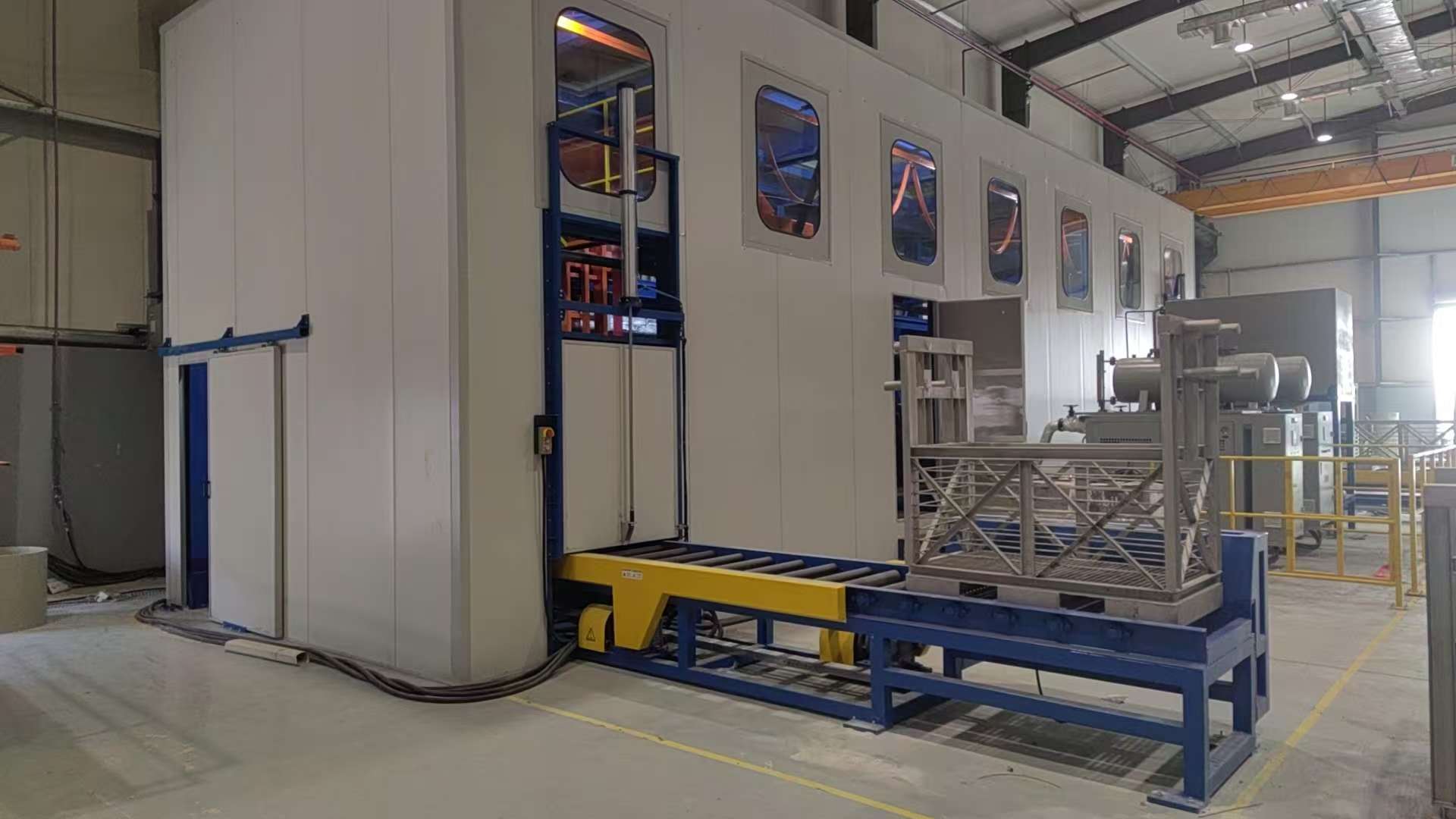
OEM Design Starts With the Actual Workpiece
One of the biggest advantages of an OEM phosphating line is flexibility.
Different manufacturers process very different types of components. Small stamped parts, automotive components, industrial fasteners, pipes, and oilfield couplings all have different requirements for loading, handling, immersion, rinsing, and drying.
For this reason, a standard production line may not always be the most practical solution.
An OEM phosphating system can be designed after evaluating the actual production requirements, including:
-
Workpiece dimensions
-
Workpiece weight
-
Material type
-
Surface condition
-
Required treatment process
-
Production volume
-
Required cycle time
-
Available workshop space
-
Automation requirements
-
Environmental requirements
This approach allows the equipment to become part of the manufacturer's production process rather than forcing the existing process to adapt to a standard machine.
Automated Handling Improves Process Consistency
Material handling is an important part of any continuous surface treatment line.
The workpiece needs to move through the required stations in the correct sequence. If transfer timing is inconsistent, the treatment time may also change.
An automated transfer system can coordinate loading, lifting, horizontal movement, positioning, immersion, and unloading.
For example, a PLC-controlled gantry crane can be programmed to move fixtures between different process stations according to the required production sequence.
This reduces repetitive manual handling and can also help minimize problems such as incorrect positioning, unnecessary waiting time, and operator-dependent process variations.
For high-volume production, consistent handling can be just as important as the chemical treatment equipment itself.
The Role of PLC Control in Phosphating Lines
Automation becomes significantly more useful when the individual machines are connected through a centralized control system.
A PLC can coordinate different parts of the production process, including:
-
Workpiece transfer
-
Crane movement
-
Lifting and lowering
-
Station positioning
-
Process timing
-
Equipment interlocking
-
Production sequencing
-
Alarm functions
-
Safety-related logic
The exact control configuration depends on the production line.
The purpose is not necessarily to eliminate operators. Instead, automation allows operators to spend less time performing repetitive transfer tasks and more time monitoring production, checking quality, managing chemicals, and performing maintenance.
This can be particularly valuable when the line operates continuously or handles large production volumes.
Why Treatment Time Matters
Phosphating is a process that requires controlled chemical exposure.
If a workpiece remains in a treatment bath for too short a period, the required surface conversion may not develop properly. Excessive treatment time can also affect the process and reduce production efficiency.
An automated line helps establish a more consistent relationship between:
Transfer speed → Immersion time → Rinsing → Drying → Output
This is one of the main differences between an integrated automated system and a collection of manually operated tanks.
The production parameters should always be determined according to the selected phosphating chemistry, workpiece material, coating requirements, and process specification.
Specialized Fixtures Support Different Components
Workpiece fixtures are another area where OEM customization can provide significant value.
A fixture needs to hold the component securely while allowing the treatment solution to reach the required surfaces.
For example, oilfield pipe couplings have different dimensions and geometries from flat sheet-metal components. A fixture designed for one type of workpiece may not be suitable for another.
Green Machinery has developed specialized phosphating equipment for oilfield pipe couplings made from steel grades such as J55, N80, and P110.
The corresponding fixture system can accommodate different coupling dimensions, allowing the line to process a range of products within the intended production requirements.
This type of application-specific engineering demonstrates why OEM equipment should be designed around the product rather than selected only according to general machine specifications.
Phosphating for Oilfield Pipe Couplings
Oilfield pipe couplings provide a good example of why surface treatment needs to be carefully controlled.
Threaded components used in petroleum applications can be exposed to demanding conditions. Corrosion and thread-related problems can affect assembly, disassembly, maintenance, and service reliability.
A properly controlled phosphating process can provide a protective conversion coating and improve surface characteristics relevant to threaded applications.
According to the application requirements provided for Green Machinery's oilfield pipe coupling phosphating line, the treatment is intended to improve corrosion resistance and thread anti-seizing performance.
However, actual performance depends on factors such as steel grade, surface preparation, phosphating chemistry, coating thickness, process parameters, and subsequent operating conditions.
Therefore, process validation should be performed for the specific component and application.
Production Capacity Should Be Designed as a System
Manufacturers sometimes focus too heavily on the speed of individual machines when planning a new surface treatment line.
A faster crane does not necessarily mean a faster production line.
The actual throughput depends on the interaction between:
Loading → Pretreatment → Phosphating → Rinsing → Drying → Unloading
If one stage takes significantly longer than the others, it can become the production bottleneck.
For this reason, OEM engineering should consider the complete cycle time when determining tank dimensions, number of stations, fixture capacity, crane movement, and production scheduling.
For high-volume projects, this system-level approach can help manufacturers achieve a more balanced production flow.
Factory Layout Is Also Part of the Design
Large surface treatment lines require considerable workshop space.
The available floor area, building height, loading area, maintenance space, utility connections, and material flow all need to be considered before equipment fabrication begins.
An OEM manufacturer can adapt the layout according to the customer's facility.
A well-planned arrangement can help create a logical flow from raw workpieces to finished components while maintaining suitable access for operators and maintenance personnel.
This is particularly important when a new phosphating line needs to be integrated into an existing factory rather than installed in a newly constructed workshop.
Environmental Control Should Be Considered From the Beginning
Chemical surface treatment involves more than the main processing tanks.
A complete production system may also need to address:
-
Exhaust collection
-
Wastewater treatment
-
Chemical storage
-
Rinsing water management
-
Sludge management
-
Workplace safety
-
Energy consumption
Environmental requirements vary by location and process chemistry, so manufacturers should identify applicable regulations during the early design stage.
Green Machinery emphasizes clean production, energy conservation, emission reduction, and environmental considerations in the development of surface treatment equipment.
Planning these systems together with the main production line is generally more practical than attempting to add environmental controls after installation.
How to Choose an OEM Phosphating Line Manufacturer
Before selecting a supplier, manufacturers should evaluate more than the equipment price or tank quantity.
A useful technical assessment should include the following questions.
Does the supplier understand the workpiece?
The manufacturer should be able to evaluate the material, dimensions, weight, geometry, and surface condition of the parts being processed.
Can the line meet the required production capacity?
The supplier should calculate the complete process cycle rather than focusing only on individual equipment speed.
Is the automation level appropriate?
The line may require automatic transfer, PLC control, process monitoring, alarms, or other functions depending on the production environment.
Can the equipment fit the factory?
The equipment layout should consider the customer's available workshop space and existing production flow.
Can environmental requirements be integrated?
Exhaust, wastewater, chemical handling, and other environmental systems should be considered as part of the complete project.
Is technical support available?
OEM projects require engineering communication before manufacturing, during installation, and after commissioning.
Green Machinery's Approach to Surface Treatment Equipment
Wuxi Green Machinery Co., Ltd. specializes in surface treatment equipment and complete production lines, including automated electroplating, phosphating, and cleaning systems.
The company integrates technology development, equipment manufacturing, sales, and after-sales service. Its experience includes customized surface treatment systems developed for different industrial applications.
As a member of the China Electroplating Association, Green Machinery maintains a focus on surface treatment technology and equipment development. The company also works with universities and research institutions to develop equipment and incorporate appropriate technologies into its product solutions.
For manufacturers with specialized production requirements, this engineering capability can be important because a complete phosphating line often requires customization in areas such as fixtures, transfer systems, tank configuration, control systems, production capacity, and workshop layout.
Final Thoughts
An automated phosphating line is much more than a series of chemical tanks connected by a conveyor.
A successful system needs to coordinate surface preparation, chemical treatment, transfer, rinsing, drying, process control, production capacity, safety, and environmental management.
For high-volume manufacturers, automation can help reduce repetitive manual handling and establish more consistent treatment sequences. For specialized products such as oilfield pipe couplings, OEM design can also provide the flexibility needed to accommodate different dimensions, materials, fixtures, and production requirements.
The most suitable phosphating line is therefore not necessarily the largest or most automated system. It is the system that matches the actual workpiece, production target, factory environment, and process requirements.
For manufacturers planning to upgrade an existing surface treatment operation or build a new automated production line, working with an experienced OEM phosphating equipment manufacturer can provide a more practical path toward stable and scalable metal surface treatment.
www.wxlvye.com
Wuxi Green